Canon In D Sheet Music Preview

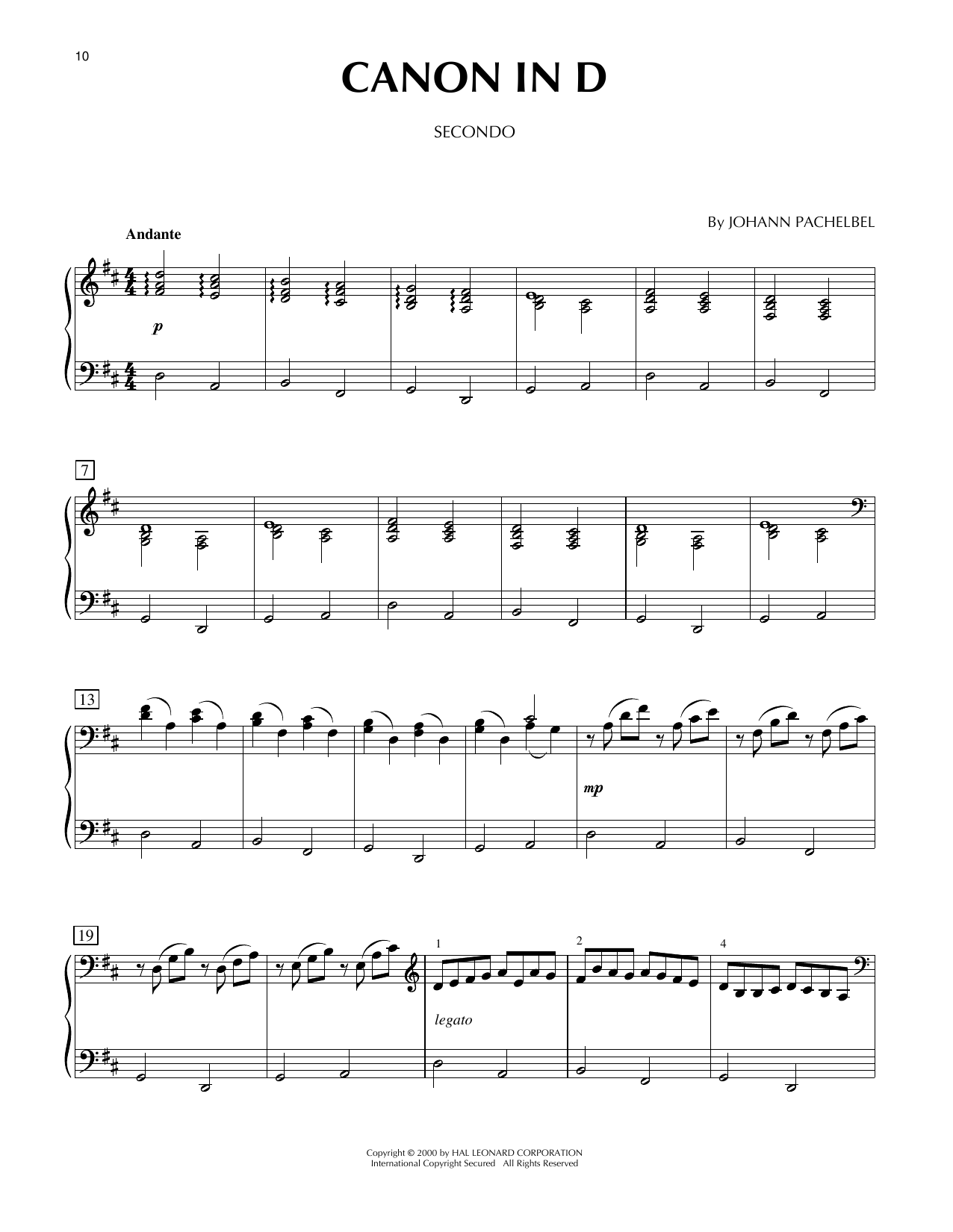
Canon In D: Piano Duet

As performed by Johann Pachelbel

Item: 35-DS01818688

Digital Download
$5.99
Description

Discover MakeMusic Cloud: thousands of interactive titles your students can play along with today.

Sample Audio
No sample audio found.
Sample Video
Additional Details
Publisher: Hal Leonard
Page Count: 4
SKU: 35-DS01818688

More about this title

About the Artist: Johann Pachelbel

Johann Pachelbel (1653-1706) was a German Baroque composer whose influence on harmonic practice extended far beyond his own century. Working primarily in Vienna and Nuremberg, he mastered the organ and composed across sacred and secular genres, but his enduring legacy rests almost entirely on this single work. Canon in D demonstrates his sophisticated understanding of ground bass technique and the harmonic progressions that would become foundational to Western music pedagogy.

Pachelbel's career positioned him at a crossroads between the Italian and German musical traditions. Though he composed hundreds of sacred works, keyboard pieces, and chamber music during his lifetime, only Canon in D achieved widespread recognition in later centuries. Music educators recognize it as a gateway to understanding Baroque counterpoint and harmonic development, making it invaluable for introducing students to compositional principles that remained vital through the Classical era and beyond.

Why we love this

This arrangement captures the essential architecture of Pachelbel's masterpiece while remaining accessible to pianists navigating early intermediate repertoire. The four pages contain everything students need to experience the mathematical elegance of the eight-measure harmonic progression that drives the entire work, making it an ideal teaching tool for chord progressions and voice leading without oversimplifying the original.

What to expect

Stately and meditative, with an almost hypnotic quality that emerges from the repeating harmonic foundation beneath flowing melodic lines. The piece inhabits a space between contemplation and celebration, making it equally fitting for intimate reflection or ceremonial grandeur.

Who it's for

Pianists comfortable with Baroque idiom and ready to deepen their understanding of harmonic cycles through performance. This suits equally well the student preparing a wedding program piece or the musician exploring foundational compositional concepts through a masterwork.

How to get the most out of it

  • Maintain consistent tempo throughout the repeating harmonic progression; the bass line's steadiness anchors the entire piece, so avoid rushing during sequential passages.
  • Shape each iteration of the melody with gentle dynamic variation rather than playing all statements at the same level; this creates forward motion across the form without disrupting the meditative quality.
  • Consider the acoustical properties of your performance space when choosing pedal usage; the harmonic richness of the progression invites resonance, but clarity matters more than saturation.

How to use it

This works beautifully as a prelude piece before a larger work or as an interlude between program sections. Its moderate length and intrinsic completeness also make it valuable for students building solo recital experience or for chamber contexts when arranged with strings.

Skills your students will build

  • recognizing and performing eight-measure harmonic progressions
  • maintaining independence between contrapuntal voices
  • applying ornamental variation techniques to a repeated melodic idea
  • understanding ground bass structure and harmonic analysis
  • executing balanced phrasing within repeating formal patterns

You May Also Like