Canon in D: Piano Digital Sheet Music

Canon in D: Piano Digital Sheet Music

Johann Pachelbel

Item: 00-PS-0002560

Digital Download
$3.99
Description

Canon in D: Piano Digital Sheet Music isn't in MakeMusic Cloud just yet...but it could be. Let us know you'd like to see it, and you'll help shape what comes next. In the meantime, start a free trial and dive into thousands of interactive titles your students can play along with today.

Sample Audio
No sample audio found.
Sample Video
Additional Details
SKU: 00-PS-0002560

More about this title

About the Creator: Johann Pachelbel

Johann Pachelbel (1653, 1706) was a German Baroque composer whose output spanned sacred vocal music, keyboard works, and chamber compositions. His career took him through several major German cities, including Erfurt, Stuttgart, and Nuremberg, where he held prestigious church positions and influenced the next generation of composers.

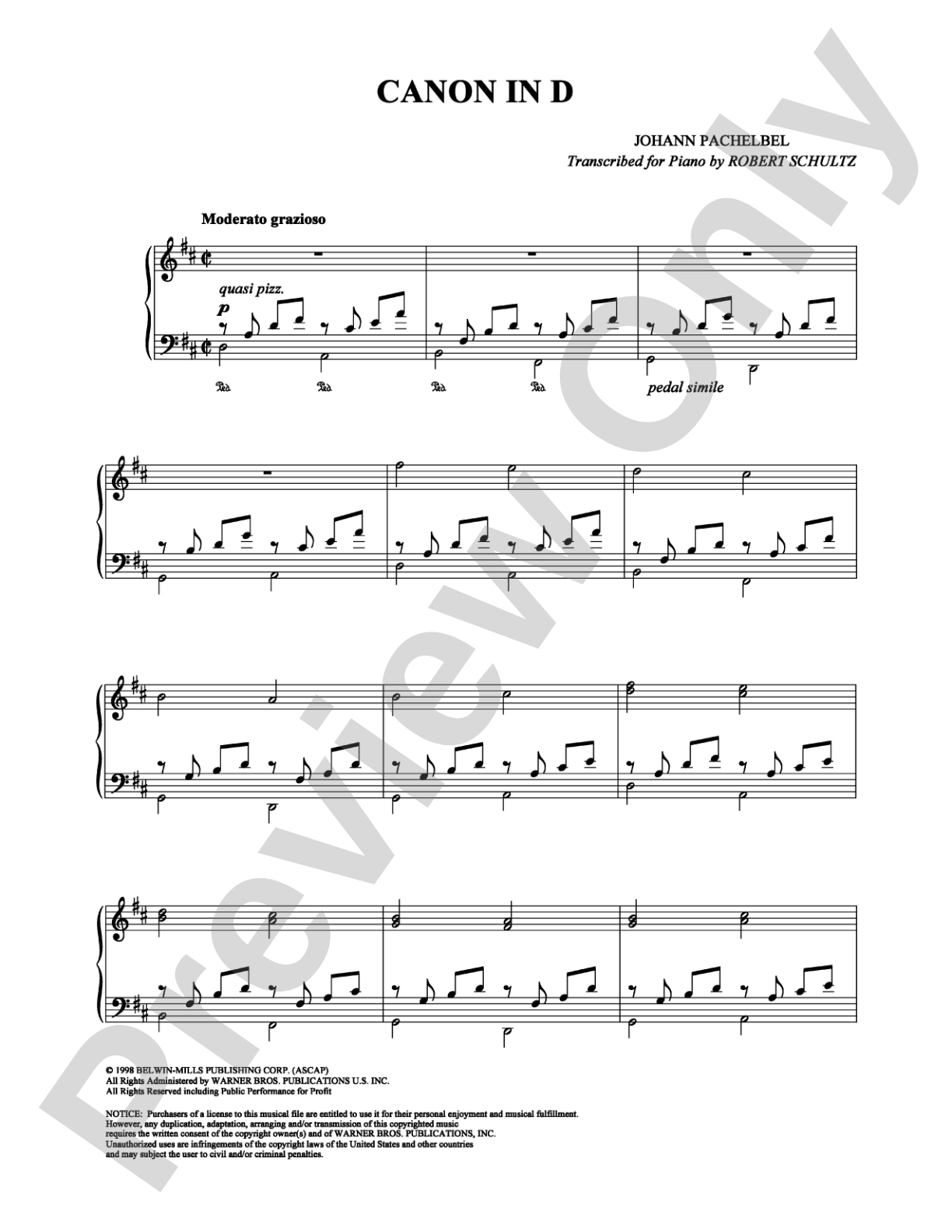
Canon in D stands as Pachelbel's most enduring contribution to the repertoire. Though composed as part of a larger collection of canons and variations for instruments, this particular work has transcended its original context to become a cultural touchstone. The elegant harmonic progression and clear contrapuntal writing showcase the hallmarks of late Baroque style while remaining accessible to performers at multiple levels.

Why we love this

Canon in D is instantly recognizable and genuinely rewarding to play, even at an intermediate level. The piece teaches voice independence and rhythmic confidence without requiring advanced technique, making it ideal for students ready to move beyond simple melodies.

What to expect

Stately and ceremonial, built on a hypnotic repetition that feels both meditative and inevitably forward-moving. The piece has a timeless quality that invites the listener into its world rather than demanding attention.

Who it's for

Intermediate pianists who want to tackle a substantial piece with genuine musical shape. This works for students preparing recital material, exploring Baroque style, or simply enjoying a piece that satisfies both player and listener.

How to get the most out of it

  • Keep the repeating bass line steady and unhurried; the ground bass is the structural foundation of the entire piece. Resist the urge to accelerate.
  • Voice the upper melody with clarity and slight emphasis so it sings above the accompaniment texture without forcing volume.
  • Pedal conservatively, changing with each new harmonic movement rather than holding the pedal throughout entire phrases.

How to use it

Program this as a bridge between student recitals and more advanced repertoire, or pair it with other Baroque works for a thematic concert. Its recognizable beauty also serves well in informal school performances or community settings where accessibility matters.

Skills your students will build

  • Voice independence between hands (steady ground bass with ornamented melody)
  • Harmonic analysis and recognition of the I, V, vi, iii progression
  • Baroque phrasing and articulation appropriate to the period
  • Sustained control of legato passages over repeated accompaniment figures
  • Understanding of counterpoint through melody-and-accompaniment relationships

You May Also Like