
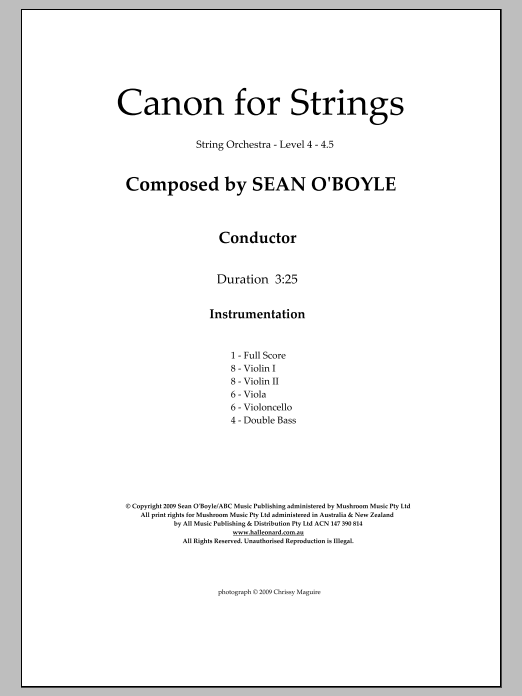

Canon for Strings: String Orchestra Conductor Score & Parts
Arranged by Sean O'Boyle
Grade: 3-4
Item: 35-PK00282840
$52.00
Pickup currently not available
Buy Extra Parts (Digital PDF Download)
| Product | Price | Quantity |
|---|---|---|
| Canon for Strings - Double Bass | $6.00 | |
| Canon for Strings - Score | $6.00 | |
| Canon for Strings - Viola | $6.00 | |
| Canon for Strings - Violin I | $6.00 | |
| Canon for Strings - Violin II | $6.00 | |
| Canon for Strings - Violoncello | $6.00 |
Parts Added to Cart!
Description
Canon - a contrapuntal compositional technique that employs a melody with one or more imitations of the melody played at various measured intervals of time. The term originates from the Greek kanon, which literally means "ruler" or "a measuring stick." Figuratively, kanon also refers to "a standard," "rule," or "law." Through the 18th century the word used to describe strict imitation was "fuga", and only in the 16th century did the word "canon" begin to be used to describe the musical form created by such a procedure. The earliest known canons are English rounds, a form called rondellus starting in the 13th century . Around this time period many canons were written in Italy under the name caccia and occasionally French chansons of that period used canon technique. During the period of the Franco-Flemish School (1430-1550), canon as a contrapuntal art form received its greatest development, while the Roman School gave it its most complete application. In the 18th century, Johann Sebastian Bach created two monumental canon cycles in his Art of the Fugue Goldberg Variations. Notable 20th century composers Arnold Schoenberg, Anton von Webern and Paul Hindemith revived interest in canon. Canons, such as "Frere Jacques" and "Row, Row, Row your boat" are a part of many singing traditions. I wrote this work as an alternative to the much loved canon of Pachelbel.


Canon for Strings: String Orchestra Conductor Score & Parts isn't in MakeMusic Cloud just yet...but it could be. Let us know you'd like to see it, and you'll help shape what comes next. In the meantime, start a free trial and dive into thousands of interactive titles your students can play along with today.
Request This Title
Tell us you want it.
Start Your Free Trial
Explore everything that's ready to play right now.
Sample Audio
No sample audio found.
Sample Video
No sample videos found.
Additional Details
Publisher:
Hal Leonard
SKU:
35-PK00282840
More about this title
Why we love this
O'Boyle's approach offers conductors a teaching piece rooted in genuine musical history rather than a familiar round. The canon form becomes a structural framework that demands careful attention to ensemble balance and rhythmic precision, which makes it far more rewarding to rehearse than workshop material. At grades 3 to 4, this sits exactly where students can grasp the imitative technique without drowning in complexity.
What to expect
The piece unfolds with elegant simplicity as successive violin and viola lines weave the same melodic idea across the ensemble. There is a satisfaction in watching independent lines lock into harmonic coherence, creating that distinctive clarity and brightness that Baroque imitative forms deliver.
Who it's for
String orchestra programs at the intermediate level who want to teach canon technique through performance rather than discussion. Directors seeking a fresh alternative to Pachelbel will find this especially useful for concert programming or as a teaching standard.
How to get the most out of it
- Establish a clear tempo and conduct with precision during the opening statements of each voice. The imitations depend entirely on rhythmic accuracy across all parts.
- Mark the exact beat where each section enters. Have students circle these moments in their parts and prepare for their entrance during the previous phrase.
- Balance the melody against accompanying voices by reminding first violins and violas they carry the primary line while second violins and cellos provide harmonic support rather than doubling.
- Rehearse the piece by voice, starting with violin I alone, then layering in each subsequent voice. This reveals how the imitation develops and prevents students from rushing or dragging.
How to use it
Pair this with other Baroque string works to build a thematic concert around the development of contrapuntal writing. The moderate length and intermediate difficulty make it ideal for mid-season programming when students have developed enough technical control to handle independent voices cleanly.
Skills your students will build
- Hearing and performing canon entries with precise rhythmic timing
- Maintaining an independent melodic line while listening to harmonic context
- Balance and blend across multiple simultaneous voice parts
- Understanding imitative form and voice leading principles
- Conducting and ensemble cohesion across staggered musical entries