
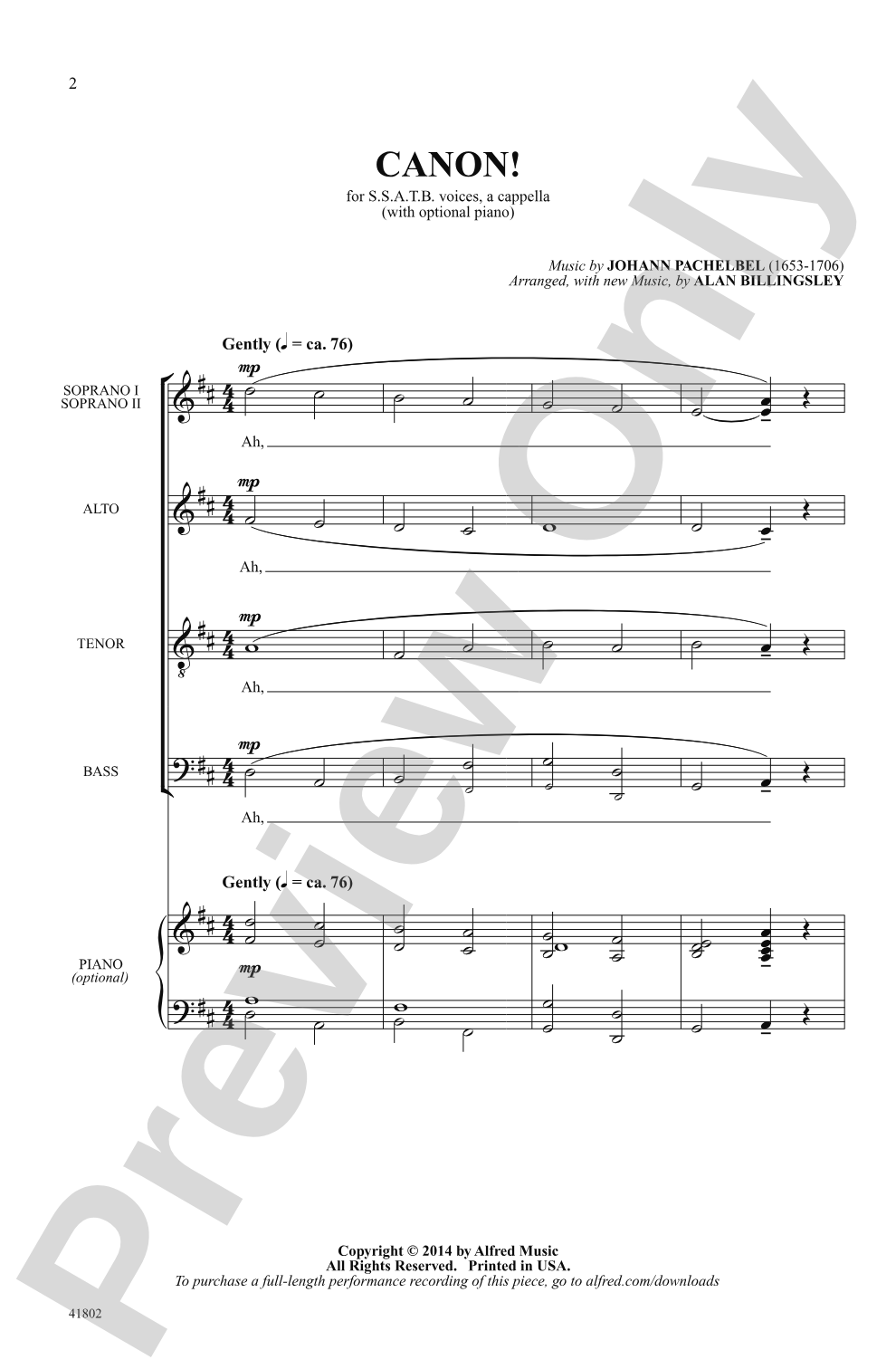
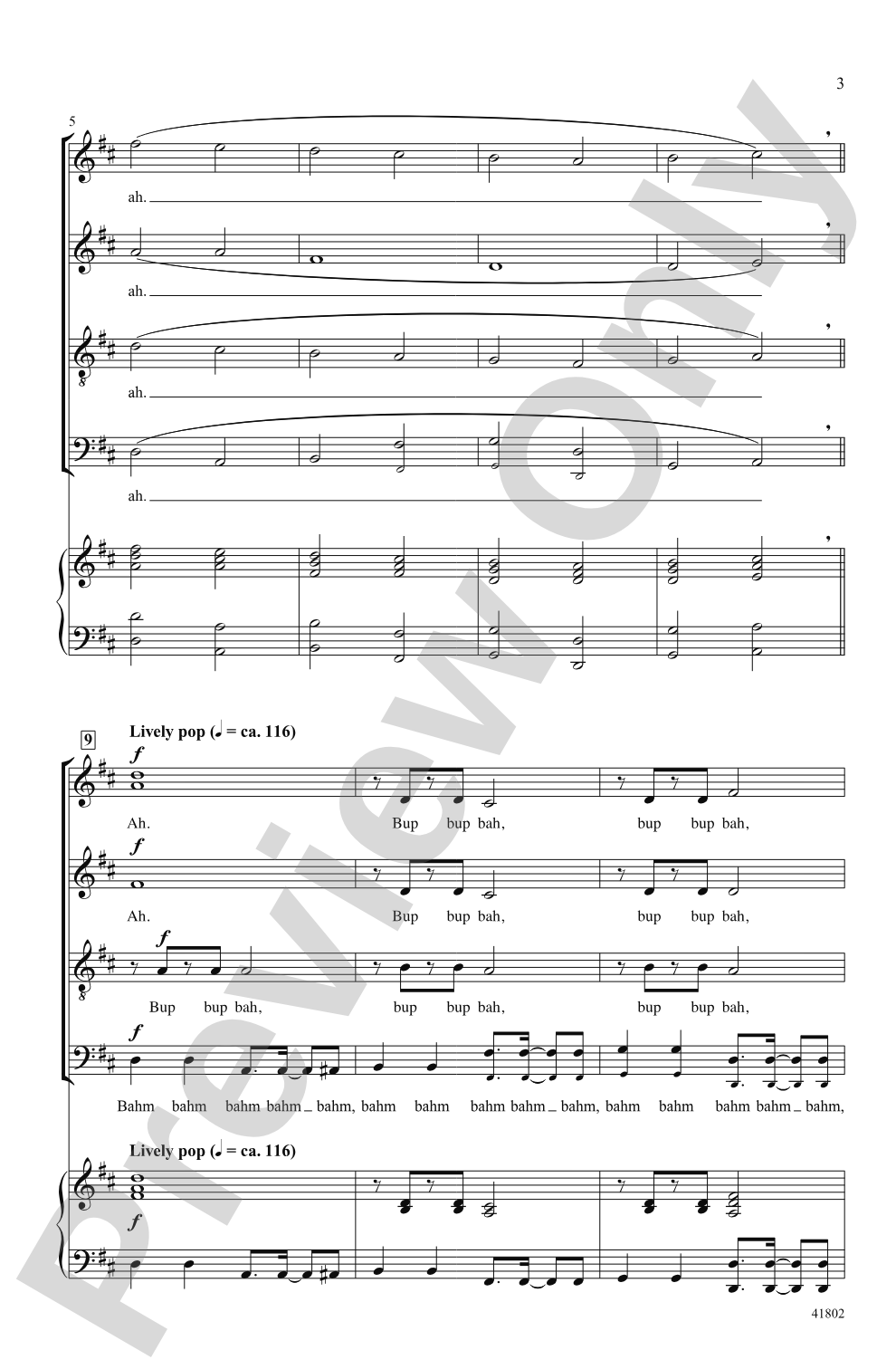
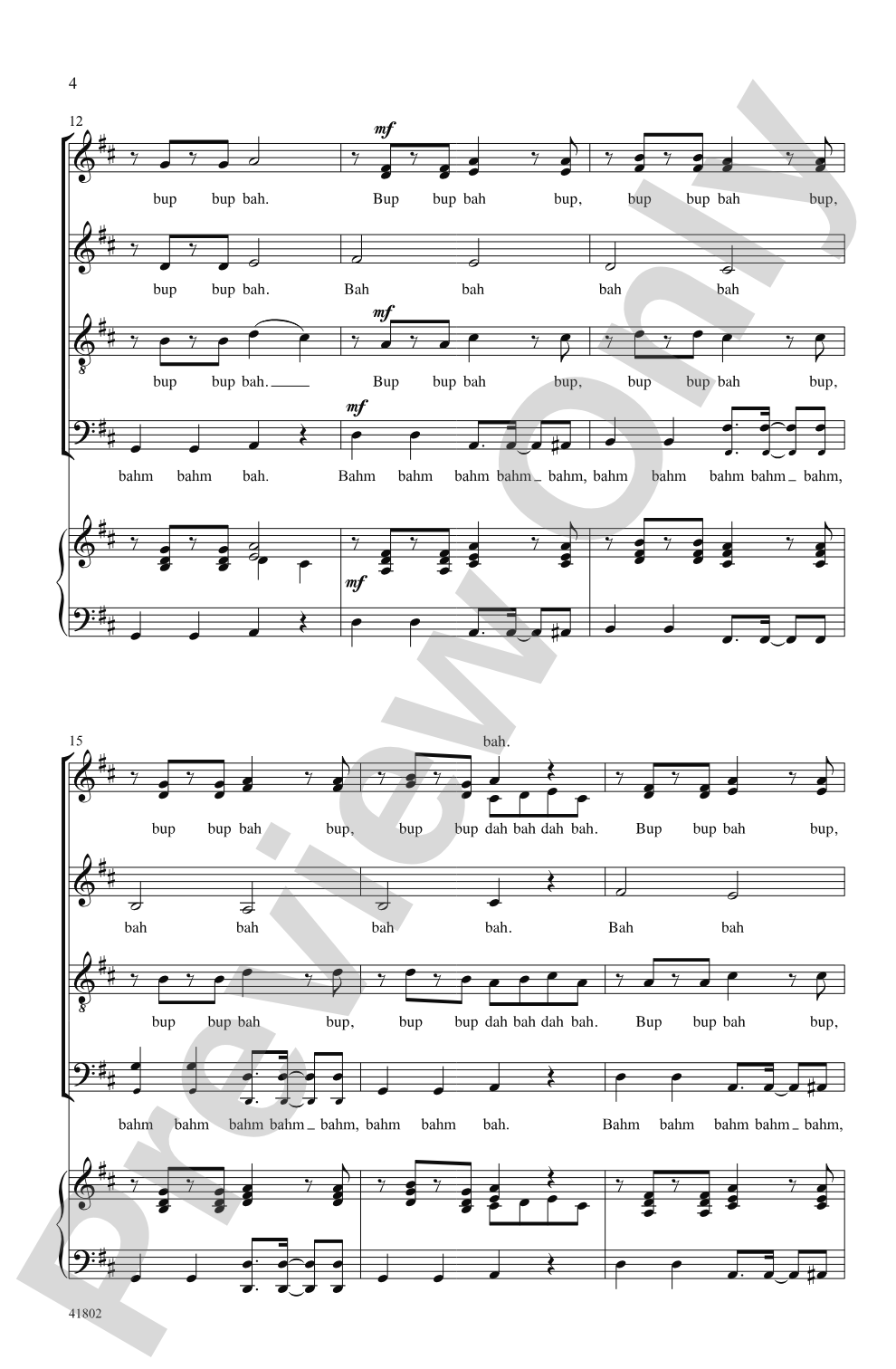

Canon!: SSATB, a cappella Choral Octavo
Music by Johann Pachelbel / arr., with new music, by Alan Billingsley
Item: 00-PO-0001911
$2.00
Minimum order quantity: 20 copies
Pickup currently not available
Related Items
Canon!: SSATB, a cappella Choral Octavo |
$2.00
|
View |
Description
Would Pachelbel approve? Who knows. But singers and audiences surely will! This rhythmic rendition presents the famous "Canon in D" with nonsensical scat syllables. Sing a cappella or with the optional piano accompaniment. It's guaranteed to be the most memorable three minutes of any concert program.


Canon!: SSATB, a cappella Choral Octavo isn't in MakeMusic Cloud just yet...but it could be. Let us know you'd like to see it, and you'll help shape what comes next. In the meantime, start a free trial and dive into thousands of interactive titles your students can play along with today.
Request This Title
Tell us you want it.
Start Your Free Trial
Explore everything that's ready to play right now.
Sample Audio
1
Audio File
--:--
0:00
0:00
Sample Video
No sample videos found.
Additional Details
Series:
Alfred Choral Designs
Publisher:
Alfred Music
Page Count:
16
SKU:
00-PO-0001911
Instrumentation:
Opt. Piano
More about this title
About the Composer: Johann Pachelbel
Johann Pachelbel (1653–1706) was a German Baroque composer whose influence on harmonic language and compositional technique extended far beyond his own era. While he wrote sacred cantatas, motets, and keyboard works throughout his career, his enduring legacy rests almost entirely on one piece: the Canon in D, which has become perhaps the most recognizable progression in Western music. Its elegant simplicity and mathematical precision make it an ideal foundation for educational arrangements and creative reinterpretations.
Pachelbel spent significant time in Vienna, Rome, and Nuremberg, absorbing the contrapuntal traditions of German and Italian schools. His Canon in D exemplifies the Baroque fascination with structural clarity and ornamentation within constraint. For today's music educators, his work remains a gateway to understanding Baroque harmony and the power of a strong melodic line supported by a consistent harmonic foundation.
Why we love this
Alan Billingsley's scat-syllable treatment transforms one of classical music's most reverent pieces into pure joy without sacrificing the integrity of the original progression. Audiences light up instantly, and the infectious rhythm and vocal texture carry the weight of the famous harmonic movement while remaining thoroughly entertaining. This arrangement delivers both musical substance and genuine fun, a rare combination that works equally well in concert and competition settings.
What to expect
Witty and propulsive, this version channels the mathematical elegance of the original Canon through a modern vocal lens. The nonsensical syllables create a sense of playful immediacy while the underlying harmonic progression anchors listeners in something deeply familiar. The result is three minutes of rhythmic momentum and harmonic satisfaction that feels both clever and genuinely musical.
Who it's for
This arrangement suits choirs at the intermediate to advanced level who are confident with part independence and intonation in a cappella contexts. It works beautifully for high school, college, and community choirs that want to perform a recognizable masterwork with contemporary personality and humor.
How to get the most out of it
- Keep the scat syllables crisp and articulate; treat them as rhythmic punctuation rather than text-singing. Each choir part needs rhythmic independence to avoid the syllables blending into an undifferentiated wash.
- Establish the harmonic foundation early in rehearsal by having singers listen to how their part relates to the unchanging bass progression. This awareness helps tune the characteristic stacked intervals.
- Balance the four voices so that no single part overshadows the others. Because the texture is thick and the harmonic movement predictable, clarity comes from ensemble blend rather than dynamic contrast.
- If using the optional piano accompaniment, ensure it supports the voices without overwhelming them. The a cappella version works superbly with rehearsed intonation and internal listening.
How to use it
Program this as a showstopper in the second half of a concert, where its recognizable theme and infectious energy will energize an audience that may have tired after heavier repertoire. It pairs well alongside other Baroque arrangements or secular vocal works, and its three-minute duration makes it ideal for filling a specific program slot or creating a cohesive thematic set around masterwork arrangements.
Skills your students will build
- Singing rhythmically independent parts while maintaining harmonic awareness
- Tuning stacked intervals and closed vowels in block harmonic textures
- Articulation and diction in scat singing without sacrificing pitch accuracy
- Listening for harmonic foundation while performing rhythmic figures
- Balancing blend and clarity across four parts in a cappella texture