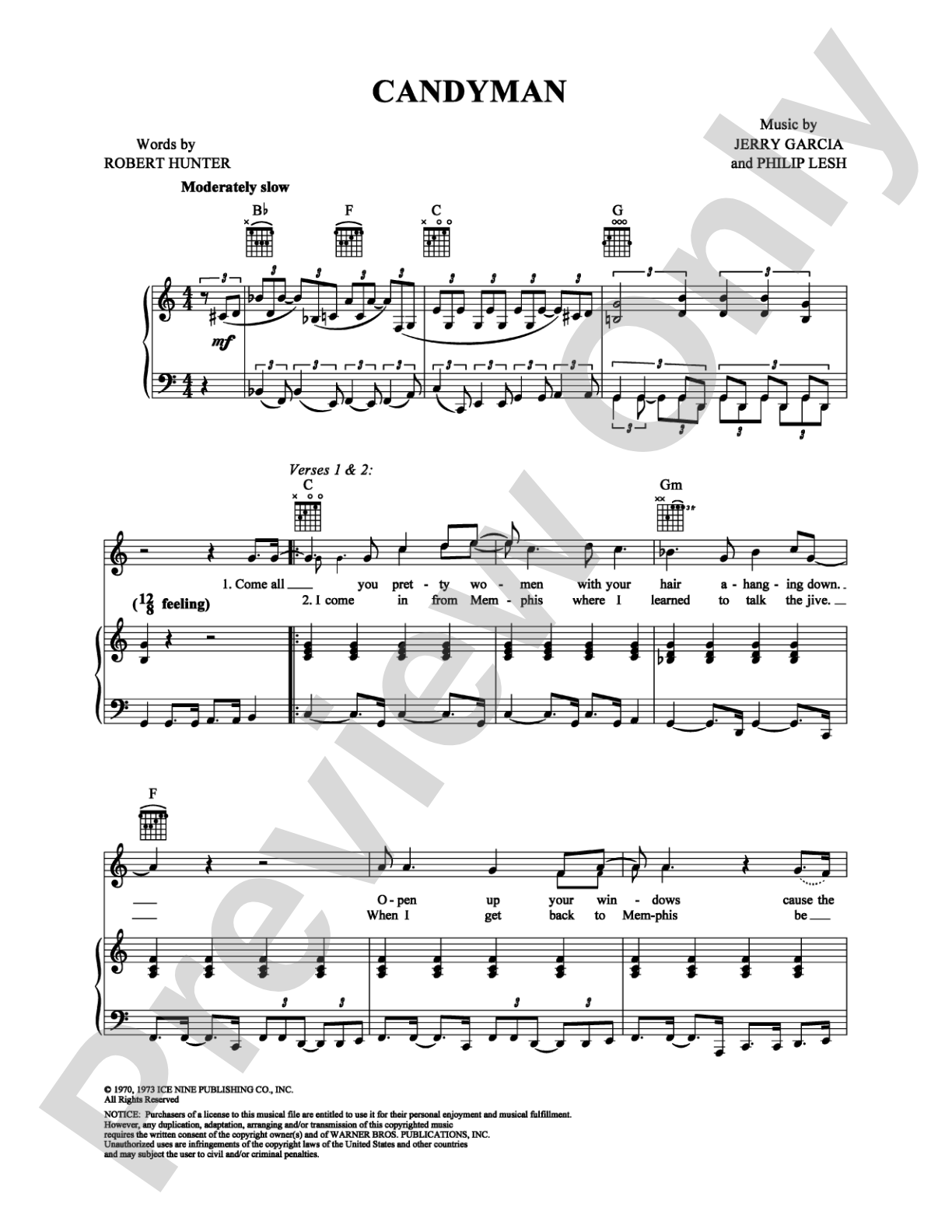
Candyman: Piano/Vocal/Chords Digital Sheet Music

Candyman: Piano/Vocal/Chords Digital Sheet Music

Jerry Garcia, Grateful Dead, Phil Lesh

Item: 00-PS-0005542

Digital Download
$2.95
Description

Candyman: Piano/Vocal/Chords Digital Sheet Music isn't in MakeMusic Cloud just yet...but it could be. Let us know you'd like to see it, and you'll help shape what comes next. In the meantime, start a free trial and dive into thousands of interactive titles your students can play along with today.

Sample Audio
No sample audio found.
Sample Video
Additional Details
SKU: 00-PS-0005542

More about this title

About the Artist: Grateful Dead

The Grateful Dead emerged from the San Francisco Bay Area in the mid-1960s as pioneers of improvisational rock, blending folk, blues, country, and psychedelia into a sound that redefined what live rock music could be. Their influence on American popular music extends far beyond their devoted fanbase; their approach to composition, arrangement, and performance has shaped generations of musicians across genres.

Why we love this

Candyman sits at an accessible entry point into the Grateful Dead repertoire for pianists and singer-pianists. The song's straightforward harmonic structure and conversational melody make it inviting for intermediate players, while its roots in American folk and blues tradition offer genuine musical substance.

What to expect

Candyman has the warmth of a folk ballad crossed with the swagger of blues storytelling. The melody sits naturally in the voice, the chords feel honest and unpretentious, and there's room for the performer to make the arrangement their own.

Who it's for

Singer-pianists preparing recital repertoire or jam-session material will find this arrangement immediately singable and pianistically satisfying. It works equally well for accompanying students exploring American rock and folk traditions or for musicians building confidence with lead sheets and chord charts.

How to get the most out of it

  • Anchor the verse melody by keeping the vocal line rhythmically loose and conversational; let the piano voicings breathe rather than locking strictly to the beat.
  • Pay attention to the chord changes in the chorus and use them to shape dynamics; small crescendos on key harmonic shifts will highlight the song's emotional arc.
  • Balance vocal presence with piano accompaniment by treating the chords as a harmonic foundation rather than constant filler; space and silence are as important as the notes you play.

How to use it

Include this alongside other American songbook standards in a recital celebrating folk and rock traditions, or use it as a bridge piece between classical and contemporary repertoire in a mixed-genre student performance. Its accessibility makes it suitable for coffeehouse settings or informal concert contexts.

Skills your students will build

  • Reading lead sheets with chord symbols
  • Balancing melody and accompaniment in vocal-piano arrangements
  • Interpreting rhythmic freedom within a metric framework
  • Connecting with the storytelling quality of folk-influenced song

You May Also Like