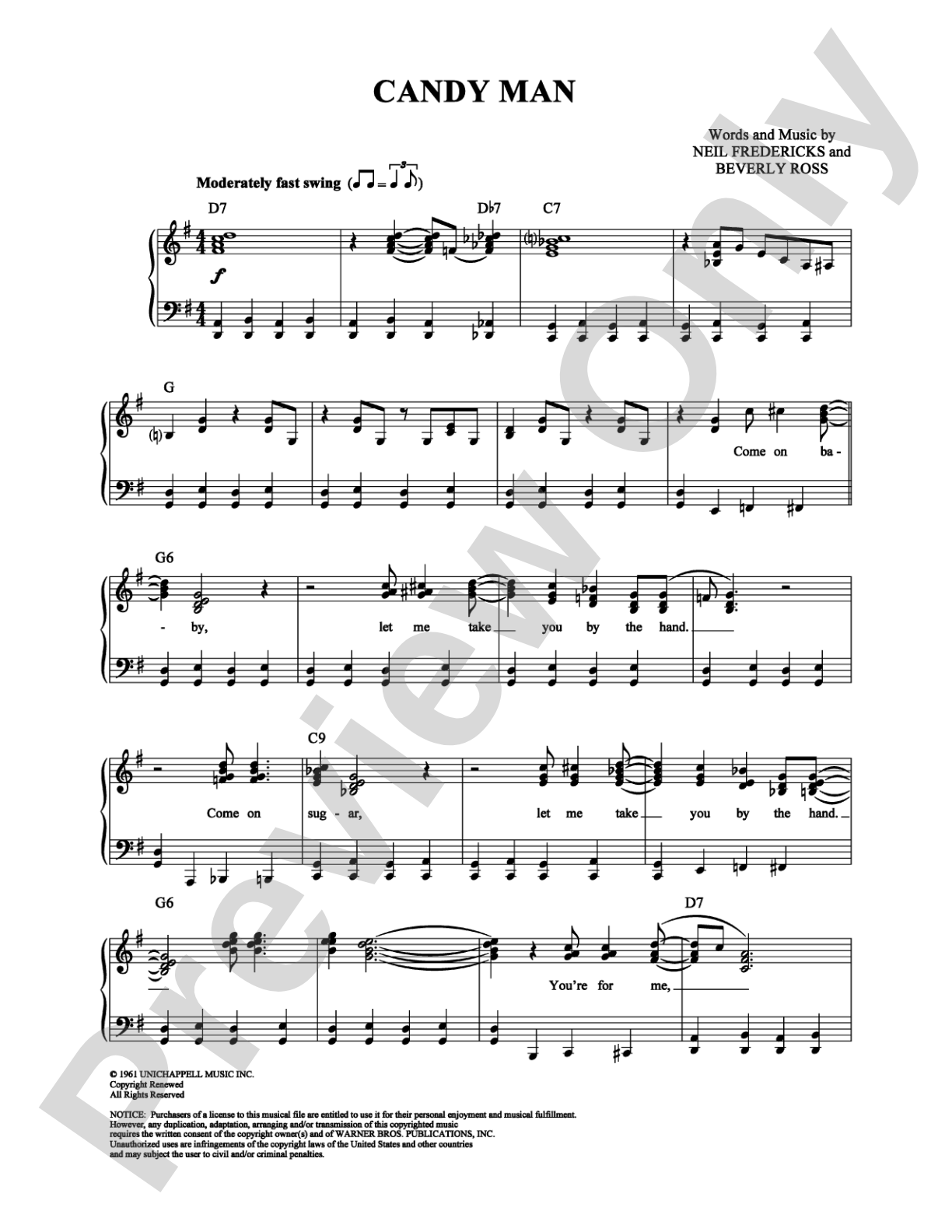
Candy Man: Piano/Vocal/Chords Digital Sheet Music

Candy Man: Piano/Vocal/Chords Digital Sheet Music

Roy Orbison, Beverly Ross, Neil Fredericks

Item: 00-PS-0007881

Digital Download
$3.99
Description

Candy Man: Piano/Vocal/Chords Digital Sheet Music isn't in MakeMusic Cloud just yet...but it could be. Let us know you'd like to see it, and you'll help shape what comes next. In the meantime, start a free trial and dive into thousands of interactive titles your students can play along with today.

Sample Audio
No sample audio found.
Sample Video
Additional Details
SKU: 00-PS-0007881

More about this title

About the Artist: Roy Orbison

Roy Orbison (1936, 1988) was an American singer-songwriter whose distinctive voice and innovative approach to rock and roll shaped popular music across three decades. Known for his dramatic vocal delivery, complex arrangements, and genre-blending work, Orbison influenced countless artists and remains a touchstone for understanding how rock vocalists can command emotional depth without sacrificing accessibility.

Why we love this

Orbison's vocal writing sits beautifully across a wide range, offering pianists and singers a chance to explore dramatic dynamic shifts and expressive phrasing within a pop rock idiom. The arrangement's straightforward chord structure makes it accessible for students while the song's emotional arc rewards thoughtful interpretation and attention to lyrical storytelling.

What to expect

Orbison's "Candy Man" has a warm, somewhat cinematic quality that blends nostalgia with earnest emotion. The piece invites singers to inhabit the character of the lyrics while the piano provides both harmonic sophistication and rhythmic forward motion.

Who it's for

This arrangement works well for intermediate to advanced pianists and singers exploring pop rock repertoire, whether in private voice lessons, piano studio settings, or as part of a recital program. It suits vocalists who have some facility with contemporary song interpretation and pianists comfortable with rhythmic accompaniment styles.

How to get the most out of it

  • Honor the dynamic contrast between verses and the more expansive moments; resist the urge to sing or play at full volume throughout.
  • Let the piano accompaniment breathe, especially during vocal passages where space between notes gives the singer room to phrase expressively.
  • Pay attention to the rhythmic pocket and groove that ties the piano and vocal line together; a slight laid-back approach can enhance the emotional weight.

How to use it

This works well on a recital that mixes genres, offering a modern or contemporary pop piece alongside classical or art song repertoire. It can also serve as an accessible introduction to rock and pop song interpretation for students transitioning from classical vocal study.

Skills your students will build

  • Interpreting pop rock phrasing and vocal inflection
  • Reading and voicing chord symbols in contemporary style
  • Balancing accompaniment texture with vocal line clarity
  • Understanding harmonic progression in popular song forms

You May Also Like