
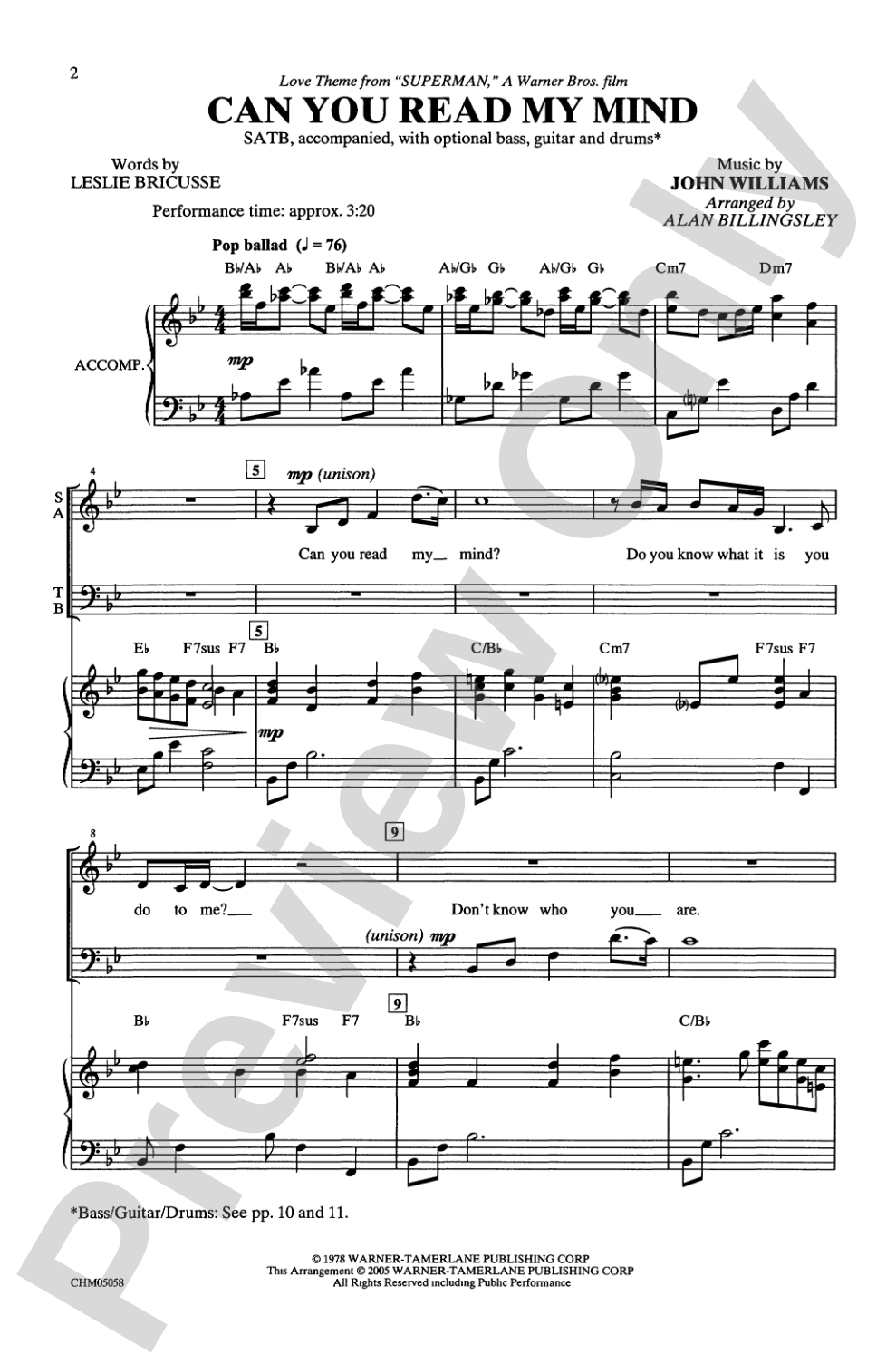
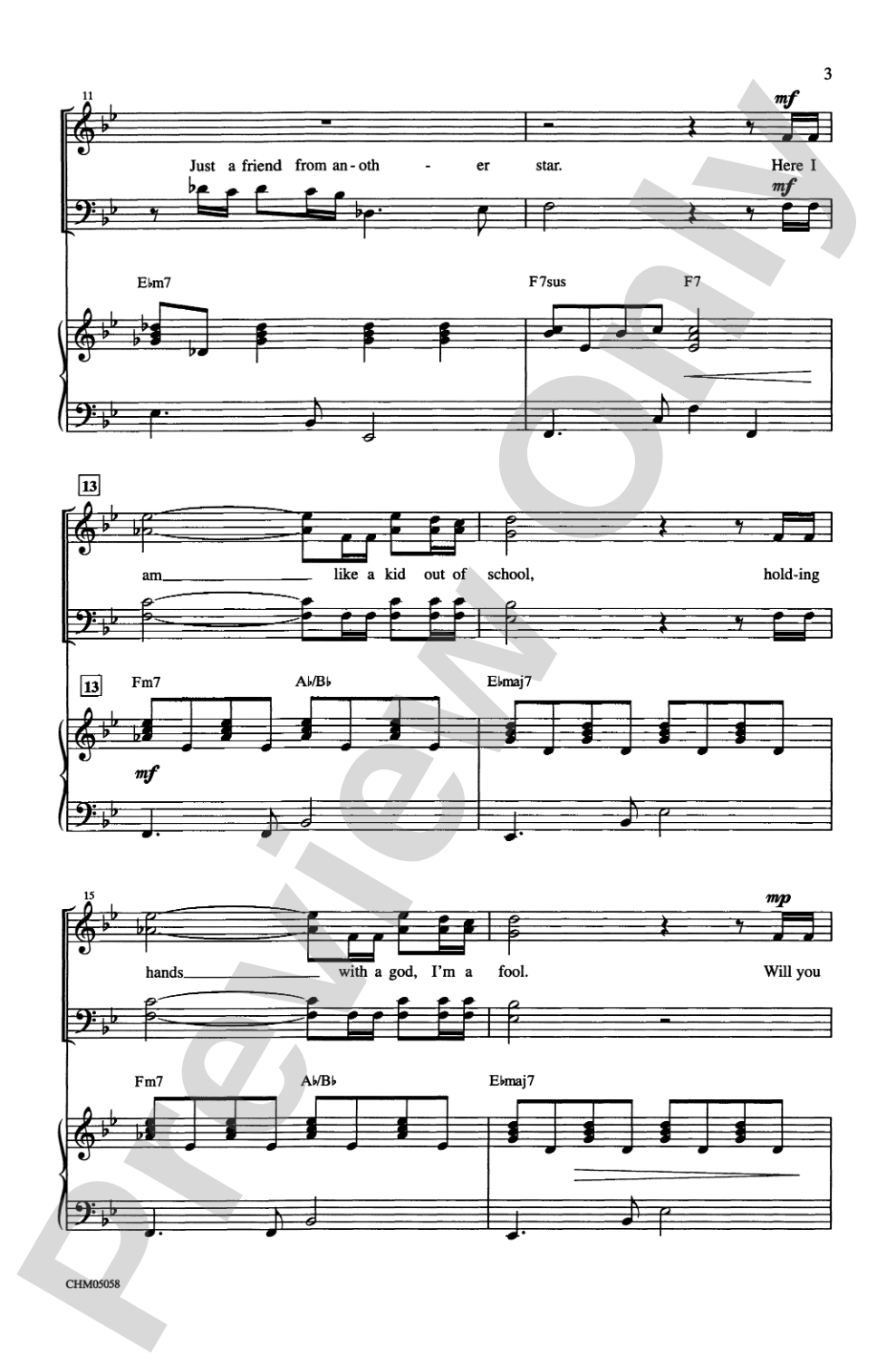

Can You Read My Mind? (from Superman): SATB Choral Octavo
From Superman
Words by Leslie Bricusse, music by John Williams / arr. Alan Billingsley
Level: Moderate
Item: 00-PO-0004853

$2.25
Minimum order quantity: 20 copies
Pickup currently not available
Description
The 1978 blockbuster movie Superman featured what is considered by many to be one of the greatest film scores of all time and starred the late great Christopher Reeve in the title role. The love theme from the movie with its haunting lyric is a beautiful ballad that has been recorded by many artists and is continually heard in concert settings throughout the world. Alan Billingsley provides this delightful new choral setting.


Don't just read it, hear it, play along with it, and watch your students grow with it. In MakeMusic Cloud, Can You Read My Mind? (from Superman): SATB Choral Octavo comes alive with professional accompaniment, adjustable tempo, and built-in practice tools that turn solo practice into real progress.
Open in the Player
Jump straight in and assign it today.
Start Your Free Trial
Open this title and explore the full library in minutes.
Sample Audio
1
Audio File
--:--
0:00
0:00
Sample Video
No sample videos found.
Additional Details
Series:
Alfred Archive Edition: Alfred Pop Choral Series
Publisher:
Alfred Music
Page Count:
12
SKU:
00-PO-0004853
More about this title
About the Composer: John Williams
John Williams stands as one of the most prolific and celebrated film composers in cinema history. His scores for Superman, Star Wars, Jaws, Indiana Jones, and countless other blockbusters have shaped the sound of modern moviemaking and earned him five Academy Awards, a Grammy Lifetime Achievement Award, and a place among the most recorded composers of all time.
Williams brings symphonic sophistication to popular music, blending classical compositional technique with memorable melodic lines that resonate across generations. His work demonstrates that film scores and concert music need not be separate worlds, a principle that makes his material exceptionally rewarding for choral and instrumental educators seeking repertoire with both musical substance and genuine appeal to singers.
Why we love this
Billingsley's arrangement captures the cinematic sweep and emotional immediacy of Williams's original theme while scaling it perfectly for high school choirs. The moderate difficulty level and SATB voicing make this accessible without sacrificing the haunting quality that makes the melody unforgettable, and the love theme's universal recognition gives singers real investment in nailing the performance.
What to expect
A tender, soaring ballad that captures the vulnerability and yearning of unspoken love. The melody sits comfortably in the voices and unfolds with Williams's trademark lyricism, creating moments of genuine beauty that stay with listeners long after the final chord.
Who it's for
High school and college choirs looking for a contemporary love song with staying power and real musical substance. Directors seeking repertoire that singers recognize and want to sing, paired with orchestration that supports rather than overwhelms their voices.
How to get the most out of it
- Shape the melodic line with long, connected phrases rather than breaking at bar lines; the lyric demands legit singing, not rhythmic punctuation.
- Balance upper voices against the lower parts so the song feels like a genuine ensemble statement rather than a solos showcase.
- Use the recorded accompaniment as a rehearsal tool early on, then work sections without it to build confidence in independent singing.
- Treat moments of harmonic richness (fuller chords underneath the melody) as climactic rather than background; these moments deserve weight and resonance.
How to use it
This works beautifully as a concert closer or as part of a film music or contemporary love song set. It pairs naturally with other accessible popular arrangements in a spring concert, or stands alone as a showcase for a choir's ability to deliver emotional depth and vocal control.
Skills your students will build
- Sustaining legit, connected phrasing through longer phrases
- Balancing melody and accompaniment within a four-part texture
- Responding to harmonic changes and musical shape rather than rhythmic landmarks
- Performing contemporary secular repertoire with musical maturity and expressivity