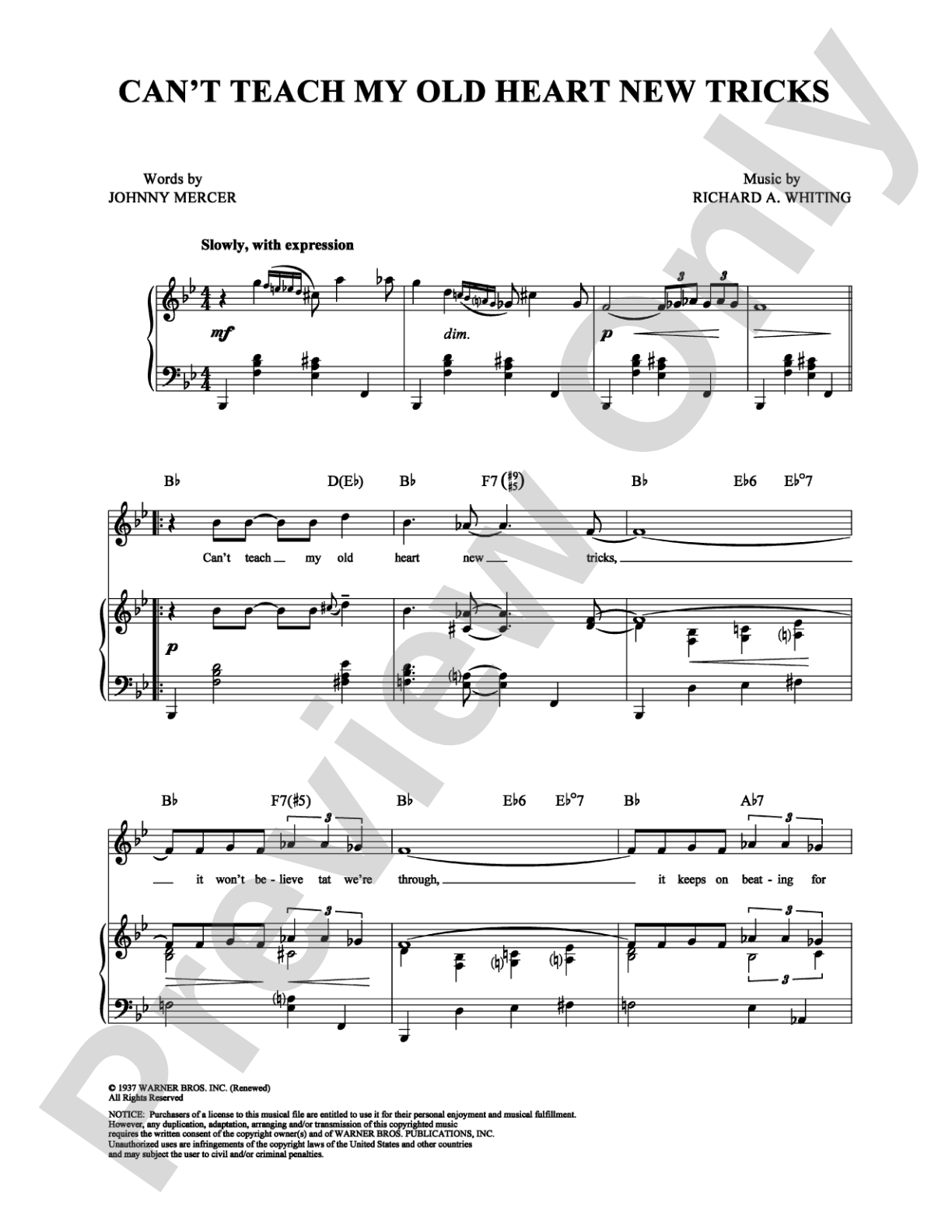
Can't Teach My Old Heart New Tricks: Piano/Vocal/Chords Digital Sheet Music

Can't Teach My Old Heart New Tricks: Piano/Vocal/Chords Digital Sheet Music

Richard A. Whiting, Margaret Whiting

Item: 00-PS-0005300

Digital Download
$3.99
Description

Can't Teach My Old Heart New Tricks: Piano/Vocal/Chords Digital Sheet Music isn't in MakeMusic Cloud just yet...but it could be. Let us know you'd like to see it, and you'll help shape what comes next. In the meantime, start a free trial and dive into thousands of interactive titles your students can play along with today.

Sample Audio
No sample audio found.
Sample Video
Additional Details
SKU: 00-PS-0005300

More about this title

About the Artist: Margaret Whiting

Margaret Whiting (1924-2011) was an American popular singer and actress who became one of the defining voices of 1940s and 1950s popular music. Daughter of composer Richard Whiting, she grew up in the world of songwriting and performance, eventually recording over 60 songs for Capitol Records and earning multiple chart hits. Her warm, expressive contralto and sophisticated phrasing made her a fixture on radio, television, and in nightclubs throughout her career.

Whiting's interpretive style emphasized emotional directness and clarity of lyric, qualities that made her recordings accessible to educators and singers seeking standards with genuine interpretive depth. Her catalog offers music teachers rich material for exploring American popular song from the golden age of Tin Pan Alley and post-war entertainment.

Why we love this

This standard gives singers a chance to work with a song that prioritizes lyrical storytelling and emotional honesty over technical showiness. The piano-vocal-chords format makes it equally useful for voice students preparing a recital piece or for jazz and popular music ensembles building their repertoire around authentic mid-century arrangements.

What to expect

The song carries a wry, self-aware quality marked by warmth rather than bitterness. There's a conversational intimacy to the lyric that invites the singer to connect emotionally without resorting to sentimentality; the musical language supports that balance through its straightforward harmonic progression and singable, memorable melody.

Who it's for

This arrangement works for voice students tackling American popular standards, jazz singers expanding their interpretive repertoire, and music theater performers seeking authentic period material. It's also well suited for private studio instruction and recital preparation at the intermediate to advanced level.

How to get the most out of it

  • Shape the melody around the natural speech rhythms of the lyric; let the conversational tone of the title inform your phrasing rather than imposing a strictly metric approach.
  • Use the chord symbols to explore harmonic substitutions if you're working in a jazz or cabaret context, but always return to the printed melody line as your anchor.
  • Balance the vocal line with the piano part; this is a song where accompaniment should support rather than compete, so adjust your dynamic choices accordingly.
  • Consider the narrative arc of the lyric across the full form; small shifts in tone and intensity will help listeners follow the emotional journey without oversinging.

How to use it

Program this alongside other mid-century American standards to build a cohesive set for a recital or concert showcasing popular song from the 1940s-50s era. It also pairs well in a jazz or cabaret-style program where the lyrical wit and harmonic accessibility serve as a bridge for audiences new to these genres.

Skills your students will build

  • Interpreting lyrical narrative and emotional subtext in popular song
  • Balancing vocal line with piano accompaniment in the piano-vocal format
  • Reading and using chord symbols for harmonic understanding
  • Shaping phrase contours using conversational speech rhythm as a guide
  • Understanding the harmonic language of mid-century American popular music

You May Also Like