
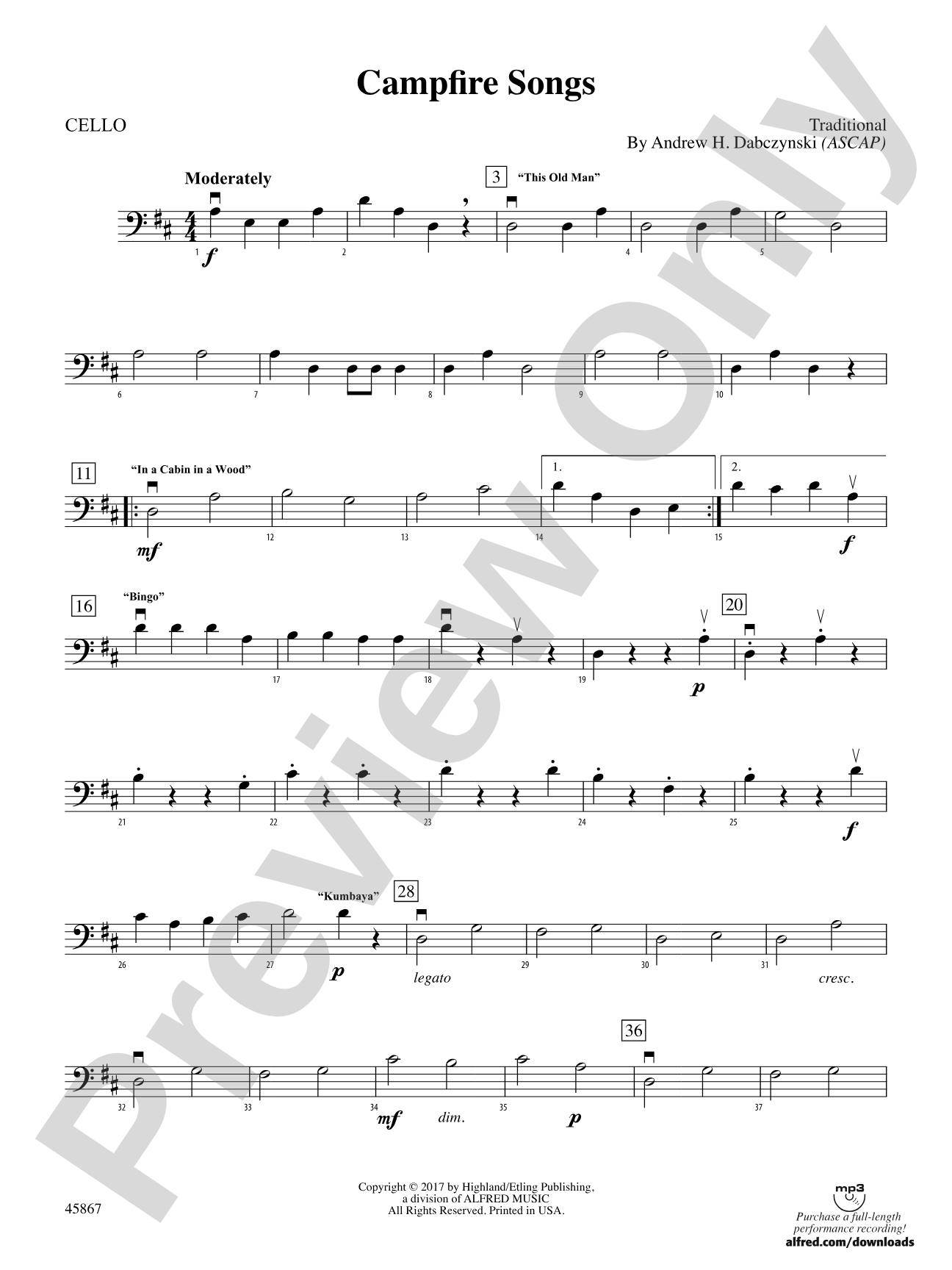

Campfire Songs: Cello
By Andrew H. Dabczynski
Grade: 0.5
Item: 00-PC-0017666_VC1
$5.99
Pickup currently not available
Description
Everyone loves to sing around a campfire, and here's a collection of favorite Campfire Songs set in the range of a one-octave D major scale with many parts doubled! This medley of easy, familiar tunes---including "This Old Man," "In a Cabin in a Wood," "Bingo," "Kumbaya," "Wheels on the Bus," and "This Little Light of Mine"---gives everyone a chance to play a melody or two, and to join in with an upbeat accompaniment. An optional sing-along part invites audience participation and makes this arrangement by Andrew H. Dabczynski the perfect piece for a first-year concert, school assembly, or summer program. (2:40) This title is available in MakeMusic Cloud.


Don't just read it, hear it, play along with it, and watch your students grow with it. In MakeMusic Cloud, Campfire Songs: Cello comes alive with professional accompaniment, adjustable tempo, and built-in practice tools that turn solo practice into real progress.
Open in the Player
Jump straight in and assign it today.
Start Your Free Trial
Open this title and explore the full library in minutes.
Sample Audio
1
Audio File
--:--
0:00
0:00
Sample Video
Additional Details
Series:
Highland/Etling String Explorer
Publisher:
Alfred Music
Page Count:
144
SKU:
00-PC-0017666_VC1
More about this title
About the Composer: Andrew H. Dabczynski

Andrew H. Dabczynski has shaped string education across decades through both classroom teaching and curriculum development. A viola performer who has played with regional orchestras including the Rochester Philharmonic and Hartford Symphony, he served as Emeritus Professor of Music Education at Brigham Young University, where he founded the BYU "New Horizons Orchestra" as a training ground for beginning adult string players and a laboratory for string pedagogy. His work earned him BYU's Joseph E. White Fellowship for Teaching and Learning, and in 2005 Utah ASTA recognized him as Higher Education Teacher of the Year.
Dabczynski's teaching roles have spanned the Eastman School of Music, public school districts in New York and Michigan, and numerous national string workshops. He co-authored the String Explorer method series, now widely used in schools nationwide. His scholarly interests in folk music and ethnomusicology inform much of his arrangement work, bringing accessible, culturally rooted repertoire into beginning orchestras.
Why we love this
This collection taps into the universal appeal of campfire songs while solving a real programming challenge: finding Grade 0.5 repertoire that engages both players and audiences. The doubled parts and one-octave D major range mean every student finds their place without frustration, and the optional sing-along transforms a concert piece into a community moment that connects the audience directly to the stage.
What to expect
Warm, accessible, and celebratory. The familiar melodies evoke nostalgia while the simple harmonic palette and transparent orchestration feel inviting rather than simplistic. There's genuine joy in the arrangement, rooted in folk tradition and designed so every player can contribute without struggle.
Who it's for
Beginning string orchestras in their first or second year, including heterogeneous groups where players span a range of readiness levels. This works equally well for school assemblies, summer programs, and first-year concert performances where audience connection matters as much as musical execution.
How to get the most out of it
- Balance the melody lines across your violin sections so that younger or less confident players hear the familiar tune clearly; this encourages listening and builds confidence.
- Use the accompaniment parts as an anchor for ensemble cohesion; even at this level, locking the rhythm section (particularly pizzicato or accompanying figures) creates a unified sound.
- If including the optional sing-along part, position a soloist or small vocal group where they can be easily heard without overwhelming the orchestral parts.
- Take advantage of the medley format to refresh the mood between tunes; small variations in tempo or dynamic shape keep the 2:40 runtime engaging for young players and audiences alike.
How to use it
Program this as a concert opener or closer on an early-year performance when you want to set a welcoming tone and invite audience participation. It pairs naturally with other Grade 0.5-1 repertoire and works exceptionally well on family concerts, school assemblies, or any concert where you're introducing the orchestra to students and families new to string music.
Skills your students will build
- Playing securely in D major with one-octave range awareness
- Reading and executing simple accompaniment patterns (pizzicato and bowed)
- Maintaining ensemble pulse and coordination across multiple parts
- Balancing melody and accompaniment roles within an arrangement
- Responding to conductor cues across a medley format with tempo and mood shifts