
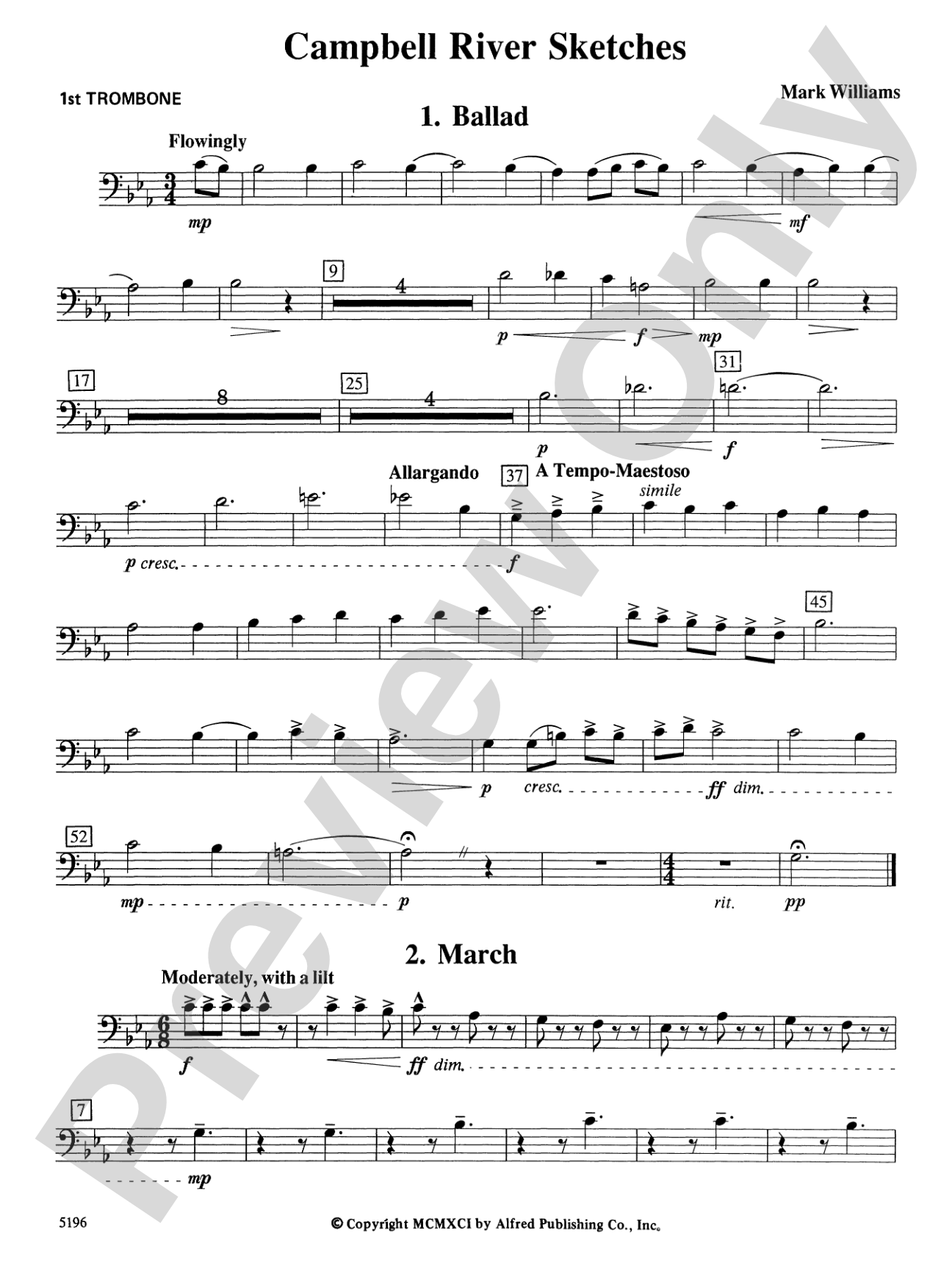

Campbell River Sketches: 1st Trombone
By Mark Williams
Grade: 3 (Medium)
Item: 00-PC-0001888_TN1
$3.00
Pickup currently not available
Description
Here's a dramatic work inspired by the beauty of the Campbell River in British Columbia. It features two contrasting themes that will really excite your maturing players. The first movement, Ballad, is a lyrical piece in the British folk song style. The second movement, March, is in 6/8 time. It opens with an accented, syncopated rhythmic motif that reoccurs throughout the work. (Grade 3) This title is available in MakeMusic Cloud.


Don't just read it, hear it, play along with it, and watch your students grow with it. In MakeMusic Cloud, Campbell River Sketches: 1st Trombone comes alive with professional accompaniment, adjustable tempo, and built-in practice tools that turn solo practice into real progress.
Open in the Player
Jump straight in and assign it today.
Start Your Free Trial
Open this title and explore the full library in minutes.
Sample Audio
1
Audio File
--:--
0:00
0:00
Sample Video
No sample videos found.
Additional Details
Series:
Growing Band Series
Publisher:
Alfred Music
Page Count:
264
SKU:
00-PC-0001888_TN1
More about this title
About the Composer: Mark Williams

Mark Williams built a prolific career as a composer and educator, leaving behind over 200 published works across band, orchestra, and choral literature. His expertise in elementary and middle school band shines throughout his catalog; he taught music in Washington state for many years while simultaneously establishing himself as a clinician and guest conductor who visited 34 states, five Canadian provinces, and Australia. Williams earned a Bachelor of Arts in Education and a Master of Education from Eastern Washington University and served as a woodwind performer and arranger for the 560th Air Force Band.
Beyond the page, Williams was an active musician, performing regularly on bassoon and serving as conductor and artistic director for the Spokane British Brass Band. His contributions to music education were recognized through numerous accolades, including the Western International Band Clinic's Gralia Competition and multiple ASCAP Special Awards. He co-authored the Accent on Achievement Band Method, a resource still widely used in schools today.
Why we love this
Williams writes with a keen sense of what maturing band students can accomplish musically without overwhelming them technically. The two-movement design gives you programming flexibility, and the contrasting characters (lyrical ballad and syncopated march) keep players engaged from rehearsal to performance. This is the kind of work that feels substantial to your ensemble while remaining accessible enough that your focus stays on musicality rather than note-reading struggles.
What to expect
The Ballad unfolds like a quiet moment by the water at dusk, with a folk-melody character that feels both intimate and unhurried. The March shifts the mood entirely: syncopated and energetic, it captures the motion and sparkle of the river itself, with a rhythmic drive that propels the ensemble forward.
Who it's for
Concert bands at the Grade 3 level who are ready to tackle contrasting moods and more sophisticated rhythmic patterns. This work suits ensembles that have moved beyond early unison writing and can handle independent part writing across sections.
How to get the most out of it
- Balance the lyrical quality of the Ballad by encouraging a singing tone across all sections; think folk melody rather than concert hall grandeur, which keeps the music grounded and authentic.
- Lock the syncopated rhythmic motif in the March during early rehearsals by isolating it in the rhythm section first, then layering other parts. Confidence in that pattern will carry the entire movement.
- Shape the repeated motif in the March by varying dynamics and articulation slightly each time it returns; this prevents it from becoming mechanical and sustains listener interest.
- Use the contrasting tempos between movements to reset your ensemble's energy during performance; the shift from Ballad to March should feel like a clear narrative turn.
How to use it
Program this as a feature work on a concert that pairs well with lighter selections or solo features; its programmatic nature makes it an ideal companion to storytelling-based programming themes. The two-movement structure also makes it suitable for festival and contest settings where adjudicators appreciate varied repertoire that demonstrates your band's range.
Skills your students will build
- Reading and performing in mixed meters (4/4 and 6/8)
- Executing syncopated rhythmic patterns with precision and control
- Maintaining lyrical tone and phrasing in folk-influenced melodic writing
- Balancing independent part writing across the full ensemble
- Shaping contrasting musical characters within a single work