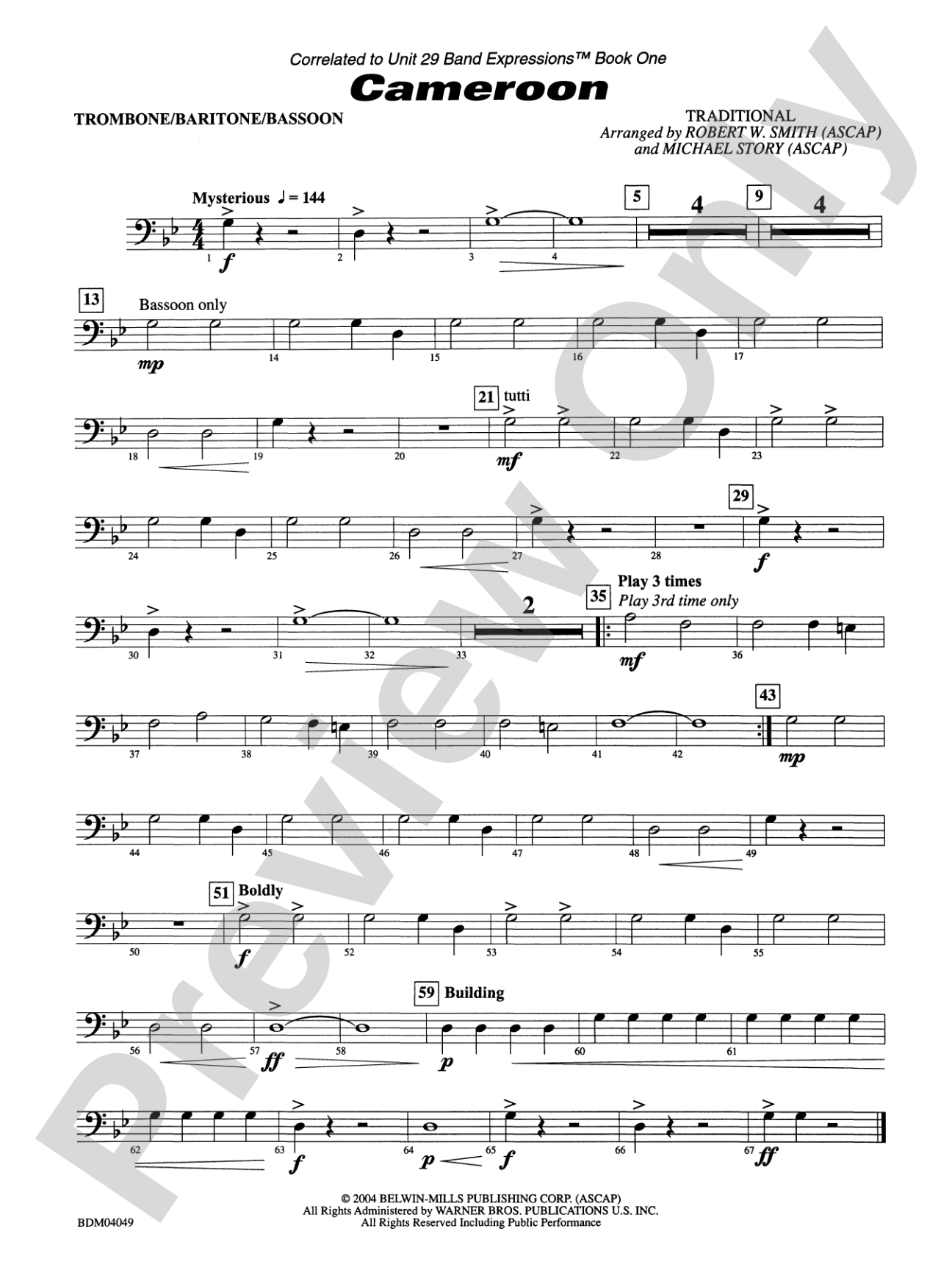
Cameroon: 1st Trombone Sheet Music Preview

Cameroon: 1st Trombone

By Robert W. Smith and Michael Story

Grade: 0.5 (Very Easy)

Item: 00-PC-0014681_TN1

Digital Download
$3.00
Description
This striking exotic work will engage your percussion section while offering a mysteriously provokative melody for the wind players. Once the captivating pulse is established, the sweet melody is introduced. Highly recommended. (2:20)

Don't just read it, hear it, play along with it, and watch your students grow with it. In MakeMusic Cloud, Cameroon: 1st Trombone comes alive with professional accompaniment, adjustable tempo, and built-in practice tools that turn solo practice into real progress.

Sample Audio
0:00
0:00
Sample Video
Additional Details
Series: Band Expressions
Publisher: Alfred Music
Page Count: 144
SKU: 00-PC-0014681_TN1

More about this title

About the Composer: Robert W. Smith

Robert W. Smith

Robert W. Smith stands among the most published composers of concert band and orchestral music in the United States, with more than 400 works to his credit. Trained at Troy State University in music education and at the University of Miami with a master's degree, Smith has built a career spanning composition, arrangement, conducting, and clinician work across North America, Europe, Asia, and Australia.

His concert band works, including symphonies like The Divine Comedy and The Odyssey, have become repertoire standards worldwide. Beyond the concert hall, Smith's music has been featured on major television broadcasts, at the Olympic Games, the Macy's Thanksgiving Day Parade, and countless other high-profile events. His prolific output and accessibility across difficulty levels have made his work a cornerstone of modern band programming.

Why we love this

Cameroon delivers exactly what young ensembles need: an accessible entry point into exotic sonority that doesn't require advanced technique. The arrangement by Michael Story keeps the writing transparent while the percussion writing stays engaging without overwhelming the section, and that hypnotic rhythmic foundation gives even developing players something tangible to lock into before the melody lands.

What to expect

Cameroon opens with a hypnotic, driving rhythm that immediately captures attention. Once the percussion establishes that compelling pulse, a gentle and mysterious melody floats above, creating a sense of discovery and warmth that feels both exotic and strangely familiar.

Who it's for

This score and parts package works for first-year and developing concert bands where players are still building fundamental ensemble skills. The very easy grade level makes it ideal for younger groups or ensembles with significant turnover, while the exotic appeal keeps rehearsals engaging beyond the typical early-grade fare.

How to get the most out of it

  • Establish the pulse in the percussion section with absolute clarity before introducing the melody. Have your timpani and bass drum lock the groove first in rehearsal, then layer in the accessory percussion once that foundation holds steady.
  • Let the melody breathe once it enters. The "sweet melody" the composer mentions will shine most when wind players treat it with warmth and restraint rather than pushing for volume.
  • Balance the exotic sonority by letting the percussion colors shine without drowning the winds. At this grade level, young players often struggle with dynamic awareness across sections.
  • Use the relatively brief runtime (2:20) to your advantage in rehearsal. Run the piece frequently from top to bottom so students internalize the arc from rhythmic foundation to melodic payoff.

How to use it

Program this as a concert opener to set an engaging mood from the first downbeat, or pair it with other world-inspired works for a thematic concert segment. Its brief length and accessible difficulty make it an excellent choice for spring concerts when you want to feature percussion without overshadowing developing soloists elsewhere on the program.

Skills your students will build

  • Maintaining consistent pulse and ensemble rhythm under percussion-driven accompaniment
  • Playing with soft dynamics and focused tone over rhythmic textures
  • Listening across sections to balance melodic and rhythmic elements
  • Responding to exotic and non-traditional harmonic colors

You May Also Like