
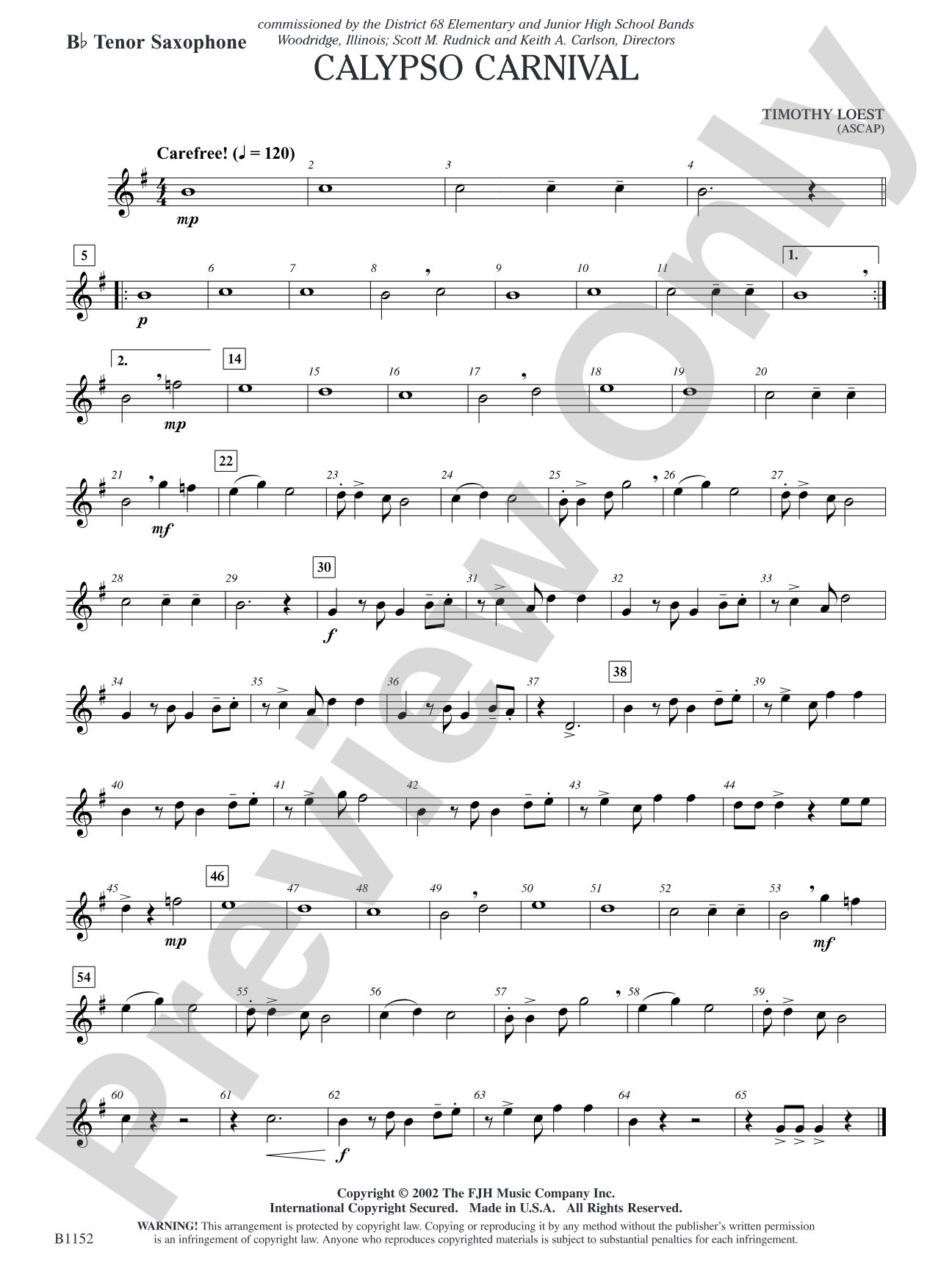

Calypso Carnival: B-flat Tenor Saxophone
By Timothy Loest
Grade: 1.5
Item: 98-PC-DB1152_TX1
$7.00
Pickup currently not available
Description
This fun, dance-like piece has a mildly syncopated motif with a percussion section including mallets, claves, maracas, agogo bells, bongos, and cowbell. The rhythmic motif is developed and all the winds get into the action before the final chorus. A perfect change of pace for your concert program. (2:30)


Calypso Carnival: B-flat Tenor Saxophone isn't in MakeMusic Cloud just yet...but it could be. Let us know you'd like to see it, and you'll help shape what comes next. In the meantime, start a free trial and dive into thousands of interactive titles your students can play along with today.
Request This Title
Tell us you want it.
Start Your Free Trial
Explore everything that's ready to play right now.
Sample Audio
1
Audio File
--:--
0:00
0:00
Sample Video
No sample videos found.
Additional Details
Series:
FJH Developing Band
Publisher:
The FJH Music Company, Inc.
SKU:
98-PC-DB1152_TX1
More about this title
About the Composer: Timothy Loest

Timothy Loest has spent over three decades in the classroom while building a reputation as a composer whose works reach thousands of young musicians annually. His music has aired on network television including The Tonight Show Starring Jimmy Fallon and Good Morning America, and his 2017 composition Cloud Gate drew over 5,000 listeners at Chicago's Millennium Park. He received the Illinois Grade School Music Association's Cloyd Myers Memorial Award for Excellence in Music Education that same year.
Loest has partnered with major publishers including FJH Music Company, C.L. Barnhouse Company, and Warner Bros. Publications since his first publication in 1995. He co-authored several widely adopted band resources: Measures of Success, Warm-ups and Beyond, Rhythms and Beyond, and Chorales and Beyond. In 2022, he founded Fanfare Music Press to focus on high-quality compositions and arrangements for band. He holds degrees from Illinois State University and Northwestern University, maintains ASCAP membership, and accepts commissions through his website.
Why we love this
Loest understands exactly what Grade 1.5 bands need: music that sounds polished and energetic without overwhelming young players. The Latin-flavored rhythmic motif sits comfortably for developing musicians, and the percussion writing is colorful without requiring a percussion section of unusual size or skill. This is the kind of piece that makes rehearsals fun and concerts memorable, proving that accessibility and musical substance are not at odds.
What to expect
Calypso Carnival captures the infectious movement and bright optimism of a street celebration. Syncopated rhythms bounce and sway above a foundation of percussion color, creating a sound that feels both accessible and genuinely festive.
Who it's for
Beginning and early intermediate concert bands looking for a high-energy novelty piece that doesn't sacrifice musical quality. Any director programming a concert that needs a mood shift will find this piece delivers fun without requiring advanced technique from the ensemble.
How to get the most out of it
- Establish the syncopated motif in sectional rehearsals before full ensemble work. Lock the rhythm with your percussionists first, then bring in the melody instruments so the dance feel emerges naturally rather than feeling forced.
- Balance the percussion palette carefully during the development section. The various mallets, claves, and pitched percussion should blend as a unified texture, not compete for attention.
- Keep the energy moving forward throughout; this piece thrives on rhythmic vitality and forward momentum. Avoid dragging the syncopations, which will rob the piece of its carnival spirit.
- Use the final chorus as your moment to crescendo both dynamically and in texture. All voices arriving together at the finish creates the celebratory payoff the arrangement promises.
How to use it
Program this in the second half of your concert to shift the mood after a more serious or formal selection. The 2:30 duration makes it ideal for a concert that mixes styles and energy levels, and it works especially well when followed by another novelty piece or a march.
Skills your students will build
- Reading and executing syncopated rhythmic patterns in a stylistically appropriate context
- Ensemble balance and blend across winds and percussion
- Stylistic interpretation of Latin and Caribbean rhythmic idioms
- Listening and responding to percussion texture and color
- Maintaining rhythmic integrity through sectional development and re-orchestration