
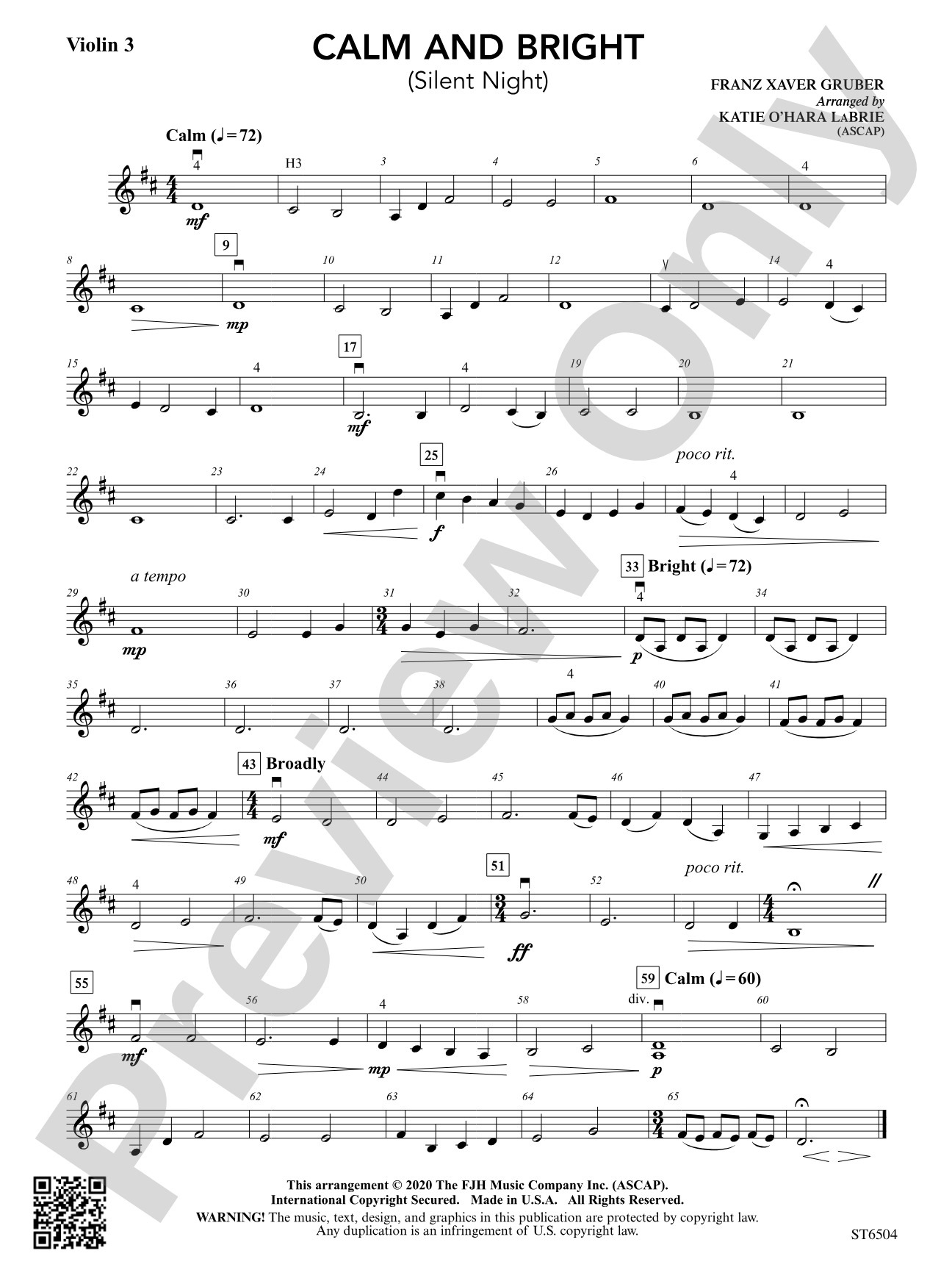

Calm and Bright (Silent Night): Violin 3 (Viola T.C.)
Silent Night
By Franz Xaver Gruber / arr. Katie O'Hara LaBrie
Grade: 2.5
Item: 98-PC-DST6504_VN3
$7.00
Pickup currently not available
Description
Lush and rich harmonies surround this inventive arrangement of Silent Night that offers a wonderful opportunity to focus on phrasing and balance. Each section is featured through interwoven melodies and changing time signatures in the contrasting "calm" and "bright" sections. A mature sounding work for intermediate players, and a sure way to enhance the quality of your winter program.


Calm and Bright (Silent Night): Violin 3 (Viola T.C.) isn't in MakeMusic Cloud just yet...but it could be. Let us know you'd like to see it, and you'll help shape what comes next. In the meantime, start a free trial and dive into thousands of interactive titles your students can play along with today.
Request This Title
Tell us you want it.
Start Your Free Trial
Explore everything that's ready to play right now.
Sample Audio
1
Audio File
--:--
0:00
0:00
Sample Video
Additional Details
Series:
FJH Developing Strings
Publisher:
The FJH Music Company, Inc.
SKU:
98-PC-DST6504_VN3
More about this title
About the Composer: Franz Xaver Gruber
Franz Xaver Gruber (1801–1863) was an Austrian organist and composer who created one of the world's most beloved melodies almost by accident. In 1818, the parish priest of Oberndorf near Salzburg asked Gruber to compose a simple song for Christmas Eve when the church organ was found to be broken. Working quickly, Gruber set a poem by Joseph Mohr to music, and "Stille Nacht" was born. The carol's humble origins and transparent beauty made it ideal for spreading across Europe and eventually the globe.
For string educators, Gruber's original melody remains enduringly useful because its simplicity and emotional directness invite creative reinterpretation at every level. The tune rewards both straightforward playing and sophisticated arranging, making it a staple of holiday concert programming from elementary orchestras to professional ensembles.
Why we love this
Katie O'Hara LaBrie's arrangement transforms a familiar carol into a work that genuinely challenges intermediate orchestras to think about phrasing and textural balance rather than just executing notes. The interplay of "calm" and "bright" sections, supported by shifting meters and woven melodic lines, gives every section meaningful material and keeps the piece engaging for players who typically hear this melody only in unison. This is the kind of winter concert piece that sounds polished and mature without requiring advanced technique.
What to expect
Serene and introspective in its calm passages, then warmly radiant when the bright sections arrive. The lush harmonies and shifting melodies create a sense of discovery, as if hearing this carol for the first time, layered and full rather than sparse and simple.
Who it's for
Intermediate string orchestras preparing a winter or holiday concert program. This arrangement serves directors who want their students to engage with a familiar melody in a fresh way, building musicianship through phrasing and balance rather than technical difficulty.
How to get the most out of it
- Shape the "calm" sections with subtle dynamic arcs; these passages showcase how lush the harmonies are when players listen carefully to blend rather than project individual lines.
- Mark the time signature changes clearly in rehearsal so the transition between "calm" and "bright" feels intentional rather than confused. These shifts drive the emotional arc of the arrangement.
- Balance the interwoven melodies by having each section identify which orchestral voice holds the primary line at any given moment. Highlight these roles during sectional rehearsals so the texture becomes transparent.
- Take the tempo shift between sections deliberately. A clear contrast makes the architecture audible and prevents the piece from settling into one mood.
How to use it
Position this as a centerpiece of your holiday concert, perhaps midway through to showcase how your orchestra handles lyrical playing and ensemble balance. It pairs well alongside other holiday selections ranging from traditional to contemporary; its Grade 2.5 level makes it accessible enough to program even with a mixed-experience ensemble.
Skills your students will build
- Phrasing and shaping long melodic lines across phrase boundaries
- Ensemble balance and blend in divisi passages
- Reading and executing time signature changes (mixed meters)
- Listening to inner voices and maintaining textural clarity