Caller Herrin Sheet Music Preview

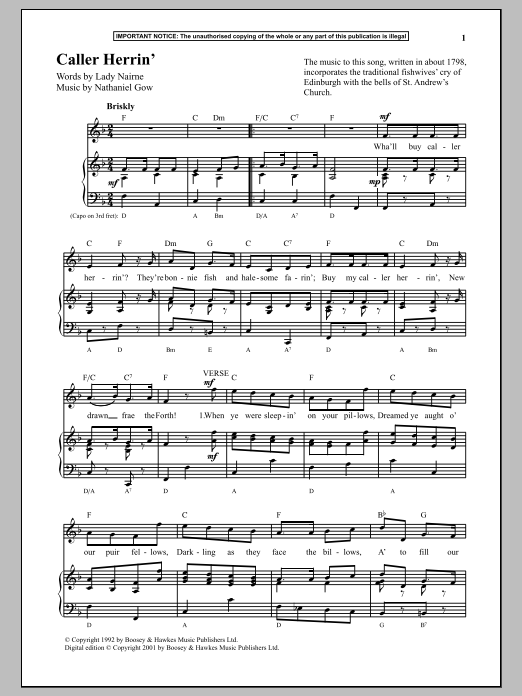
Caller Herrin: Piano Vocal

As performed by Nathaniel Gow

Item: 35-DS00236458

Digital Download
$5.99
Description

Caller Herrin: Piano Vocal isn't in MakeMusic Cloud just yet...but it could be. Let us know you'd like to see it, and you'll help shape what comes next. In the meantime, start a free trial and dive into thousands of interactive titles your students can play along with today.

Sample Audio
No sample audio found.
Sample Video
Additional Details
Publisher: Hal Leonard
Page Count: 2
SKU: 35-DS00236458

More about this title

About the Artist: Nathaniel Gow

Nathaniel Gow (1763-1831) was a Scottish composer and violinist who inherited the vast collection and publishing business of his father, Niel Gow, one of Scotland's most celebrated fiddlers. Nathaniel expanded this legacy considerably, composing over 300 works that drew from traditional Scottish dance and song while incorporating the refined harmonic language of the Classical era. His output includes dances, rondos, and vocal settings that remain central to Scottish musical heritage and continue to appear in choral and instrumental programs worldwide.

Why we love this

Gow's treatment of "Caller Herrin" balances authentic Scottish character with elegant vocal writing that sits naturally for singers at various levels. The piano part provides both accompaniment and musical substance, creating an arrangement that works equally well in a recital setting or as a concert opener that immediately signals cultural intention to your audience.

What to expect

The piece carries the warmth and directness of a street cry given musical dignity. There's an underlying narrative strength that pulls listeners in through simple, memorable melody paired with piano writing that honors without overwhelming the voice.

Who it's for

This arrangement serves vocalists exploring song literature beyond art song tradition, choirs programming Scottish or folk-influenced repertoire, and pianists seeking collaborative repertoire with genuine musical weight. Voice students will find the tessitura and phrase lengths manageable while still developing musicianship in traditional song style.

How to get the most out of it

  • Let the melody breathe in the style of a folk song rather than adhering strictly to metronomic time; slight flexibility in phrasing supports the narrative quality of the text.
  • Balance the vocal line so that text clarity takes precedence, especially on longer phrases where diction supports storytelling.
  • Use the piano introduction and interludes to establish the Scottish character through articulation and touch rather than pedal-heavy playing.

How to use it

Include this in a folk song or cultural music unit to provide historical context and variety within a vocal recital. It pairs naturally with other British Isles repertoire or works as a thoughtful bridge between classical and traditional music in a concert that explores cultural identity through song.

Skills your students will build

  • Sustaining text clarity and narrative intent across phrases
  • Accompanying and being accompanied in folk-song style
  • Responding to Scottish vocal ornamentation and inflection
  • Collaborating between voice and piano to achieve interpretive balance

You May Also Like