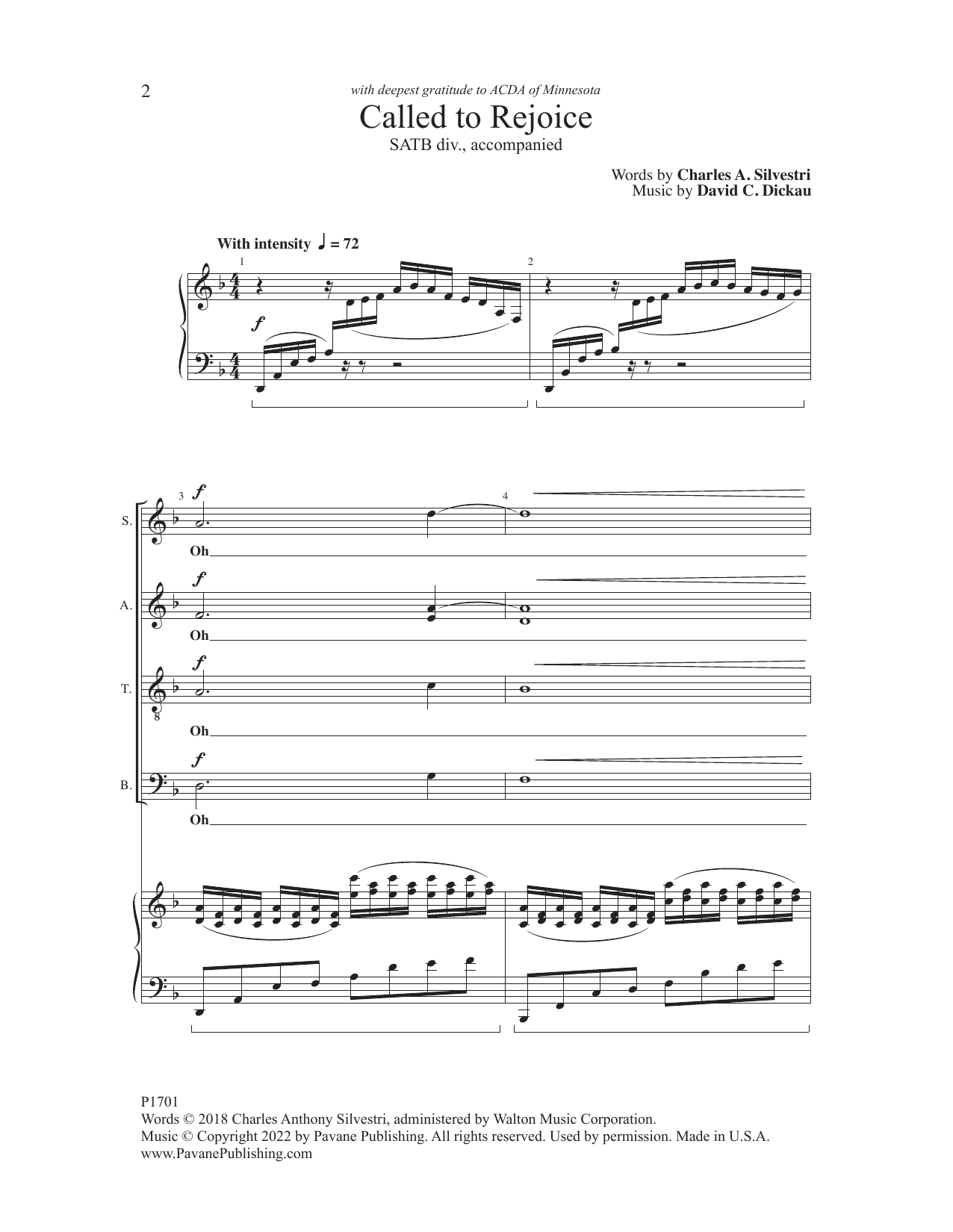
Called to Rejoice Sheet Music Preview

Called to Rejoice: SATB Divisi Choral Octavo

By Charles A. Silvestri and David C. Dickau / By David C. Dickau

Item: 35-DS01104025

Digital Download
$3.35
Description

Called to Rejoice: SATB Divisi Choral Octavo isn't in MakeMusic Cloud just yet...but it could be. Let us know you'd like to see it, and you'll help shape what comes next. In the meantime, start a free trial and dive into thousands of interactive titles your students can play along with today.

Sample Audio
No sample audio found.
Sample Video
Additional Details
Publisher: Hal Leonard
Page Count: 16
SKU: 35-DS01104025

More about this title

About the Composer: Charles A. Silvestri and David C. Dickau

Charles A. Silvestri is a composer and arranger whose choral works span sacred and secular repertoire, with particular strength in accessible, singable writing that challenges without overwhelming. David C. Dickau brings expertise in text setting and harmonic language that serves the poetry at hand.

Together, Silvestri and Dickau craft pieces designed for singers who want to feel the emotional weight of what they're singing. Their collaborative approach balances musical substance with practical considerations for rehearsal and performance.

Why we love this

This setting lands perfectly for choirs wanting substance without severity. The divisi writing creates richness and textural variety without demanding an unusually large ensemble, and the text treatment respects both the poetic content and the singers' need for air and clarity.

What to expect

Energetic and affirmative, with moments of tenderness threaded through the rejoicing. The music has momentum without rushing; it feels like a conversation among friends rather than a proclamation from on high.

Who it's for

Intermediate to advanced SATB choirs with secure ensemble skills and access to all four standard voice parts. This works equally well for high school show choirs, college audition ensembles, and community choirs ready for more sophisticated text and harmonic language.

How to get the most out of it

  • Balance the divisi voices carefully in sections where parts split; soprano and alto divisions especially benefit from slightly favoring the upper line in rehearsal first, then pulling back in performance.
  • Commit to the text from the first rehearsal. This piece rewards singers who understand what 'rejoice' means in context and aren't just moving through syllables.
  • Listen across sections for harmonic blend when voices move in parallel motion; unison or near-unison passages need precise intonation to land.
  • Mark breath points early and communicate them clearly. With 16 pages of material, singers need permission to breathe naturally without losing the line.

How to use it

Slot this as a contrasting anchor in a concert heavy with sacred works, or use it to open a secular program that needs both buoyancy and musicality. The length and moderate difficulty make it suitable mid-concert, where it can catch the ear after a demanding opening without overstaying its welcome.

Skills your students will build

  • Reading divisi notation and maintaining individual voice independence
  • Balancing text clarity with sustained legit tone
  • Ensemble intonation across harmonic shifts
  • Interpreting poetic intent through musical choices

You May Also Like