
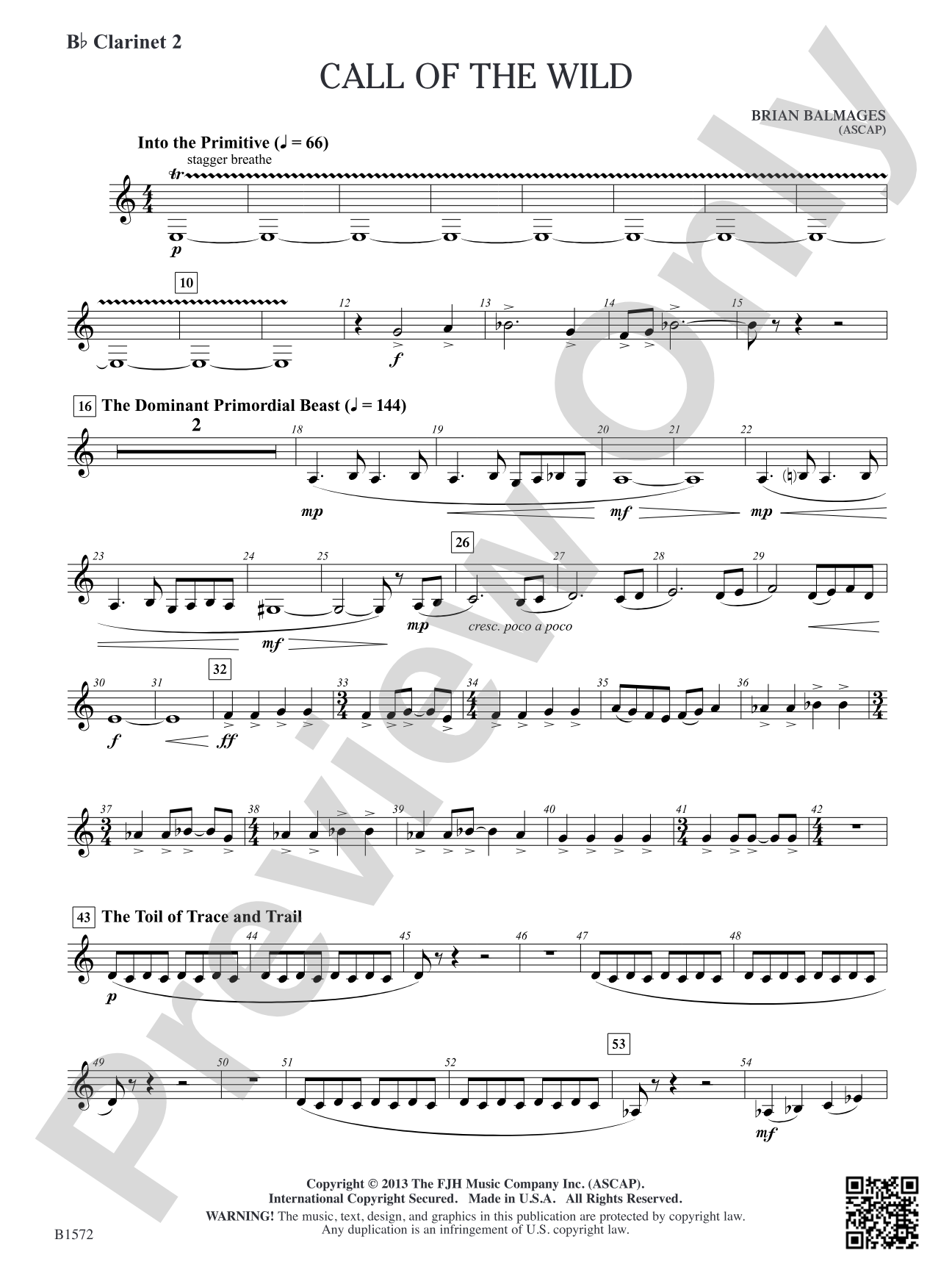

Call of the Wild: B-flat Clarinet 2
By Brian Balmages
Grade: 3
Item: 98-PC-DB1572_C2
$7.00
Pickup currently not available
Description
Based on the novel by American author Jack London, this powerful work depicts a dog’s struggle as he progressively moves from a domesticated animal to a creature of the wild. All sections of the piece are titled after chapters in the novel. The opening powerful fanfare over dissonant woodwind trills moves into a fast-paced section as Buck has his brutal introduction into primitive law. The music becomes angrier as dramatic battles occur along with long journeys without adequate food and water. Eventually, the music becomes heroic and resolute before the opening fanfare returns once more (The Sounding of the Call) and Buck finally completes his transformation, returning to the wild.


Don't just read it, hear it, play along with it, and watch your students grow with it. In MakeMusic Cloud, Call of the Wild: B-flat Clarinet 2 comes alive with professional accompaniment, adjustable tempo, and built-in practice tools that turn solo practice into real progress.
Open in the Player
Jump straight in and assign it today.
Start Your Free Trial
Open this title and explore the full library in minutes.
Sample Audio
1
Audio File
--:--
0:00
0:00
Sample Video
No sample videos found.
Additional Details
Series:
FJH Concert Band
Publisher:
The FJH Music Company, Inc.
SKU:
98-PC-DB1572_C2
More about this title
About the Composer: Brian Balmages

Brian Balmages composes and conducts across orchestral, band, and chamber music with equal facility. His works have been heard at Carnegie Hall, the Kennedy Center, Sydney Opera House, and the Toronto Centre for the Arts, performed by ensembles ranging from professional orchestras to elementary school groups. He received the A. Austin Harding Award from the American School Band Directors Association and won the 2020 NBA William D. Revelli Composition Contest for Love and Light.
Balmages is an elected member of the American Bandmasters Association and holds the inaugural James Madison University Distinguished Alumni Award from the School of Visual and Performing Arts. He has been commissioned by the University of Miami to compose for presidential inaugurations and his music was performed at the 2013 Presidential Inaugural Prayer Service. As a guest conductor, he regularly appears at the Midwest Clinic, College Band Directors Conference, state ASTA conferences, and ensembles worldwide. He currently serves as Director of MakeMusic Publications and Digital Education for Alfred and MakeMusic.
Why we love this
Balmages captures the novel's emotional arc without sacrificing musical clarity or accessibility. The structural pacing moves your band through distinct dramatic moments, each grounded in actual chapter titles from London's text, which gives students something concrete to visualize and conduct toward. This is the kind of programmatic work that engages young musicians because the story unfolds through their instruments, not alongside them.
What to expect
The music moves from civilized grandeur through raw struggle toward primal freedom, and you feel all three states vividly. Dissonance and driving rhythms collide with sweeping melodic moments, creating an arc that feels earned rather than imposed. By the final return of that opening fanfare, your band will understand Buck's transformation not as a plot point but as something they've lived through musically.
Who it's for
Grade 3 concert bands ready for music with genuine narrative thrust. Your ensemble should have solid fundamentals in rhythm and part independence, but this work doesn't demand advanced technical facility. Directors programming for contest or festival play will find this piece strikes the balance between artistic substance and realistic execution.
How to get the most out of it
- Shape the opening fanfare as a cohesive gesture; the dissonant woodwind trills underneath should support rather than obscure the brass declaration.
- Keep the fast-paced section driving forward without rushing; Grade 3 ensembles often accelerate when they feel energy. Steady eighth notes in the rhythm section are your anchor.
- Balance the angry, dramatic passages by letting the lower voices carry harmonic weight while upper woodwinds and brass define the character. Resist the urge to play everything loud.
- Bring clarity to the heroic section by ensuring articulation is consistent across sections. This moment earns its power through precision, not volume.
How to use it
Program this as a centerpiece that anchors a concert around literary or narrative themes. It works equally well as a standalone statement piece or paired with other programmatic works at a similar level. The Grade 3 accessibility means it can anchor a concert without requiring a supporting program of simplifications, freeing you to build outward into other repertoire.
Skills your students will build
- Following a conductor's interpretation of extended programmatic narrative
- Balancing dissonance and clarity in harmonic writing
- Sustaining intensity through repeated rhythmic figures without rushing
- Shaping a multi-section work with structural coherence
- Coordinate articulation across sections to define character changes