
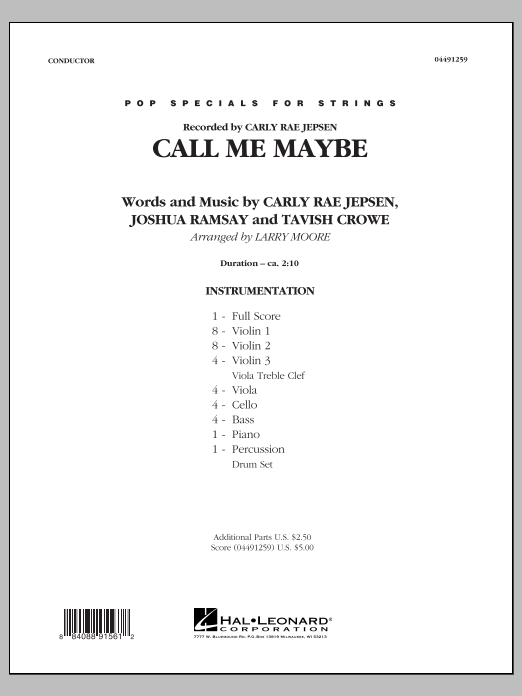

Call Me Maybe: String Orchestra Conductor Score & Parts
As performed by Carly Rae Jepsen / Arranged by Larry Moore
Grade: 3-4
Item: 35-PK00276627
$45.00
Pickup currently not available
Buy Extra Parts (Digital PDF Download)
| Product | Price | Quantity |
|---|---|---|
| Call Me Maybe - Conductor Score (Full Score) | $6.00 | |
| Call Me Maybe - Violin 1 | $7.00 | |
| Call Me Maybe - Violin 2 | $7.00 | |
| Call Me Maybe - Violin 3 (Viola Treble Clef) | $7.00 | |
| Call Me Maybe - Viola | $7.00 | |
| Call Me Maybe - Cello | $7.00 | |
| Call Me Maybe - Bass | $7.00 | |
| Call Me Maybe - Piano | $7.00 | |
| Call Me Maybe - Percussion | $7.00 |
Parts Added to Cart!
Description
This upbeat hit recorded by Carly Rae Jepsen has taken the charts by storm and quickly has become a pop anthem. This great sounding arrangement will go together quickly with great audience appeal for any concert. Dur: 2:10


Call Me Maybe: String Orchestra Conductor Score & Parts isn't in MakeMusic Cloud just yet...but it could be. Let us know you'd like to see it, and you'll help shape what comes next. In the meantime, start a free trial and dive into thousands of interactive titles your students can play along with today.
Request This Title
Tell us you want it.
Start Your Free Trial
Explore everything that's ready to play right now.
Sample Audio
No sample audio found.
Sample Video
No sample videos found.
Additional Details
Publisher:
Hal Leonard
SKU:
35-PK00276627
More about this title
About the Artist: Carly Rae Jepsen
Carly Rae Jepsen emerged from Canadian Idol as a pop artist with genuine songwriting instincts. Her 2011 album "Curiosity" established her as a serious composer and performer, but "Call Me Maybe" from 2012 became the cultural phenomenon that defined her career, breaking records across streaming platforms and earning Grammy nominations.
For music educators, Jepsen's work represents the accessibility and immediate appeal of contemporary pop songwriting. "Call Me Maybe" endures because its hook is genuinely memorable and its structure is built on clear, singable phrases. These qualities translate beautifully to ensemble arrangements where students can connect with music their peers actually listen to.
Why we love this
This arrangement hits the sweet spot between student-friendly and genuinely sophisticated. Larry Moore's scoring captures the song's irresistible energy without oversimplifying it, giving your string players real parts to execute. Your audience will recognize it immediately, and your students will feel the satisfaction of performing something current that matters to their world.
What to expect
Bright, propulsive, and instantly joyful. The arrangement preserves the song's infectious pop sensibility while giving strings the room to shine with real interplay between sections. You'll hear that famous hook bloom when your ensemble hits it together.
Who it's for
String orchestras looking to program accessible, high-energy pop music that resonates with student musicians and audiences alike. This works for groups at the intermediate level who have solid rhythmic chops and can handle coordinated articulation across parts.
How to get the most out of it
- Keep the tempo steady and driving. The tunefulness of this piece depends on forward motion; rushing or dragging will flatten the bounce that makes the song memorable.
- Balance the melody prominently in whichever section carries it (likely violins), but resist the urge to let the rest of the ensemble fade to nothing. The rhythmic accompaniment holds the energy.
- Pay attention to articulation consistency across the string section, especially in rhythmic figures. Clean, unified tonguing or bow strokes will make the arrangement sound polished.
- The recorded accompaniment can anchor tempo and feel, but use it as reference, not crutch. Your students will own the piece more fully when they're listening to each other.
How to use it
Pair this with one serious work and a classical standard to create a balanced concert that shows your program's range. It's especially effective as an opener or closer because its energy and familiarity engage the audience from the first notes. Spring concerts and family concerts are natural homes for this piece.
Skills your students will build
- Executing steady rhythmic figures in pop idiom
- Maintaining rhythmic independence while following a clear harmonic framework
- Balancing melodic and accompaniment roles within an ensemble
- Responding to contemporary music styles and arrangements
- Coordinating articulation across multiple string sections