
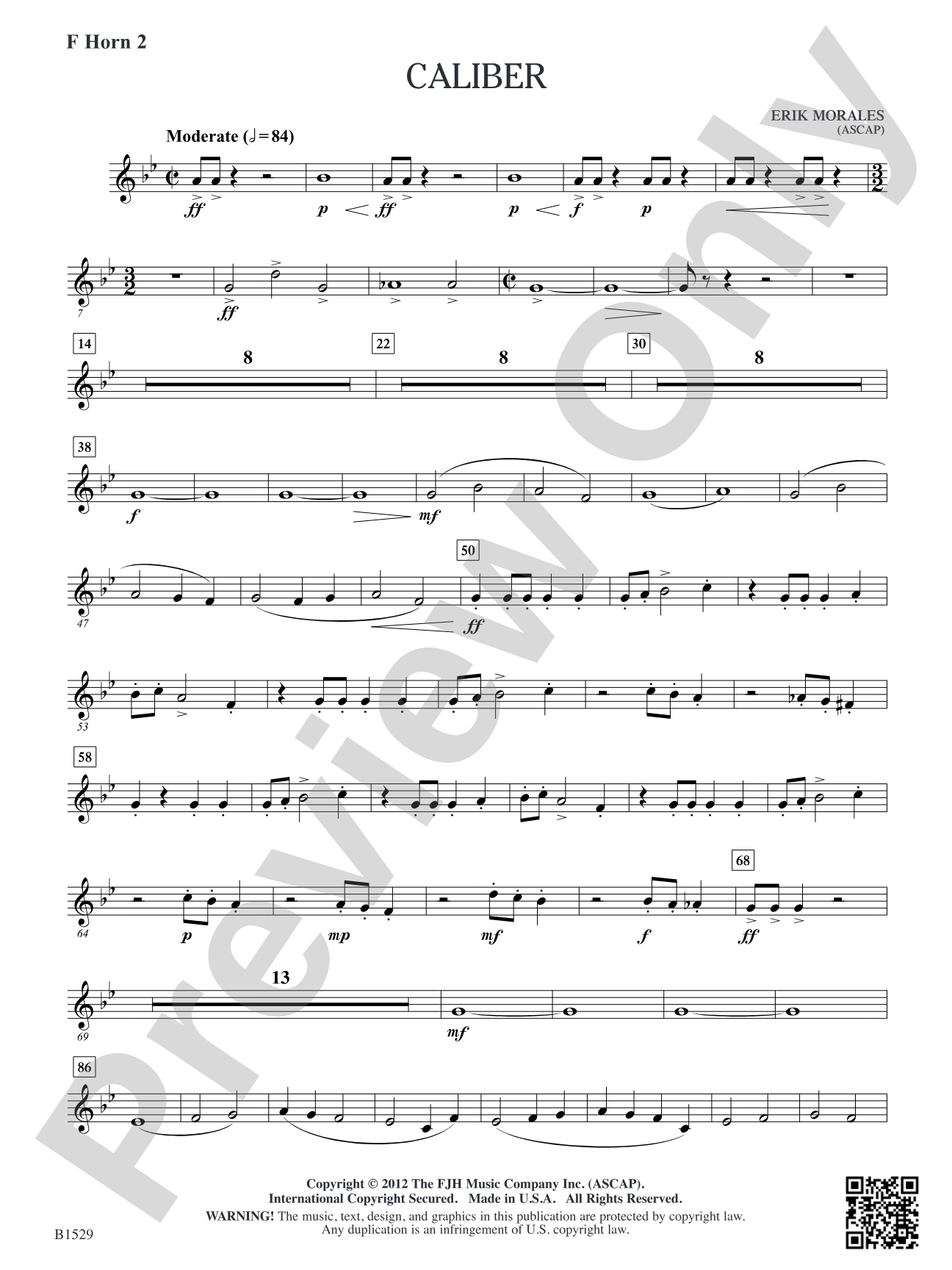

Caliber: F Horn 2
By Erik Morales
Grade: 3
Item: 98-PC-DB1529_H2
$7.00
Pickup currently not available
Description
Inspired by the inner workings of a mechanical wristwatch, Caliber contrasts the steady rhythmic nature of watches with broad flowing melodies. Rute sticks are used to mimic the sound of a ticking watch. The entire work develops continuously as the music moves into a final series of explosive chords with an underlying pulse. Innovative and highly entertaining!


Don't just read it, hear it, play along with it, and watch your students grow with it. In MakeMusic Cloud, Caliber: F Horn 2 comes alive with professional accompaniment, adjustable tempo, and built-in practice tools that turn solo practice into real progress.
Open in the Player
Jump straight in and assign it today.
Start Your Free Trial
Open this title and explore the full library in minutes.
Sample Audio
1
Audio File
--:--
0:00
0:00
Sample Video
No sample videos found.
Additional Details
Series:
FJH Concert Band
Publisher:
The FJH Music Company, Inc.
SKU:
98-PC-DB1529_H2
More about this title
About the Composer: Erik Morales

Erik Morales began composing during his high school years in South Florida, when his former band director commissioned him to arrange music for marching band in 1985. That early opportunity launched a prolific career spanning classical, jazz, and commercial genres. He studied composition at Florida International University and earned his bachelor's degree from the University of Louisiana, Lafayette in 1989.
With over 150 published works across wind, orchestral, jazz, and chamber settings, Morales has built a reputation for balancing artistic substance with educational accessibility. His contributions to the trumpet repertoire are particularly celebrated; his trumpet ensembles won first place at the 2006 and 2008 National Trumpet Competitions, and his Concerto for Trumpet in C and Piano premiered at the 2009 International Trumpet Guild conference. In 2016, he was inducted into the Louisiana Association for Jazz Education's Hall of Fame. Schools and organizations across the nation regularly commission new works from him.
Why we love this
Caliber delivers a Grade 3 piece with genuine compositional sophistication. The central conceit—using rute sticks to evoke the mechanical precision of a watch while layering broad, singing melodies against that ticking—creates an engaging contrast that feels fresh without demanding excessive technical demands from your ensemble. Directors appreciate how it holds audience attention through clever orchestration and a dramatic arc that builds to those explosive final chords.
What to expect
Caliber unfolds like watching the intricate gears of a precision instrument. The steady ticking creates an almost hypnotic backdrop while lyrical melodies float across the texture, generating tension between mechanical predictability and human expression. As the work develops, this contrast intensifies, culminating in a thrilling release of energy.
Who it's for
Band directors building a Grade 3 concert program need pieces that engage both performers and audiences. Caliber works for ensembles with solid fundamental skills and the ability to maintain rhythmic accuracy while balancing multiple textural layers. It fits well in festival and contest settings where something inventive yet musically substantial makes an impression.
How to get the most out of it
- Establish the ticking pulse in early rehearsals as the foundational layer. Once players lock into that steady rhythmic foundation, the melodic lines emerge more naturally and the contrast reads clearly to listeners.
- Balance the rute stick articulation carefully so the ticking remains conversational rather than relentless; the goal is to suggest the mechanical nature without overshadowing the flowing melodies.
- Shape the final series of explosive chords with clear ensemble breath and unified dynamic control to maximize impact as the underlying pulse powers toward the conclusion.
- Use sectionals to ensure inner voices maintain rhythmic precision through the continuous development section, where harmonic interest often rests in parts beyond the melody line.
How to use it
Program Caliber early in a concert to set an engaging tone and showcase your ensemble's rhythmic tightness and melodic control. Its theatrical concept and accessible difficulty level make it an ideal opener before moving into weightier repertoire. The piece also works well for festival performances where a distinctive musical idea and polished execution stand out.
Skills your students will build
- Maintaining steady pulse while playing complex rhythmic figures in surrounding parts
- Balancing articulation between rhythmic and melodic layers within a single ensemble texture
- Reading and executing continuous harmonic development across extended phrases
- Responding to dramatic dynamic shifts and textural changes in ensemble context
- Coordinating rhythmic precision across the ensemble during rapid harmonic transitions