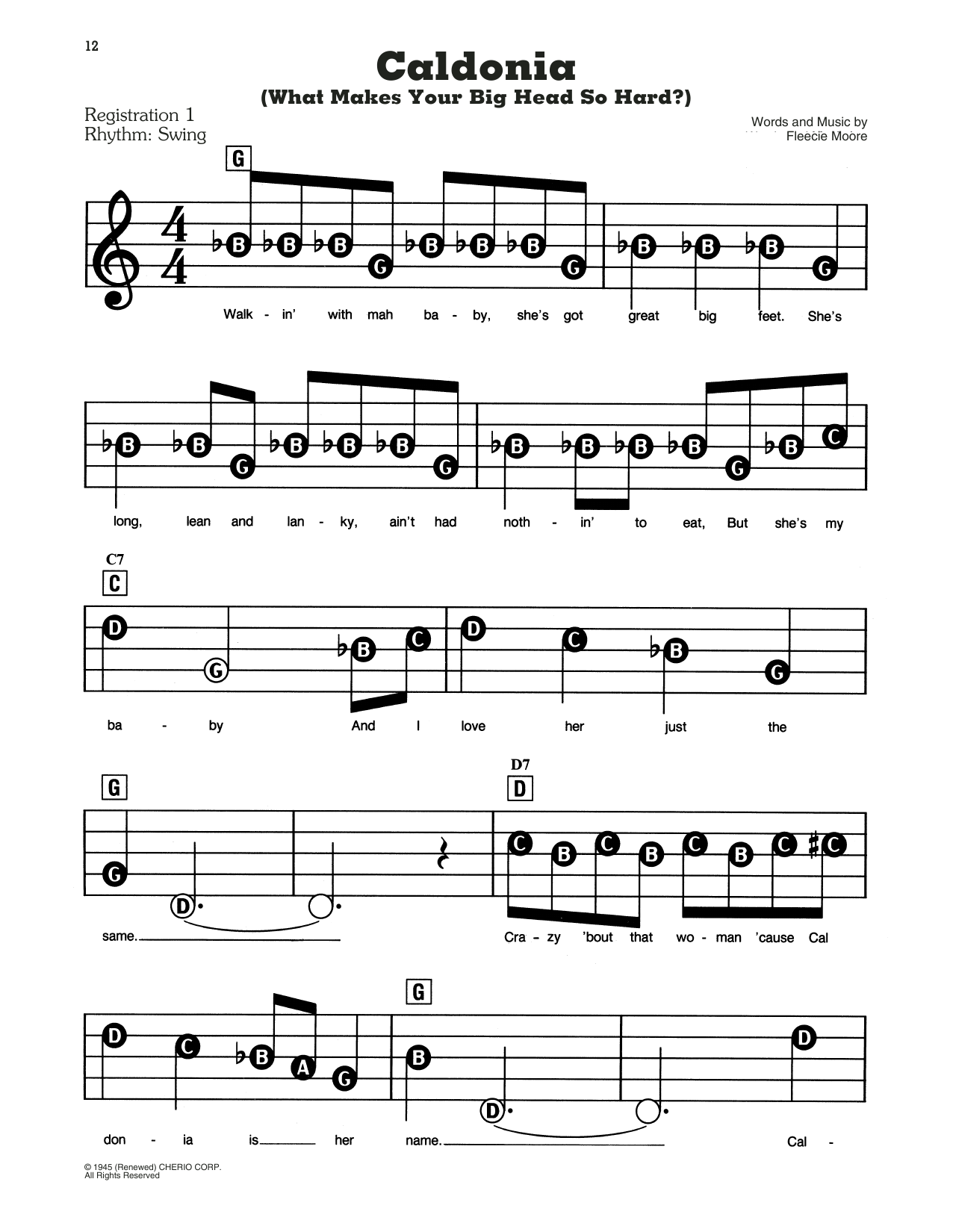
Caldonia (What Makes Your Big Head So Hard?) Sheet Music Preview

Caldonia (What Makes Your Big Head So Hard?): E-Z Play Today

As performed by Woody Herman & His Orchestra

Item: 35-DS00460011

Digital Download
$4.99

One moment…

One moment…

Description

Caldonia (What Makes Your Big Head So Hard?): E-Z Play Today isn't in MakeMusic Cloud just yet...but it could be. Let us know you'd like to see it, and you'll help shape what comes next. In the meantime, start a free trial and dive into thousands of interactive titles your students can play along with today.

Sample Audio
No sample audio found.
Sample Video
Additional Details
Publisher: Hal Leonard
Page Count: 2
SKU: 35-DS00460011

More about this title

About the Artist: Woody Herman & His Orchestra

Woody Herman led one of the most enduring and innovative big bands in jazz history, spanning from the 1930s through the 1980s. His ensembles were known for their disciplined swing, inventive arrangements, and ability to absorb new stylistic influences while maintaining a distinctive house sound that kept audiences engaged across generations.

Why we love this

This tune cracks open the relationship between jazz and blues vocabulary in a way that feels natural rather than academic. The straightforward melody and chord changes make it approachable for developing pianists while the underlying groove rewards anyone who digs into the swing eighth-note feel and style.

What to expect

Loose and grooving, with the kind of unbuttoned charm that lets a melody land without overthinking it. The blues harmonies ground the piece while the title's cheeky humor gives it real personality on a recital or concert program.

Who it's for

Students ready to move beyond classical touch and explore the rhythmic and tonal demands of jazz and blues styles. This works equally well for pianists interested in understanding jazz arranging or those preparing for jazz combo contexts.

How to get the most out of it

  • Establish the shuffle clearly in your left hand from the opening. The groove depends on that lilting quality rather than straight rhythms.
  • Find the pocket behind the beat rather than driving it forward. This style of blues swing sits in the pocket rather than pushes against it.
  • Listen to how the original recording handles dynamics across the form. The repetition of the head calls for subtle variations in touch and intensity to hold listener interest.

How to use it

Pair this alongside other big band standards to show the range of material from the swing era, or use it as a bridge piece when introducing students to the stylistic expectations of jazz ensemble work. It reads quickly enough to work as an encore or standalone novelty number.

Skills your students will build

  • Swing eighth-note feel and articulation
  • Blues form and harmonic language
  • Comping vocabulary and left-hand independence
  • Style-appropriate phrasing and dynamics

You May Also Like