
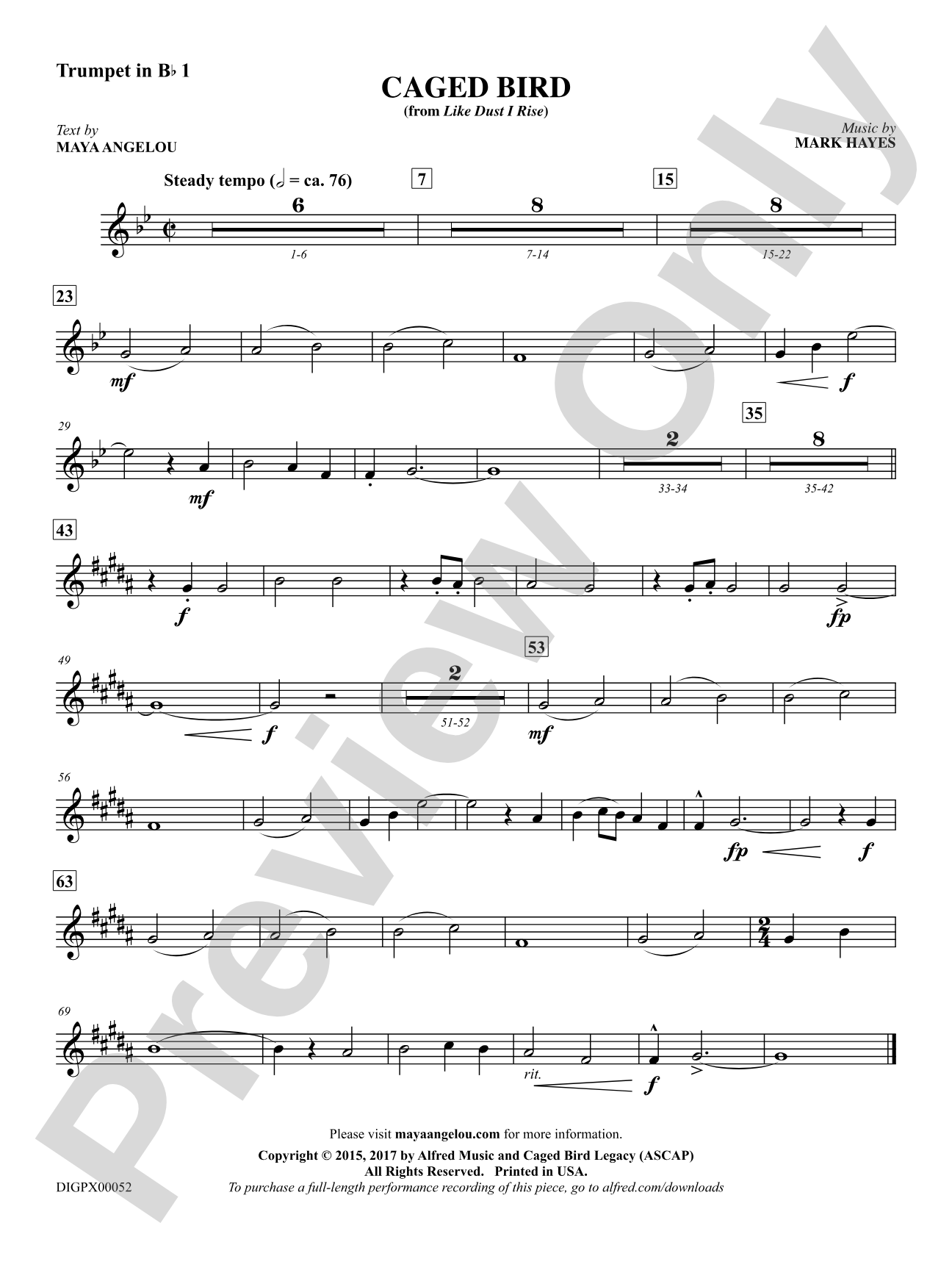

Caged Bird: 1st B-flat Trumpet
From Like Dust I Rise (A Choral Song Cycle)
Text by Maya Angelou, music by Mark Hayes
Item: 00-PC-0017786_T1
$3.00
Pickup currently not available
Description
A folk-like setting of Maya Angelou's empowering poem, which compares a bird's longing to be liberated with that of all people. Hayes chooses a minor key with plenty of harmonic tension and a walking tempo that suggests the footsteps of those who have come before. The final Picardy third is the ultimate symbol of freedom. This is the second movement from the song cycle Like Dust I Rise.


Caged Bird: 1st B-flat Trumpet isn't in MakeMusic Cloud just yet...but it could be. Let us know you'd like to see it, and you'll help shape what comes next. In the meantime, start a free trial and dive into thousands of interactive titles your students can play along with today.
Request This Title
Tell us you want it.
Start Your Free Trial
Explore everything that's ready to play right now.
Sample Audio
No sample audio found.
Sample Video
No sample videos found.
Additional Details
Series:
Alfred Choral Designs
Publisher:
Alfred Music
Page Count:
40
SKU:
00-PC-0017786_T1
Instrumentation:
SoundPax
More about this title
About the Composer: Mark Hayes
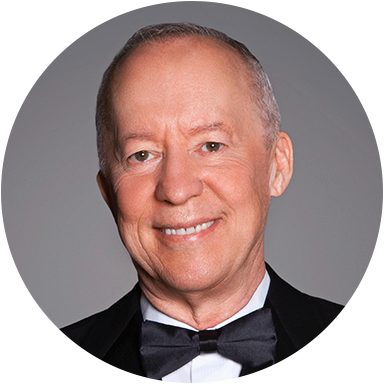
Mark Hayes has composed and arranged over 1,750 published works across sacred and secular genres, establishing himself as one of the most prolific voices in choral music. A summa cum laude graduate in piano performance from Baylor University, he has conducted world premieres at Lincoln Center and served as guest conductor at major venues including Carnegie Hall and the National Cathedral. His work spans choral cycles, orchestrations for musical theater, and an extensive catalog of piano compositions ranging from classical to gospel to jazz.
Beyond the concert hall, Hayes has contributed significantly to music theater, orchestrating the musical Madame Buttermilk and arranging scores for theatrical productions. In 2010, Baylor University recognized his leadership in Christian music with a dedicated award. His compositions consistently blend sophisticated harmonic language with accessibility, making his work valuable in both educational and professional settings across the United States and internationally.
Why we love this
Hayes transforms Angelou's iconic poem into a choral experience that respects its gravity while making it singable. The minor key and harmonic tension create authentic emotional weight, and that final Picardy third lands as a genuine musical statement of hope rather than a cheap trick. This is sophisticated writing that doesn't demand unreasonable ranges or unusual voicing.
What to expect
The opening establishes a contemplative minor landscape that feels searching and honest. As the piece unfolds, harmonic tension accumulates, reflecting the struggle within Angelou's metaphor, until the final shift to major breaks through like actual daylight. The walking tempo grounds everything; this is not ethereal or abstract, but grounded in the real experience of those yearning for freedom.
Who it's for
This setting serves choirs seeking repertoire that honors a powerful literary text without oversimplifying it. Singers should have solid musicianship and comfort with minor tonalities and harmonic complexity. Directors programming concerts around themes of justice, resilience, or freedom will find this piece both musically and thematically substantive.
How to get the most out of it
- Shape the minor tonality to feel grounded and intentional rather than dark; the walking tempo should feel like steady progress, not heaviness.
- Prepare singers for the harmonic tension in the body of the piece by discussing the text's emotional arc so they can commit vocally to the dissonance.
- The final Picardy third shift demands clear intonation and a unified dynamic approach; rehearse the moment that the major chord enters so it lands with clarity and warmth.
How to use it
Program this as an anchor piece in a concert exploring themes of social justice or human dignity, where it can stand alongside other contemporary choral works of substance. It also functions powerfully as the centerpiece of a program devoted to Hayes's choral cycle Like Dust I Rise, or as a meaningful closing piece when paired with spirituals or freedom songs. The piece rewards a dedicated rehearsal investment and works best when given enough program real estate to breathe.
Skills your students will build
- Reading and sustaining harmonic tension in minor tonalities
- Navigating sudden tonal shifts (Picardy third) with secure intonation
- Connecting lyrical text to harmonic gesture for expressive singing
- Maintaining ensemble blend through dissonance and chromatic voice leading