
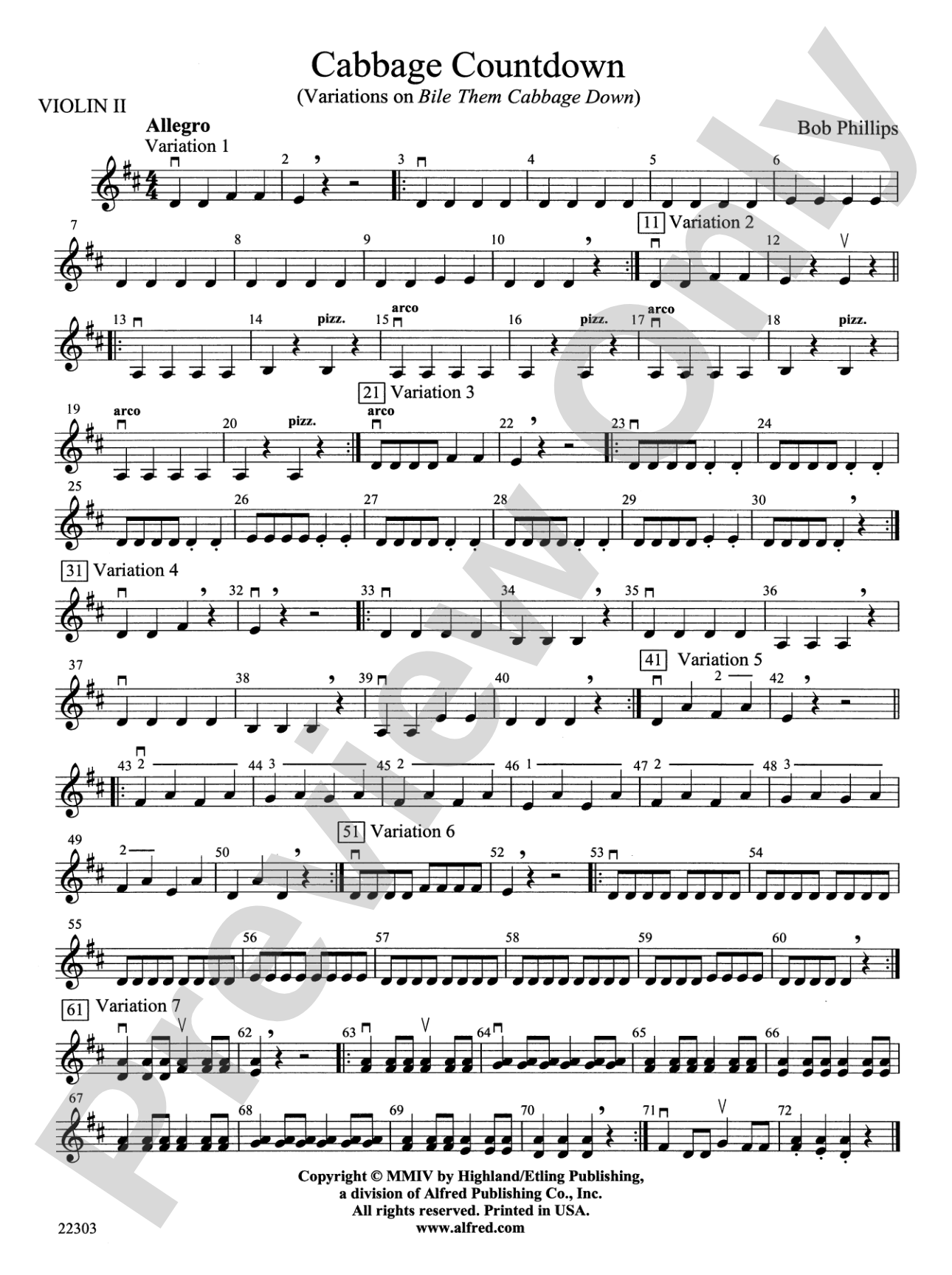

Cabbage Countdown: 2nd Violin
(Variations on Bile Them Cabbage Down)
By Bob Phillips
Grade: 1
Item: 00-PC-0000552_VN2
$5.99
Pickup currently not available
Description
A refreshing and fun look at a well-known tune, Cabbage Countdown is a set of variations on the American fiddle tune "Bile Them Cabbage Down." Entertain your audience and make the kids feel cool, while using the piece to review and solidify first-year rhythm patterns. In the key of D major, each rhythmic variation is played by all sections and is easily accessible by first-year players.


Don't just read it, hear it, play along with it, and watch your students grow with it. In MakeMusic Cloud, Cabbage Countdown: 2nd Violin comes alive with professional accompaniment, adjustable tempo, and built-in practice tools that turn solo practice into real progress.
Open in the Player
Jump straight in and assign it today.
Start Your Free Trial
Open this title and explore the full library in minutes.
Sample Audio
1
Audio File
--:--
0:00
0:00
Sample Video
No sample videos found.
Additional Details
Series:
Highland/Etling String Explorer
Publisher:
Alfred Music
Page Count:
72
SKU:
00-PC-0000552_VN2
More about this title
About the Composer: Bob Phillips

Bob Phillips has shaped string education across multiple decades through prolific composition and innovative pedagogy. Since 1953, he has authored over 25 instructional series and published more than 200 works for orchestras and bands, establishing himself as a leading voice in making eclectic musical styles accessible to young string players. His groundbreaking publications spanning jazz, rock, mariachi, Latin, and fiddle repertoire have influenced how teachers approach ensemble diversity.
For 27 years, Phillips built the Saline, Michigan string program into a national model, eventually directing the internationally recognized Saline Fiddlers Philharmonic ensemble. He has served as resident conductor and arranger for major festivals, conducted multiple all-state orchestras across the country, and received recognition as an ASCAP award-winning composer whose works regularly appear at the Midwest Clinic. His instructional DVDs and conducting work at camps and honors orchestras continue to shape string pedagogy nationally.
Why we love this
Phillips has crafted a piece that accomplishes what many directors struggle to balance: genuine entertainment value paired with deliberate skill reinforcement. Each rhythmic variation systematically revisits first-year patterns without feeling like drill work, and the familiar fiddle tune grounds the learning in something students immediately recognize and enjoy. The fact that every section plays every variation means no one sits idle while others work, keeping engagement high across the entire ensemble.
What to expect
Unpretentious and energetic, with the warmth of a folk tune that audiences recognize instantly. The variations build momentum and playfulness, inviting students to feel the satisfaction of playing something that sounds sophisticated yet remains accessible to their technical level.
Who it's for
String orchestras in grades 1-2 with players reading first-position basics and foundational rhythm vocabulary. This works equally well as a strategic review piece in spring or as an entry point for students who need concrete reinforcement of core rhythmic patterns before moving forward.
How to get the most out of it
- Allow each section time to nail the rhythmic variation independently before combining parts. Since all sections play the same rhythms, sectional work builds confidence and ensures clean ensemble entrances.
- Emphasize stylistic clarity in the fiddle tune context; the bounce and lilt of the source material should shape phrasing and bow articulation rather than applying standard classical technique throughout.
- Use the progression of variations to build ensemble cohesion visibly. As students see how their rhythm work translates across multiple iterations, confidence in reading and ensemble balance grows naturally.
How to use it
Place this in a concert where you want to showcase first-year achievements without apology. The recognizable tune and accessible variations make it ideal for family concerts, school assemblies, or festivals where you want the audience to hear solid musicianship from developing players. It also serves as a bridge piece between classical and folk styles, helping establish repertoire diversity early in the school year.
Skills your students will build
- Reading rhythmic patterns in mixed meters and varied note groupings
- Maintaining steady pulse across ensemble sections with uniform rhythmic content
- Stylistic understanding of fiddle tune phrasing and articulation
- Building independence within ensemble texture when all parts carry equal rhythmic responsibility
- Confidence in sight-reading through systematic variation and repetition of core patterns