
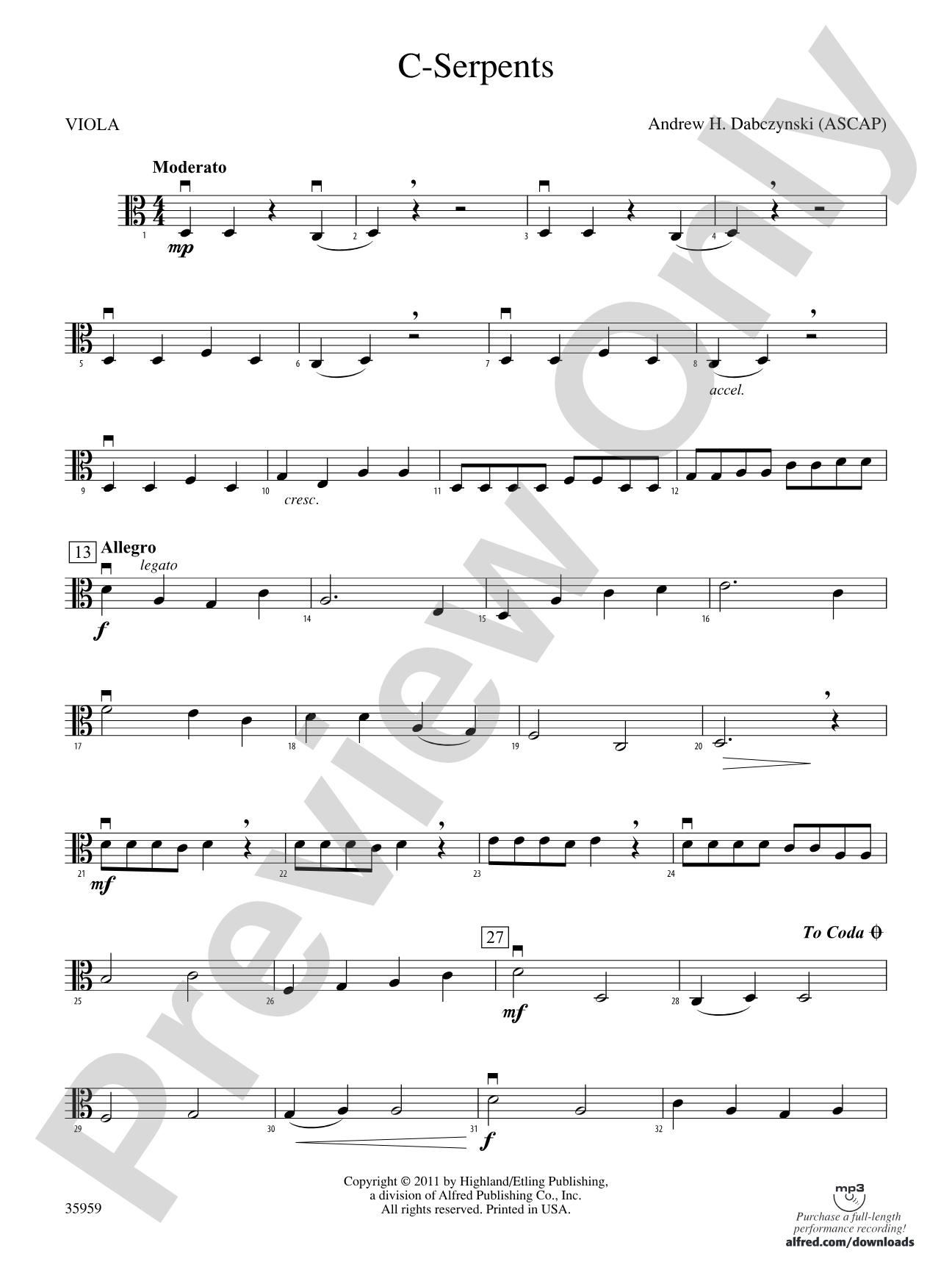

C-Serpents: Viola
By Andrew H. Dabczynski
Grade: 1.5
Item: 00-PC-0015034_VA1
$5.99
Pickup currently not available
Description
Here's the perfect piece for your "C-farers!" Written especially for young violists, cellists, and bassists, C-Serpents explores the depths of the lower strings. Simple modes are creatively mixed with contemporary-sounding rhythms and harmonies for a work that's perfect for students within their first two years of string study. Students and audiences will enjoy discovering what lurks beneath the staff in C-Serpents! This title is available in MakeMusic Cloud.


Don't just read it, hear it, play along with it, and watch your students grow with it. In MakeMusic Cloud, C-Serpents: Viola comes alive with professional accompaniment, adjustable tempo, and built-in practice tools that turn solo practice into real progress.
Open in the Player
Jump straight in and assign it today.
Start Your Free Trial
Open this title and explore the full library in minutes.
Sample Audio
1
Audio File
--:--
0:00
0:00
Sample Video
No sample videos found.
Additional Details
Series:
Highland/Etling String Explorer
Publisher:
Alfred Music
Page Count:
140
SKU:
00-PC-0015034_VA1
Instrumentation:
string w/ vln3, pno acc
More about this title
About the Composer: Andrew H. Dabczynski

Andrew H. Dabczynski has served on the faculty at Brigham Young University as Emeritus Professor of Music Education, where he founded and directed the BYU New Horizons Orchestra, an ensemble designed for adult beginners that also functions as a laboratory for string teacher preparation. His work in that program earned him BYU's Joseph E. White Fellowship for Teaching and Learning. He has held teaching and administrative roles at the Eastman School of Music, in public school districts across New York and Michigan, and at numerous colleges and national string workshops.
Dabczynski's credentials as a string educator rest on deep performing experience and comprehensive pedagogical training. He earned a B.M. in viola performance from Eastman, an M.A. from the University of Connecticut (where he performed in the graduate string quartet), and a Ph.D. in Music Education from the University of Michigan. As a violist, he has performed with the Rochester Philharmonic, Hartford Symphony, Portland Symphony, Kalamazoo Symphony, and Greenwich Symphony orchestras, and spent six years in the Colden String Quartet at Western Michigan University. He co-authored the String Explorer method series, widely adopted in American string programs, and has served in leadership roles with the American String Teachers Association, earning Utah ASTA's Higher Education Teacher of the Year award in 2005 and recognition for Outstanding Contributions to Music Education in 2014.
Why we love this
Dabczynski writes for the lower strings with genuine affection and understanding of what younger cellists and bassists can accomplish together. Rather than relegating them to rhythmic accompaniment, he gives them melodic voice and treats their section as the expressive heart of the piece, which builds confidence and genuine ownership in students still finding their way on their instruments. The pairing of modal simplicity with contemporary rhythmic language sounds fresh without asking for technique beyond the reach of first and second-year players.
What to expect
C-Serpents captures a sense of exploration and discovery, with modal harmonies creating a contemplative, almost mysterious atmosphere as the lower strings navigate their musical terrain. The interplay of simple harmonic language with modern rhythmic energy gives the piece momentum and character that keeps student players and audiences engaged.
Who it's for
String orchestras with cellists and bassists in their first or second year of study who benefit from repertoire that values their developing voices equally. This piece also works well for programs seeking grade 1.5 concert material that doesn't shy away from contemporary language while remaining accessible.
How to get the most out of it
- Balance the piece so the lower strings remain audible as the primary voices; resist the temptation to let the violins overshadow the musical line.
- Establish the rhythmic vocabulary early in rehearsal by isolating the contemporary rhythmic figures in the lower strings before adding the full ensemble.
- Work the modal sonorities as harmonic anchors rather than exotic color; modal music relies on a clear tonal center and resolution that young players need to hear and feel.
How to use it
Program this as a centerpiece for a concert that spotlights your developing string section, or pair it with traditional repertoire to show how young players can handle contemporary compositional approaches. It works particularly well on a mixed-level concert where you want to highlight musicianship and ensemble balance rather than technical display.
Skills your students will build
- Reading and sustaining modal harmonies (dorian, mixolydian, and aeolian modes)
- Rhythmic accuracy with contemporary syncopation and mixed meter figures
- Balancing individual line integrity within ensemble texture
- Listening and responding as a section to carry the primary melodic material
- Developing tone quality and intonation in the lower string registers