
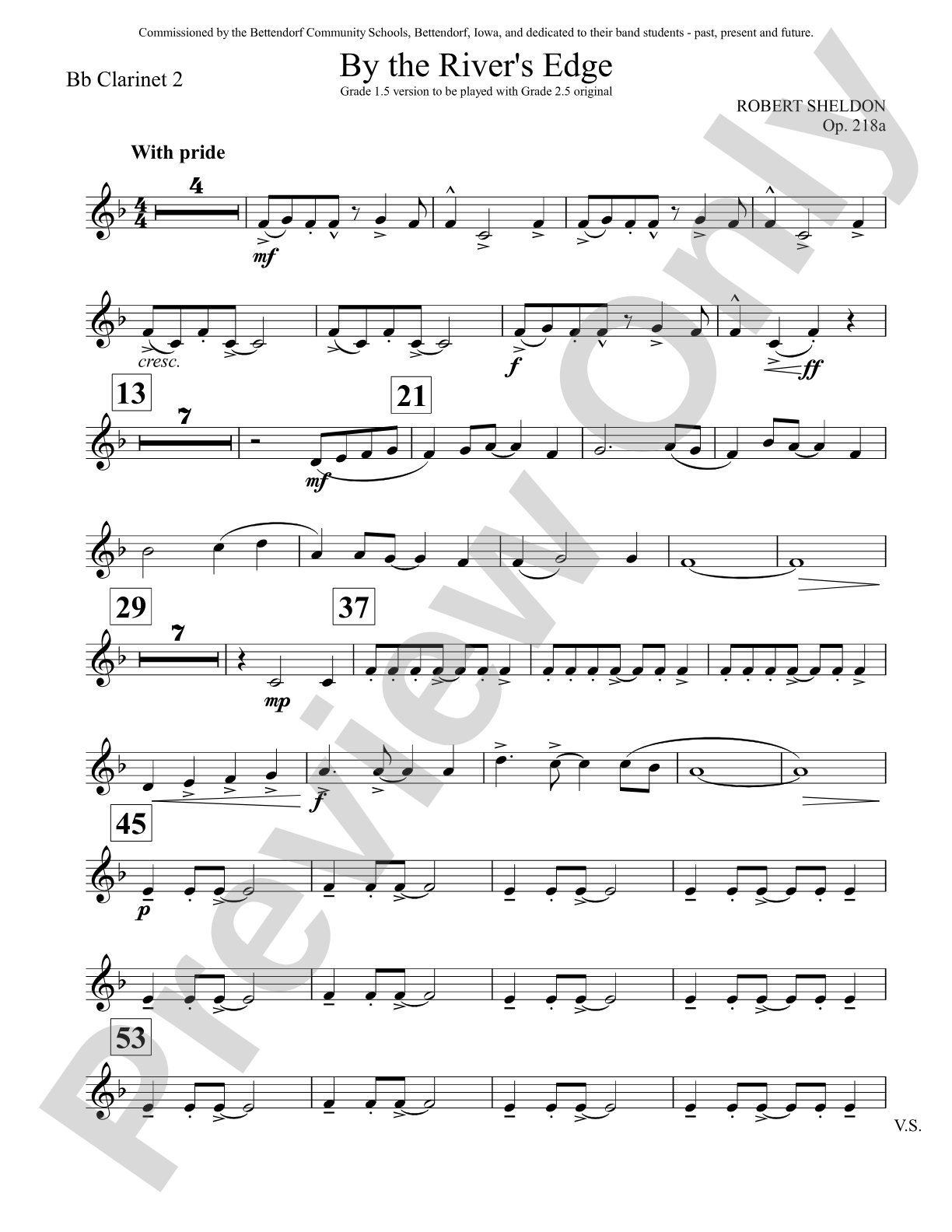

By the River's Edge: 2nd B-flat Clarinet
Multi-Level Parts for Young Band
By Robert Sheldon
Grade: 1.5 (Very Easy)
Item: 00-PC-0018603_C2
$3.00
Pickup currently not available
Description
Brimming with tuneful melodies and rhythmic textures, Robert Sheldon's By the River's Edge exudes feelings of confidence and pride, while also providing moments of introspection. Additionally, everyone has parts that are fun to play! This item consists of Grade 1.5 parts to play along with the printed printed version (00-48128) that is a Grade 2.5.
These multi-level parts are available for bands with players of varied levels of ability and allow less experienced musicians to play along on pieces that have printed parts for more advanced ensembles. Perfect for massed band concerts, performances that combine middle school and high school groups, or for supplying specific players a less demanding part when needed. Please refer to the recording for the printed version By the River's Edge (00-48128). (4:00)


These multi-level parts are available for bands with players of varied levels of ability and allow less experienced musicians to play along on pieces that have printed parts for more advanced ensembles. Perfect for massed band concerts, performances that combine middle school and high school groups, or for supplying specific players a less demanding part when needed. Please refer to the recording for the printed version By the River's Edge (00-48128). (4:00)
Don't just read it, hear it, play along with it, and watch your students grow with it. In MakeMusic Cloud, By the River's Edge: 2nd B-flat Clarinet comes alive with professional accompaniment, adjustable tempo, and built-in practice tools that turn solo practice into real progress.
Open in the Player
Jump straight in and assign it today.
Start Your Free Trial
Open this title and explore the full library in minutes.
Sample Audio
No sample audio found.
Sample Video
No sample videos found.
Additional Details
Series:
Alfred Digital Concert Band
SKU:
00-PC-0018603_C2
More about this title
About the Composer: Robert Sheldon

Robert Sheldon stands among today's most frequently performed composers of wind band literature. His works have earned him recognition from the American School Band Director's Association, Phi Beta Mu, and the American Society of Composers, Authors and Publishers. He is the lead author of Sound Innovations for Concert Band, a widely adopted resource in music education.
Sheldon's music appears regularly on state and international contest lists and is performed by ensembles worldwide. His career includes appearances as guest conductor for All-State and Regional Honor Bands, residencies at universities across the United States and internationally (including Japan, Canada, Italy, Germany, Australia, and China), and presentations at state music education conferences. He has conducted his own works at Carnegie Hall, Orchestra Hall in Chicago, Boston's Symphony Hall, the Sydney Opera House, and the Kennedy Center. VanderCook College of Music awarded him an honorary doctorate in 2020.
Why we love this
Sheldon's ear for orchestration shines here: every section has legitimate musical material to play, which means your less experienced musicians aren't relegated to whole notes while stronger players carry the piece. The multi-level structure lets you field one ensemble with genuine mixed ability levels rather than splitting your band into separate rehearsals, and the Grade 1.5 parts stay true to the musical character of the Grade 2.5 printed version. It's a practical solution that also sounds unified.
What to expect
The piece balances confident, prideful themes with quieter moments of reflection, creating a shape that feels both substantial and accessible. Tuneful melodies and rhythmic drive give it musical weight without overwhelming less experienced ensembles, and the orchestration invites every player into the musical conversation.
Who it's for
This is designed for bands mixing grade levels or player abilities within a single concert setting. It works equally well for a middle school ensemble where a few advanced players need fuller material, a massed band event bringing together middle and high school groups, or any program where your strongest players and your newest musicians perform the same piece together.
How to get the most out of it
- Balance the lyrical passages by asking your Grade 1.5 players to shape their lines with intention; a simpler part still needs phrasing and direction.
- Mark clear sectional entrances in all parts so mixed-ability players can find their place without relying on complex navigation.
- Let the rhythmic textures breathe in the introspective moments; resist rushing through silence and space.
- Record a sectional run-through with both part levels to hear how the scoring blends before rehearsing full ensemble.
How to use it
Use this for a concert featuring mixed ability levels or a massed band performance where you want unified programming without separate arrangements. It also solves the practical problem of giving select players a less demanding part during a school year when they're still developing technique, letting them participate in repertoire their section mates are playing at full difficulty.
Skills your students will build
- Reading and maintaining independence on simplified parts within a multi-level ensemble texture
- Balancing confidence with dynamic control in tuneful melodic passages
- Executing rhythmic accuracy while listening to surrounding textures
- Understanding how supporting material contributes to the overall musical shape