

Bwana Awabariki: 3-Part Mixed Choral Octavo
Swahili Folk Song / arr. Ruth Morris Gray
Item: 00-PO-0007495
$2.20
Minimum order quantity: 20 copies
Pickup currently not available
Description
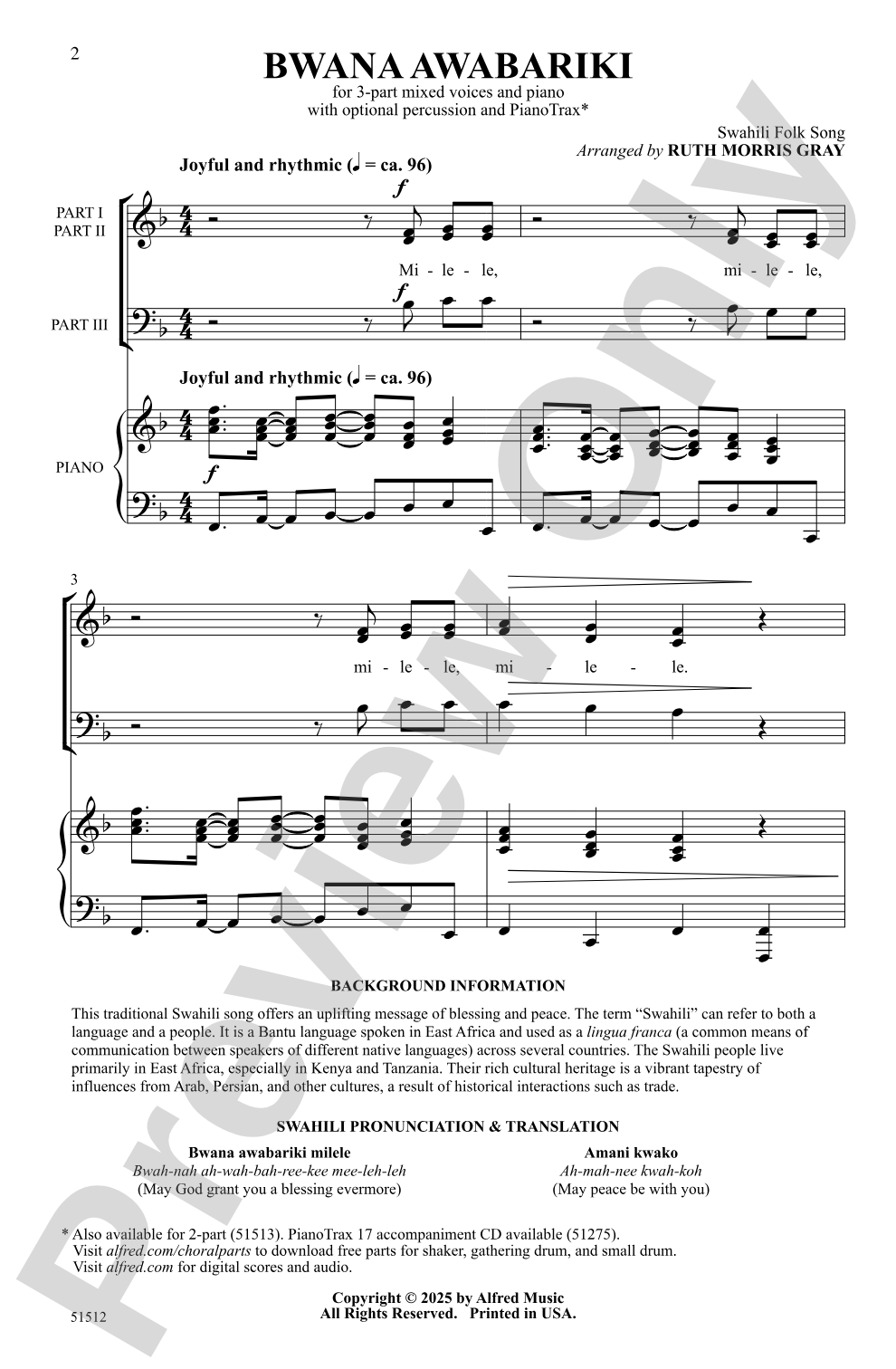
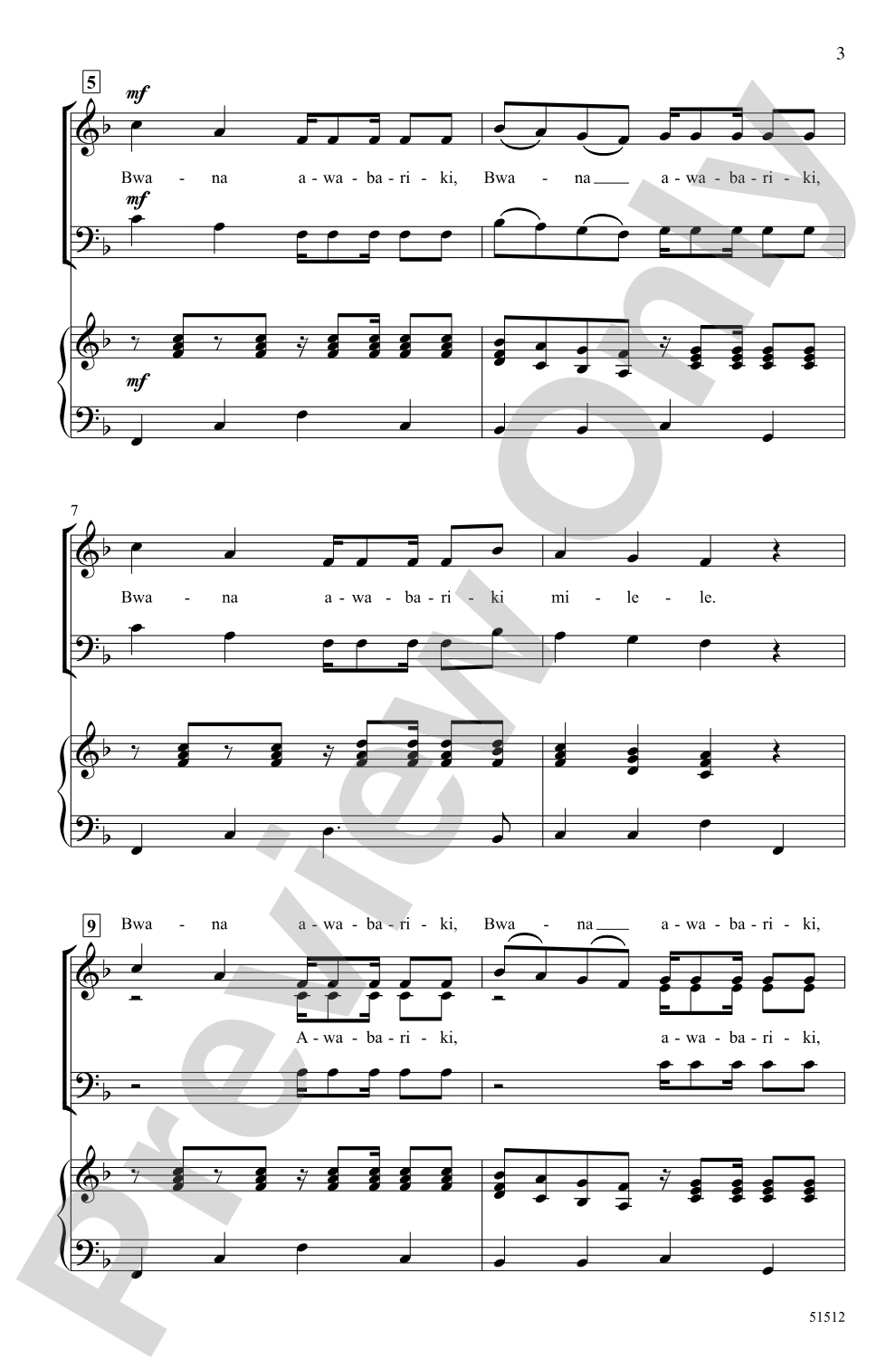
This vibrant Swahili chorus is spot-on for developing groups. Joyful rhythmic patterns, tuneful triads, and a five-word text make this fun-filled arrangement easy to assemble and quick to memorize. In the middle, two brief solos call for the choir to respond, and a brief optional descant joins toward the end. A pronunciation/translation guide is included, download free percussion parts online.


Bwana Awabariki: 3-Part Mixed Choral Octavo isn't in MakeMusic Cloud just yet...but it could be. Let us know you'd like to see it, and you'll help shape what comes next. In the meantime, start a free trial and dive into thousands of interactive titles your students can play along with today.
Request This Title
Tell us you want it.
Start Your Free Trial
Explore everything that's ready to play right now.
Sample Audio
1
Audio File
--:--
0:00
0:00
Sample Video
Additional Details
Series:
Alfred Choral Designs
Publisher:
Alfred Music
Page Count:
8
SKU:
00-PO-0007495
More about this title
About the Arranger: Ruth Morris Gray

Ruth Morris Gray serves as Director of Choirs at Rosemead High School in Rosemead, California, where she has taught piano and choir since 2004. She holds a Bachelor of Music in Piano Performance and Composition from Biola University and earned her Master of Arts in Music Composition from UC Santa Barbara. Gray has published more than 100 choral works and completed her California Single Subject Music Credential at California State University, Northridge.
Beyond her work as a composer, educator, and conductor, Gray is an active performer and traveler. She shares her passion for music and outdoor pursuits, including swimming, reading, and cycling, with her husband, Douglas.
Why we love this
Gray's arrangement captures the infectious energy of this Swahili song while making it genuinely accessible for developing choirs. The rhythmic patterns feel organic and alive, not simplified, and the inclusion of optional descant and brief solos creates natural opportunities for singers to step forward without requiring advanced technique.
What to expect
Bwana Awabariki radiates joy through bright harmonies and syncopated rhythms that make singers feel the groove in their bodies. The arrangement balances accessibility with authentic character, creating music that feels celebratory rather than simplified.
Who it's for
This arrangement suits developing choral programs looking for material that sounds impressive without demanding years of training. It works equally well in middle school, early high school, or community choir settings where singers are building confidence and rhythmic independence.
How to get the most out of it
- Establish a steady pulse before teaching any text. Tap the main rhythmic patterns during warm-up to build muscle memory for the syncopated sections.
- Teach the Swahili pronunciation separately using the included guide, then layer the melody on top once the sounds are secure.
- Have the soloists (whoever they are at performance time) rehearse their responses frequently in full rehearsals so the choir learns to listen and respond as an ensemble rather than waiting for a conductor's gesture.
- Balance the optional descant in the final section carefully; it should add shimmer, not overwhelm the main voice parts.
How to use it
Program this piece in a concert celebrating world music or multicultural traditions, where it can stand alongside other global repertoire. Its quick memorability makes it ideal for pops concerts, spring festivals, or community events where audience engagement matters as much as technical polish.
Skills your students will build
- Reading and performing syncopated rhythmic patterns in a choral context
- Pronouncing and understanding text in a non-English language
- Responding to soloists as an ensemble without relying on a conducted downbeat
- Singing triadic harmony in three-part mixed voicing
- Balancing optional descant lines with primary voice parts