Buttercup: Lead Sheet Digital Sheet Music

Buttercup: Lead Sheet Digital Sheet Music

Neal Hefti

Item: 00-PS-0009224

Digital Download
$1.99
Description

Buttercup: Lead Sheet Digital Sheet Music isn't in MakeMusic Cloud just yet...but it could be. Let us know you'd like to see it, and you'll help shape what comes next. In the meantime, start a free trial and dive into thousands of interactive titles your students can play along with today.

Sample Audio
No sample audio found.
Sample Video
Additional Details
SKU: 00-PS-0009224

More about this title

About the Artist: Neal Hefti

Neal Hefti (1922-2008) was a composer, arranger, and bandleader whose work defined the sound of mid-century jazz and television. He led his own big band in the 1950s, recorded prolifically for Columbia Records, and arranged for some of jazz's finest vocalists. His gift for melody and harmony earned him recognition far beyond the bandstand; he composed the theme for the television series Batman, demonstrating his range across popular music genres.

In jazz education, Hefti's compositions serve as models for understanding swing arranging, harmonic sophistication, and the interplay between ensemble and soloist. His lead sheets remain standard repertoire for jazz ensembles, combos, and private study because they balance accessibility with enough harmonic interest to reward careful listening and performance.

Why we love this

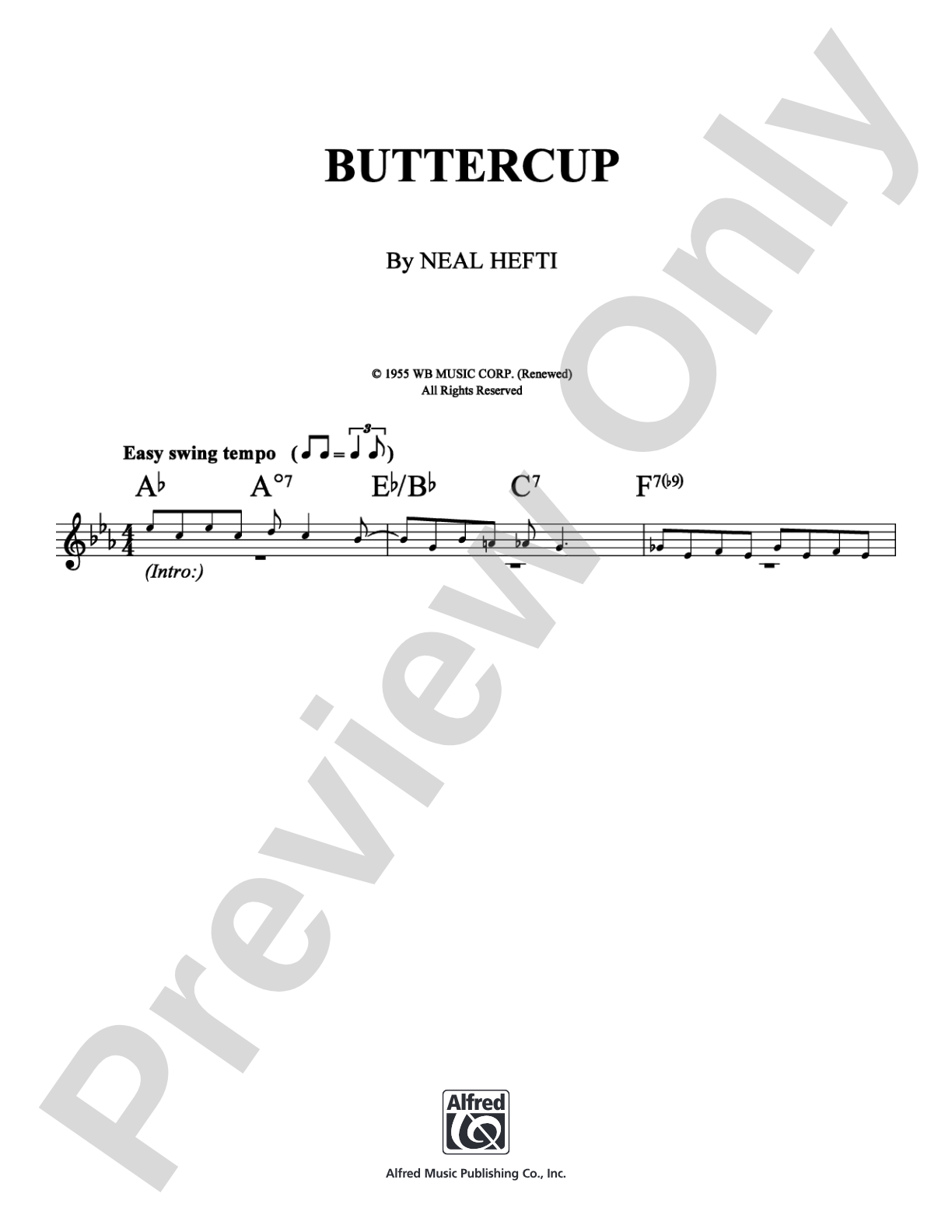
Hefti's "Buttercup" sits squarely in the jazz standard repertoire with genuine melodic charm and harmonic substance. The lead sheet format makes it immediately playable for jazz combos, vocalists, and soloists without requiring a full arrangement, yet the tune rewards close harmonic attention and personal interpretation.

What to expect

Bright and warmly swinging, "Buttercup" has the easy confidence of a tune that knows exactly what it wants to say. The melody sits comfortably in the middle register, inviting singers and soloists into its relaxed groove without demanding flashiness.

Who it's for

Jazz musicians working with lead sheets in combo settings, vocalists building their jazz standards vocabulary, and jazz students learning to read changes and navigate swing idioms. Directors programming jazz-heavy concerts will find this accessible enough for younger students while substantial enough for advanced ensembles.

How to get the most out of it

  • Balance the melody's lyrical character with the swing feel; this tune should float above the rhythm section rather than land heavily on the beat.
  • Explore the harmony on successive choruses. The chord changes offer room for interesting reharmonization and soloist creativity.
  • Work with your rhythm section to establish a confident groove; the tune's simplicity gives soloists space to stretch, but only if the foundation is solid.

How to use it

Include this as a feature for a jazz vocalist or instrumental soloist in a concert setting, or use it as a flex tune in a jazz ensemble set where soloists need room to develop ideas. Its familiar style makes it an excellent bridge between standard swing repertoire and more contemporary jazz programming.

Skills your students will build

  • Reading and interpreting lead sheet notation
  • Comping changes and harmonic flexibility
  • Swing phrasing and articulation
  • Balancing melody with accompaniment in a trio or combo
  • Building extended improvisations over a 32-bar form

You May Also Like