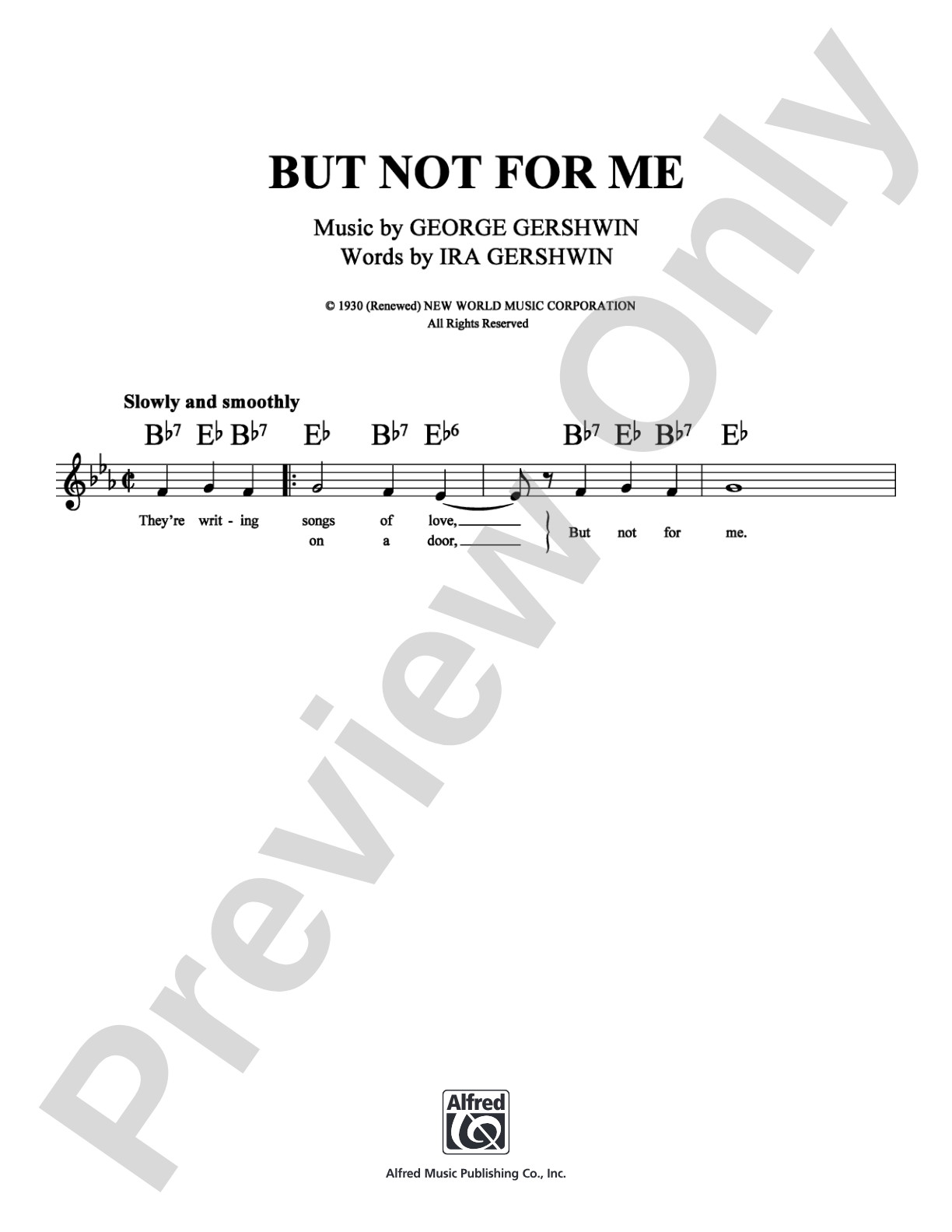
But Not For Me: Lead Sheet Digital Sheet Music

But Not For Me: Lead Sheet Digital Sheet Music

George Gershwin, Harry James, Judy Garland, Ginger Rogers

Item: 00-PS-0008598

Digital Download
$1.99
Description

But Not For Me: Lead Sheet Digital Sheet Music isn't in MakeMusic Cloud just yet...but it could be. Let us know you'd like to see it, and you'll help shape what comes next. In the meantime, start a free trial and dive into thousands of interactive titles your students can play along with today.

Sample Audio
No sample audio found.
Sample Video
Additional Details
SKU: 00-PS-0008598

More about this title

About the Artist: Judy Garland

Judy Garland (1922-1969) remains one of the most influential vocalists in American popular music. Her ability to convey emotional depth through phrasing and her instantly recognizable instrument made her a defining voice of the Golden Age of Hollywood and beyond.

Garland's interpretations of standards continue to serve as models for singers learning jazz vocabulary, lyrical storytelling, and how to inhabit a song with conviction. Her recordings demonstrate the power of balancing technical control with raw emotional authenticity.

Why we love this

This is a song that rewards close listening to Garland's phrasing choices and her emotional arc through the lyric. Singers get to study how a master vocalist shapes a deceptively simple melody into something deeply personal, making it an essential reference recording for understanding how standards should breathe.

What to expect

Wistful and composed. The melody has a conversational quality, like someone thinking out loud, balanced against harmonies that acknowledge deeper disappointment. It's introspective without wallowing.

Who it's for

Jazz vocalists and singers studying standards will find this lead sheet essential for learning the melody, harmony, and chord changes. Pianists and instrumentalists preparing to accompany singers also benefit from having this chart to understand the tune's structure and harmonic movement.

How to get the most out of it

  • Study how the melody sits in relation to the harmonic rhythm. The lead sheet reveals moments where the melody lands on extensions or suspensions, which is where the emotional weight of the song lives.
  • Pay attention to the lyrical content in performance. The song's bittersweet quality depends on singers understanding the resignation and hope embedded in the text.
  • Reference recordings of this standard by multiple artists to hear different interpretive choices. Each approach reveals something new about the tune's flexibility.
  • Consider the vocal range and tessitura for your singer. This tune sits in a specific place, and transposition decisions will affect how the story lands.

How to use it

Include this in a jazz standards recital or a program exploring the Great American Songbook. It pairs well with other Gershwin standards and works as a centerpiece for a set focused on introspection and emotional maturity in repertoire.

Skills your students will build

  • Interpreting swing-era harmonic language and jazz chord substitutions
  • Phrasing over a jazz chord progression with expression and control
  • Understanding melodic shape and how to shape a phrase across bar lines
  • Reading lead sheet notation and chord symbols

You May Also Like