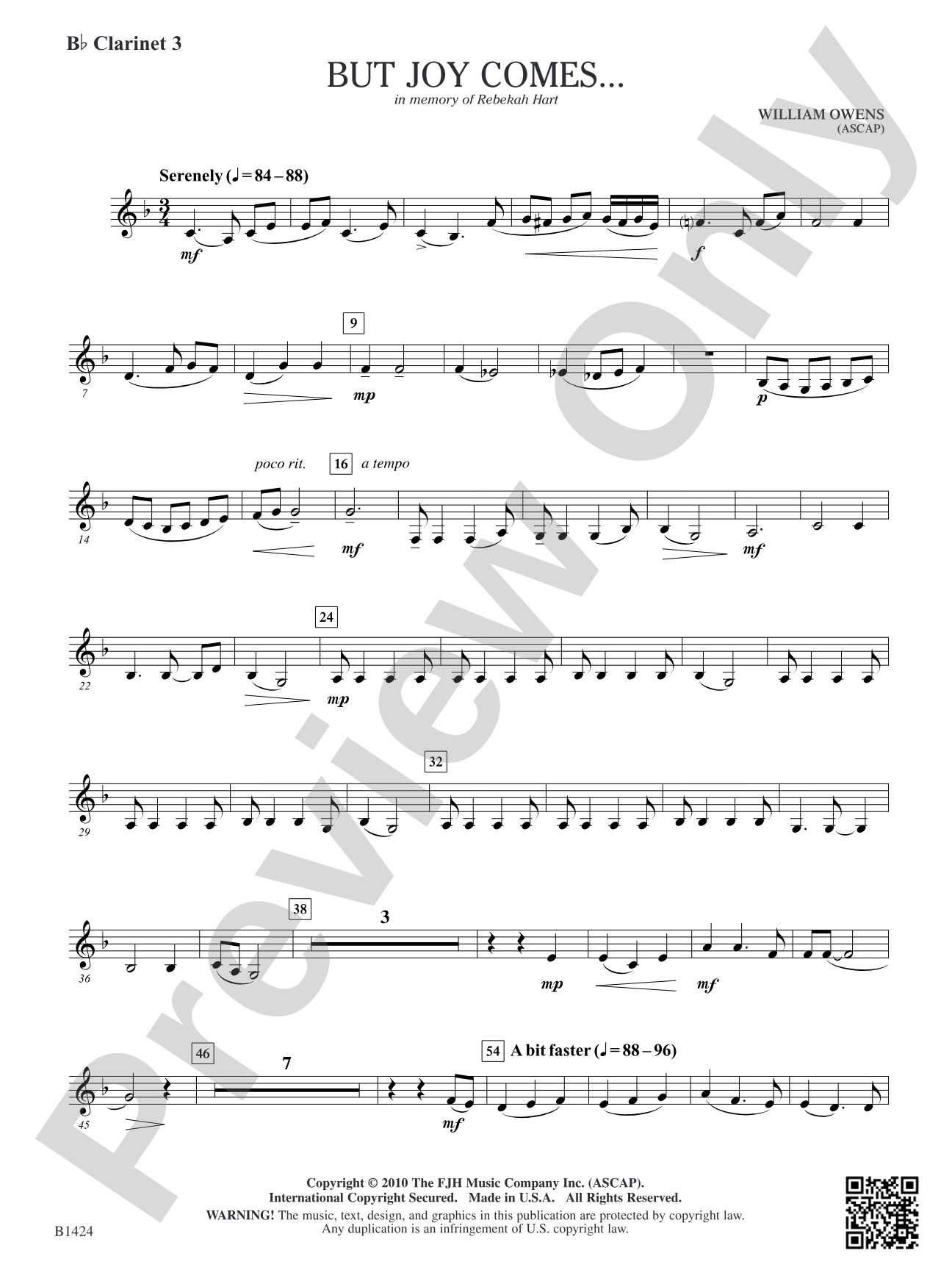
But Joy Comes...: B-flat Clarinet 3 Sheet Music Preview

But Joy Comes...: B-flat Clarinet 3

By William Owens

Grade: 3

Item: 98-PC-DB1424_C3

Digital Download
$7.00
Description
...Weeping may endure for a night, but joy comes in the morning. This beautiful verse is the center of this haunting work dedicated to a vibrant young lady whose life ended all too soon. While not technically difficult, the potential for musical expression and maturity is vast. Very captivating!

But Joy Comes...: B-flat Clarinet 3 isn't in MakeMusic Cloud just yet...but it could be. Let us know you'd like to see it, and you'll help shape what comes next. In the meantime, start a free trial and dive into thousands of interactive titles your students can play along with today.

Sample Audio
0:00
0:00
Sample Video
Additional Details
Series: FJH Concert Band
Publisher: The FJH Music Company, Inc.
SKU: 98-PC-DB1424_C3

More about this title

About the Composer: William Owens

William Owens

William Owens has spent three decades shaping young musicians as a band director in Texas while building an extraordinary catalog of over 300 compositions. Born in Gary, Indiana in 1963, he graduated from VanderCook College of Music and has since become a fixture on festival and contest lists across North America, recognized by ASCAP, the Texas Bandmasters Association, and his alma mater as a Distinguished Alumnus.

Owens approaches composition for developing ensembles with a pragmatic intelligence that balances accessibility with genuine musical substance. His works appear regularly in educational texts and on state required music lists, a testament to his understanding of what young bands need to play and what conductors need to teach. He now resides in Fort Worth with his wife Georgia, dividing his time between composition, conducting clinics, and his passion for American history and classic automobiles.

Why we love this

Owens crafts something rare here: a piece that sits comfortably within the technical reach of a Grade 3 band while demanding serious interpretive maturity from your musicians. The dedication and musical substance elevate it beyond standard contest fare, giving your group the chance to explore genuine emotional depth without wrestling with virtuosic demands.

What to expect

The piece inhabits a contemplative, vulnerable space. There is sorrow here, but also reconciliation and the emergence of light. The harmonic language feels modern and thoughtful, the orchestration transparent enough that young players can hear themselves within the larger sound.

Who it's for

Grade 3 concert bands preparing for festival or contest programming who want something with real artistic substance. Directors seeking a vehicle for teaching musical maturity and emotional expression without placing unreasonable technical demands on their students.

How to get the most out of it

  • Allow space and silence to breathe throughout the work. Young musicians often rush during moments of repose, and restraint is what creates the haunting quality Owens intended.
  • Balance ensemble sonorities carefully, especially when the main melodic lines move between sections. Clarity serves the text and emotional arc better than a thick, blended sound.
  • Shape the work's arch deliberately across its entire length. Identify the structural turning points and plan your dynamic approach well before rehearsal begins.
  • Attend to intonation with particular care during sustained harmonic passages. Owens's harmonic language benefits from precision that lesser tuning will undermine.

How to use it

This works beautifully as an anchor for a concert exploring resilience, faith, or transformation. Pair it with contrasting works to show emotional range, or program it as the final piece of an evening to leave listeners in a place of quiet reflection and hope.

Skills your students will build

  • Sustaining long tones with consistent intonation and tone quality
  • Shaping musical phrases with direction and intention rather than mechanical phrasing
  • Listening critically to ensemble balance and blend
  • Understanding harmonic function through careful listening and tuning adjustments
  • Connecting textual meaning to musical interpretation

You May Also Like