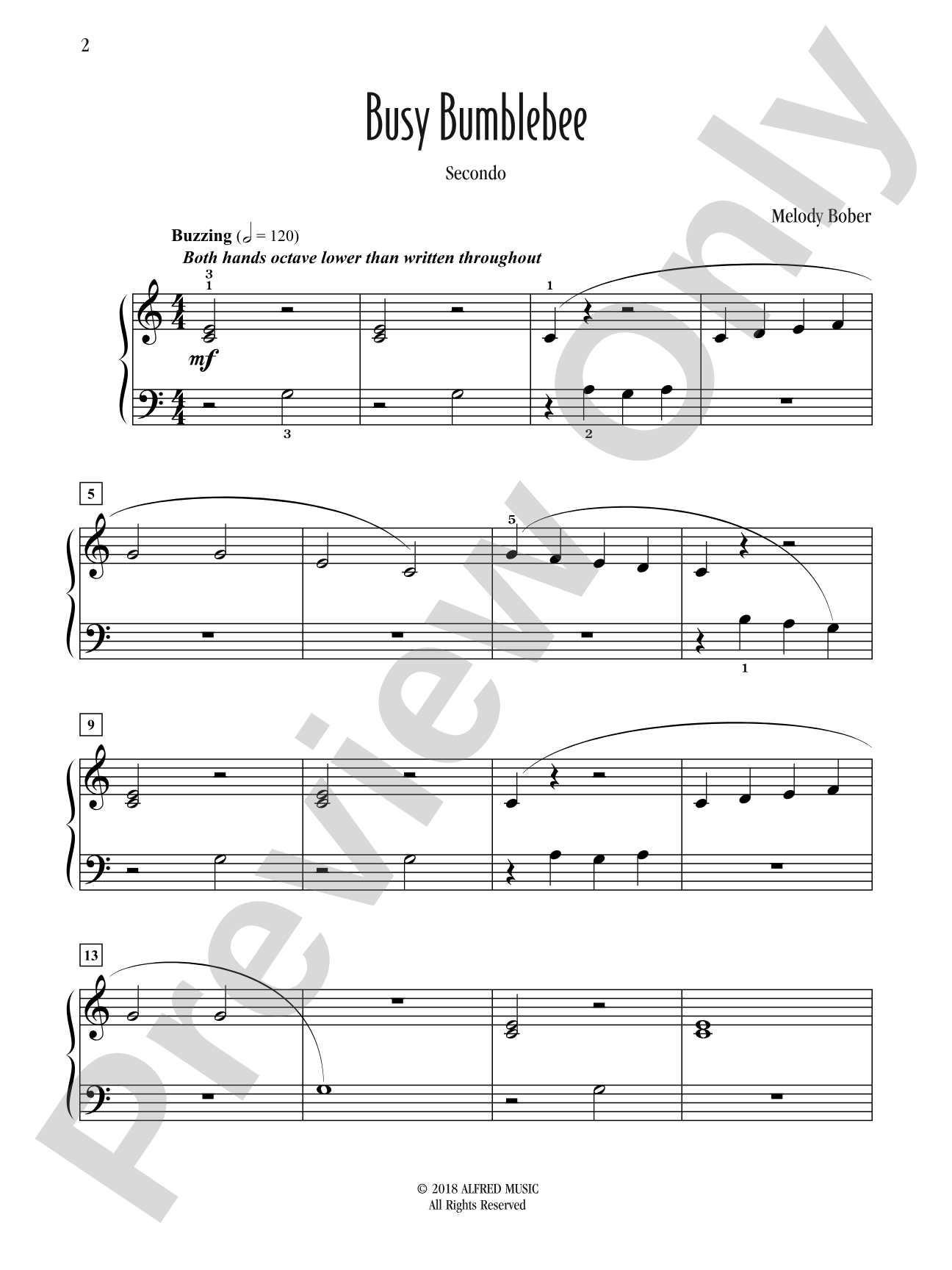
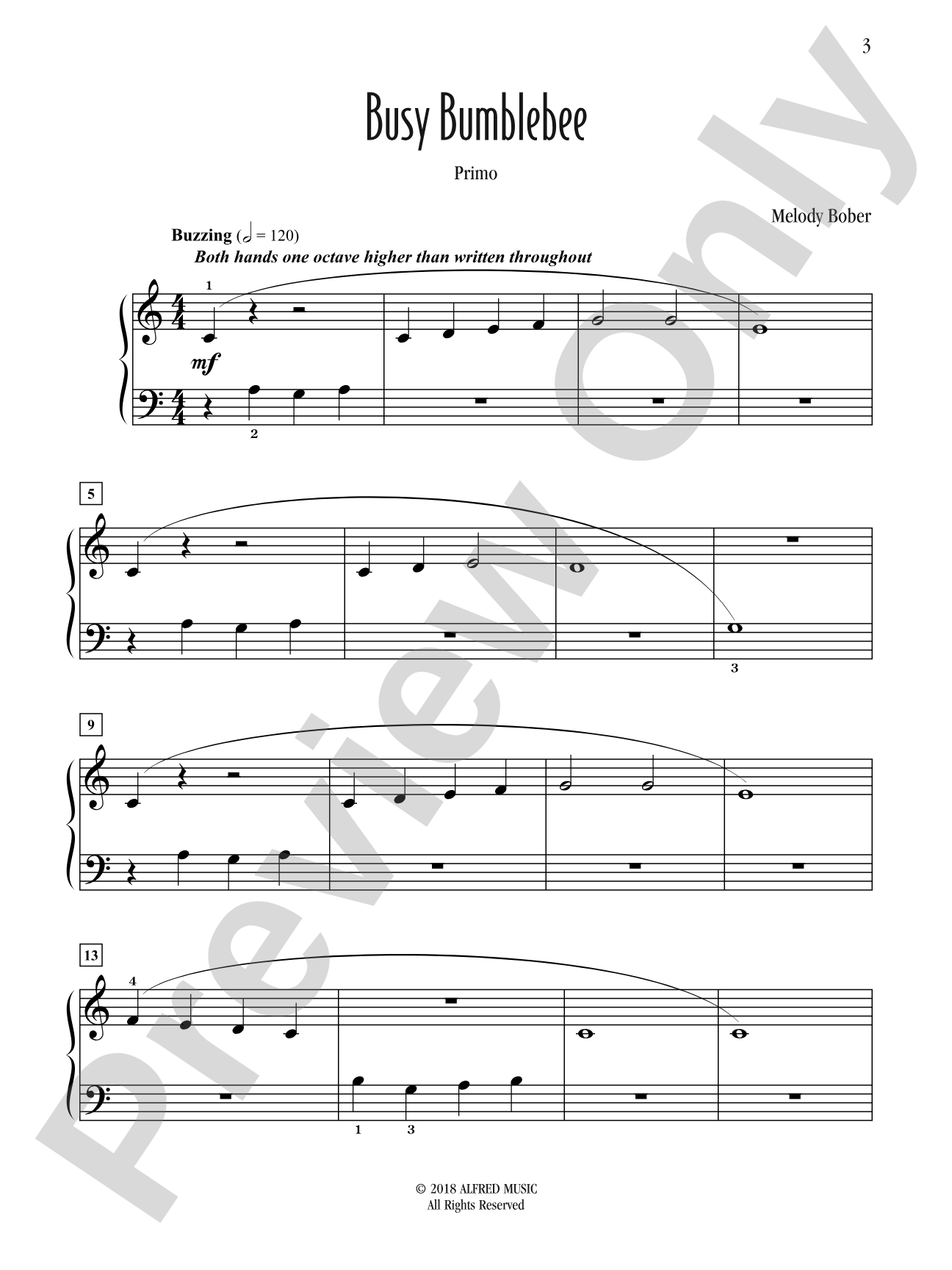
Busy Bumblebee Sheet Music Preview

Busy Bumblebee: Piano

By Melody Bober

Level: Elementary

Item: 00-PS-0016042

Digital Download
$4.99
Description
The melodic line of Busy Bumblebee is traded back and forth between the secondo and primo parts much like a canon. The lively tempo will give the feeling of two beats per measure even though the time signature is 4/4. A minimal amount of hands-together chordal playing is required in the middle section. Students at the elementary level will sound impressive when the piece is played up to tempo. A Federation Festivals 2020-2024 selection.

Busy Bumblebee: Piano isn't in MakeMusic Cloud just yet...but it could be. Let us know you'd like to see it, and you'll help shape what comes next. In the meantime, start a free trial and dive into thousands of interactive titles your students can play along with today.

Sample Audio
No sample audio found.
Sample Video
Additional Details
Series: The Alfred Duet Series
Publisher: Alfred Music
Page Count: 8
SKU: 00-PS-0016042

More about this title

About the Composer: Melody Bober

Melody Bober

Melody Bober holds degrees in music education from the University of Illinois at Champaign-Urbana and in piano performance from Minnesota State University, Moorhead. Her training under pianists Joel Shapiro and Andrew Froelich, alongside music educator Mary Hoffman and jazz instructor Tony Caramia, shaped her approach to composition and pedagogy.

Bober brings two decades of public school teaching, university-level instruction, and active studio teaching to her work as a composer. She serves as a church pianist and former music director, and her reputation as both clinician and composer has made her a sought-after presenter at piano teacher conventions and workshops throughout North America. Her compositions reflect her commitment to writing music that builds students' musicianship while deepening their engagement with the instrument.

Why we love this

The canonic exchange of melody between primo and secondo creates genuine musical conversation without requiring synchronized technical demands on both players. A piece at this level rarely delivers the payoff that comes from playing this at tempo; the lively pulse makes elementary pianists feel like accomplished musicians, which sustains their motivation through the work needed to get there.

What to expect

Quick, buoyant, and playful. The trade-off of melody between parts creates constant forward motion, while the brisk pulse gives the impression of perpetual motion without requiring virtuosic finger work. There's a moment of spacious calm when hands play together in the middle section before the energy returns.

Who it's for

Elementary-level piano students preparing for recital or festival performance. The duet format works well for studio partnerships or early experiences with ensemble playing, where both players operate at similar technical levels.

How to get the most out of it

  • Establish the lively tempo before the first run-through. The 4/4 time signature will feel like cut time when played up to speed, so practice at performance tempo from the beginning rather than gradually building it.
  • Balance the melodic exchanges so listeners can follow the dialogue between parts. If one player dominates dynamically, the canonic effect disappears.
  • Approach the hands-together chordal section in the middle as a textural contrast. Clarity matters more than loudness; let those measures breathe before the melody returns.

How to use it

Pair this with other duets or ensemble pieces to showcase students' readiness for collaborative playing. Its lighthearted character and impressive sound-to-difficulty ratio make it an ideal closer for a recital or a strong selection for festival competition within the elementary division.

Skills your students will build

  • Playing at a consistent brisk tempo without rushing
  • Balancing melody and accompaniment between two independent parts
  • Executing hands-together chord voicings in a four-hand duet context
  • Listening actively to a partner's part to maintain rhythmic cohesion
  • Sustaining musical phrasing across canonic exchanges

You May Also Like