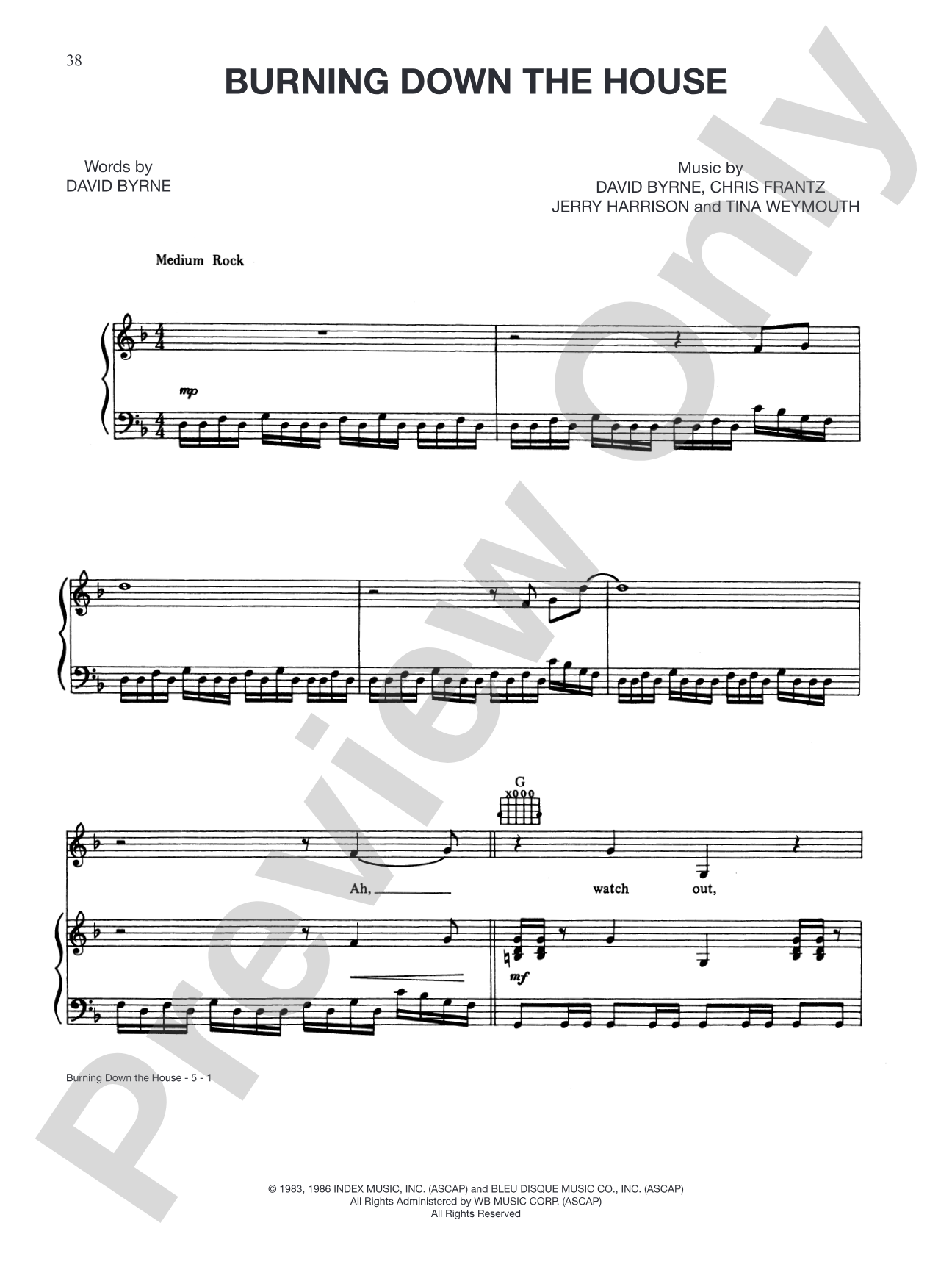
Burning Down the House Sheet Music Preview

Burning Down the House: Piano/Vocal/Chords

Item: 00-PS-0010857

Digital Download
$3.99

One moment…

Description
Each songbook in the Big Book series provides musicians of all ability levels with a big list---usually 40 or more titles per book---of the very best songs from a favorite musical genre.

This Big Book title includes a total of 46 of the best rock songs of our time. Songs include After Midnight (Eric Clapton) * Chasing Cars (Snow Patrol) * Have a Nice Day (Bon Jovi) * Hotel California (Eagles) * It's Been Awhile (Staind) * Losing My Religion (R.E.M.) * Owner of a Lonely Heart (Yes) * Soak Up the Sun (Sheryl Crow) * Talk (Coldplay) * Wish You Were Here (Pink Floyd) * and many more.

Burning Down the House: Piano/Vocal/Chords isn't in MakeMusic Cloud just yet...but it could be. Let us know you'd like to see it, and you'll help shape what comes next. In the meantime, start a free trial and dive into thousands of interactive titles your students can play along with today.

Sample Audio
No sample audio found.
Sample Video
Additional Details
Series: The Big Book Series
Publisher: Alfred Music
Page Count: 256
SKU: 00-PS-0010857

More about this title

About the Composer: David Byrne

David Byrne, best known as the founder and frontman of Talking Heads, brought art school intellectualism and restless innovation to rock music starting in the mid-1970s. His influence extends far beyond his own prolific output; his approach to songwriting, arrangement, and performance has shaped how musicians think about integrating rhythmic complexity, unconventional song structures, and theatrical presentation into popular music.

As a composer and bandleader, Byrne demonstrated that rock could be cerebral without sacrificing emotional impact or groove. His work continues to serve as a model for musicians seeking to expand what rock music can express and contain.

Why we love this

This collection draws from four decades of rock's most singable, guitar-driven hits, giving singers and pianists immediate access to songs that audiences genuinely want to hear. The range spans stadium anthems, intimate ballads, and mid-tempo rockers, so you can program generously across one recital or build a mixed setlist that sustains energy without becoming exhausting.

What to expect

Familiar and substantial. These 46 songs have earned their place through repeated airplay and genuine emotional resonance; you'll find yourself playing arrangements that feel both comforting and alive. The mix of power ballads, rhythmically propulsive rock, and introspective indie-inflected tracks creates a collection that can shift mood and energy while maintaining its essential rock character throughout.

Who it's for

Singers and pianist-vocalists preparing material for coffeehouses, open mics, auditions, or informal performance. The collection works equally well for pianists accompanying singers in duet or for solo performers who want to expand their repertoire with proven hits that connect immediately with listeners.

How to get the most out of it

  • Match your vocal approach to the recording's tone. Some of these songs (Clapton, Pink Floyd) thrive on restraint and space; others (Bon Jovi, Sheryl Crow) benefit from confident projection and attitude.
  • Pay attention to the chord chart voicings rather than defaulting to root position. Rock piano often sits higher in the mix, and the printed voicings reflect how these songs actually sound on record.
  • Lock the rhythm with the bass line, even when playing solo. These songs are built on groove, and your left hand should commit to the pulse rather than drifting into accompaniment patterns.
  • Use the vocal melody as your guide for phrasing, not a rigid boundary. Rock interpretation rewards bending phrases slightly ahead or behind the beat to match the emotional temperature of the lyric.

How to use it

Program this as the foundation of a rock-themed recital, pairing selections to tell a narrative arc (opening with something high-energy, moving through introspection, closing with a crowd favorite). Individual songs also slot well into mixed programs where you want to acknowledge popular music without abandoning craft; a single Coldplay or R.E.M. track can stand beside classical or jazz repertoire.

Skills your students will build

  • Reading chord charts and interpreting voicing variations in popular music notation
  • Balancing vocal line with accompaniment texture without losing rhythmic pocket
  • Adapting recorded arrangements to solo voice and piano without losing the song's character
  • Maintaining steady groove and pulse across varied rhythmic patterns and syncopation
  • Phrasing decisions informed by lyrical content and emotional arc within a song

You May Also Like