Burgmüller: Twenty-five Easy Etudes, Op. 100 Sheet Music Preview

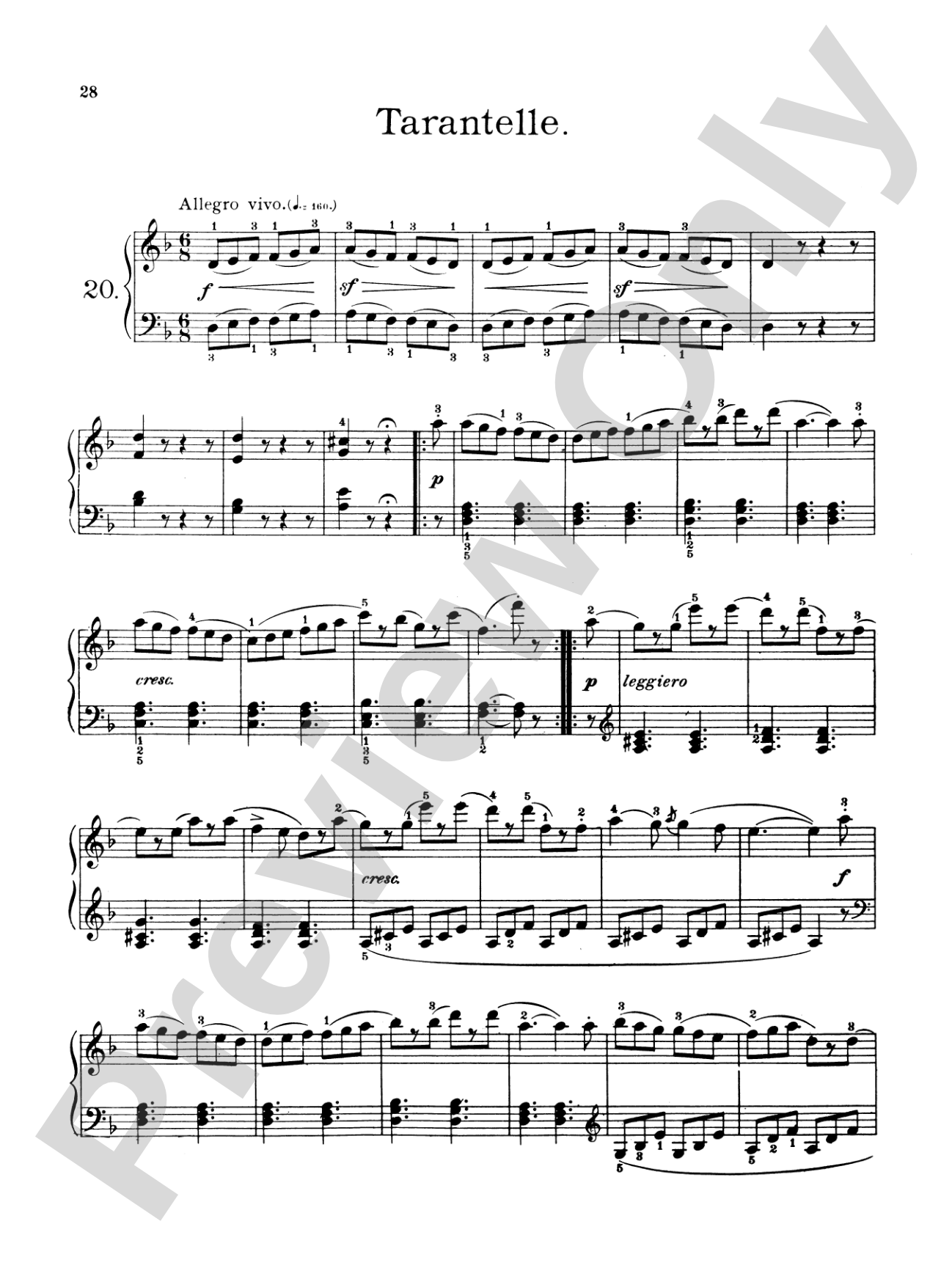
Burgmüller: Twenty-five Easy Etudes, Op. 100

By Johann Friedrich Burgmüller

Item: 00-PC-0005815

Digital Download
$0.99
Description
Friedrich Burgmüller, (1806--1874) was a German pianist and composer. This set of 25 progressive studies is an excellent source of short technical pieces for students. More demanding pieces are the 18 Characteristic Studies, Op. 109, and the 12 pieces of Op. 105 are even more demanding. Includes: La Candeur * Arabesque * Pastorale * Petite Reunion * Innocence * Progress * Courant Limpide * La Gracieuse * La Chasse * Tendre Fleur * La Bergeronnette * Adieu * Consolation * Styrienne * Ballade * Douce Plainte * Babillarde * Inquietude * Ave Maria * Tarantelle * Harmonie des Anges * Barcarolle * Retour * L' Hirondelle * La Chevaleresque.

Don't just read it, hear it, play along with it, and watch your students grow with it. In MakeMusic Cloud, Burgmüller: Twenty-five Easy Etudes, Op. 100 comes alive with professional accompaniment, adjustable tempo, and built-in practice tools that turn solo practice into real progress.

Sample Audio
No sample audio found.
Sample Video
Additional Details
Series: Kalmus Edition
Publisher: Alfred Music
Page Count: 40
SKU: 00-PC-0005815

More about this title

About the Composer: Johann Burgmüller

Johann Friedrich Franz Burgmüller (1806–1874) was a German pianist and composer who spent much of his career in Paris, where he became a respected teacher and salon musician. His pedagogical works earned him a lasting place in piano education; he understood what intermediate students needed to advance technically without overwhelming them musically.

Why we love this

These 25 etudes strike the rare balance between genuine musicality and clear technical purpose. Each piece has character enough to hold a student's interest while targeting specific skills, which means students practice willingly rather than viewing these as pure mechanics. The collection's steady progression also lets you assign pieces strategically throughout the year without hunting through multiple books.

What to expect

These pieces evoke the genteel salon world of 19th-century Europe. Melodies are graceful and singable, accompaniments are logical and transparent, and the overall character hovers between pastoral charm and understated virtuosity. There is nothing bombastic here; instead, each piece whispers rather than shouts its technical purpose.

Who it's for

Intermediate piano students roughly three to five years into study who are developing consistent hand independence and can manage moderate technical demands. Teachers seeking short, focused pieces that address specific skills (scalar work, broken chords, hand coordination, trill figures) without requiring students to memorize long-form structures will find this collection invaluable for lesson planning and home practice assignments.

How to get the most out of it

  • Map the hand shape and position shifts before drilling the passage work; most technical challenges come from awkward transitions between registers rather than speed itself.
  • Attend to the title of each piece as a guide to character and tempo: La Candeur asks for simplicity and directness, while Tarantelle demands rhythmic precision and drive.
  • Record yourself playing through a full etude at the target tempo, then listen back for uneven phrasing or dynamic neglect; many students rush through these pieces treating them as studies only, missing their expressive potential.
  • Practice the piece hands separately at a tempo that allows articulation clarity, then unite hands only once each hand knows its line independently.

How to use it

Assign individual etudes as students reach corresponding technical milestones rather than working through them as a single recital. A student might perform La Candeur or Arabesque early in a student recital as a warm piece, then return to pieces like Tarantelle or La Chevaleresque later in the year once strength and confidence have built. These also pair well in a program designed around pedagogical repertoire or Romantic piano literature.

Skills your students will build

  • Scalar passage work and hand position shifts across the keyboard
  • Broken chord patterns and arpeggiation
  • Hand independence between melody and accompaniment
  • Rhythmic clarity in dance-like forms (tarantelle, barcarolle, styrienne)
  • Trill execution and ornamental figures
  • Dynamic shaping and phrasing within short musical forms
  • Pedal control for resonance without muddiness

You May Also Like