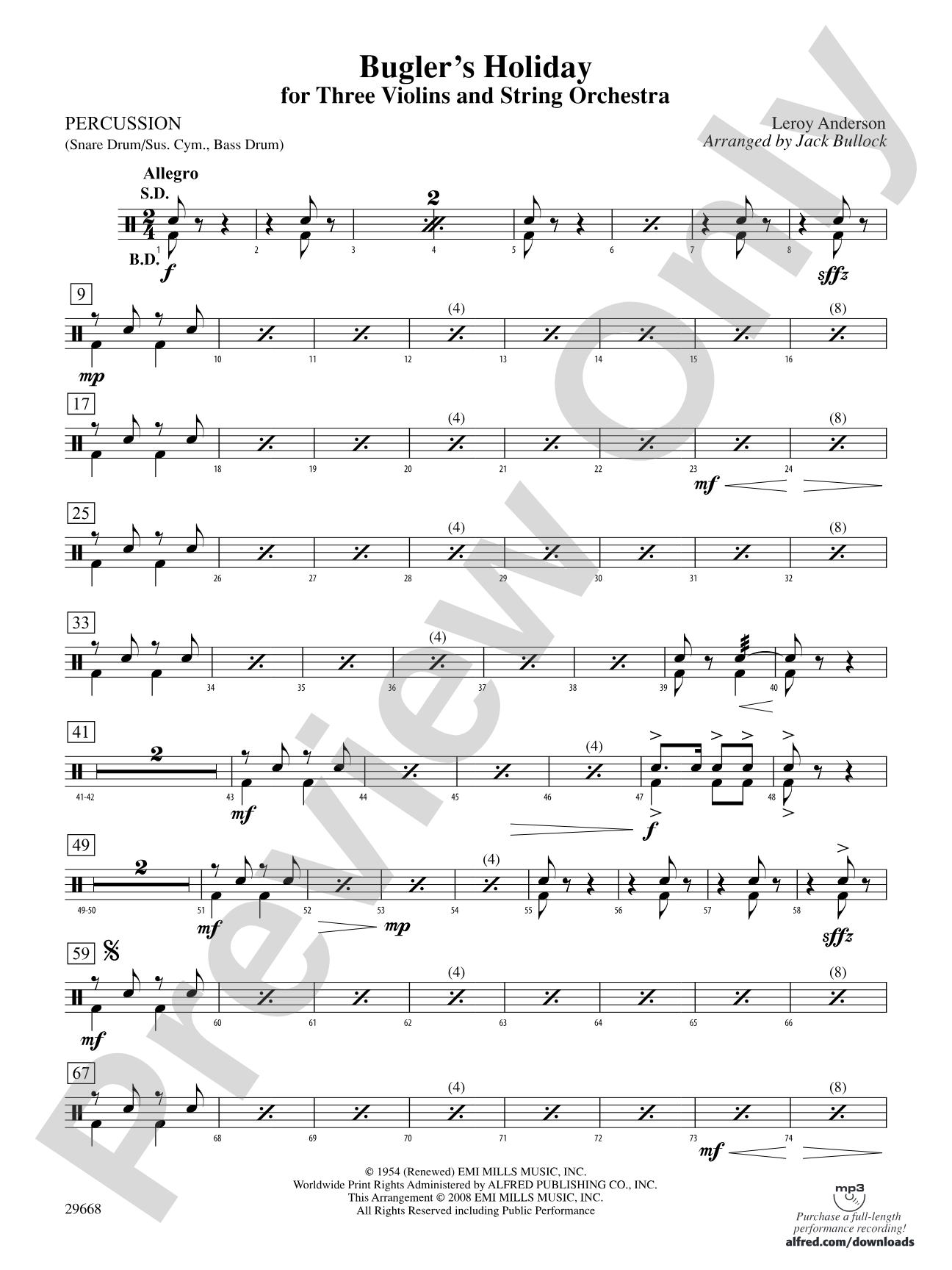
Bugler's Holiday for Three Violins and String Orchestra: 1st Percussion Sheet Music Preview

Bugler's Holiday for Three Violins and String Orchestra: 1st Percussion

By Leroy Anderson / arr. Jack Bullock

Grade: 3

Item: 00-PC-0001543_PC1

Digital Download
$5.99
Description
What a treat to have the famous "Bugler's Holiday" for Trumpet Trio and Orchestra arranged for three violins and strings! A fabulous setting of a Leroy Anderson classic and a great way to feature the violins in a wonderfully accessible solo. (3:20) This title is available in MakeMusic Cloud.

Don't just read it, hear it, play along with it, and watch your students grow with it. In MakeMusic Cloud, Bugler's Holiday for Three Violins and String Orchestra: 1st Percussion comes alive with professional accompaniment, adjustable tempo, and built-in practice tools that turn solo practice into real progress.

Sample Audio
0:00
0:00
Sample Video
Additional Details
Series: Pop Intermediate String Orchestra
Publisher: Alfred Music
Page Count: 168
SKU: 00-PC-0001543_PC1

More about this title

About the Composer: Leroy Anderson

Leroy Anderson (1908-1975) composed over 140 works during his career, establishing himself as a master of light orchestral music with wit, sophistication, and impeccable harmonic craft. His pieces, which include "Plink, Plank, Plunk!" and "Sleigh Ride," balance accessibility with genuine musical substance, making them staples in educational and professional orchestras alike. Anderson's gift for memorable melody and orchestration that sounds more complex than it is has secured his place as one of America's most performed composers.

Why we love this

Anderson's original "Bugler's Holiday" is a concert favorite, and this string arrangement opens the piece to orchestras without trumpet specialists while keeping the jaunty energy and melodic appeal completely intact. Jack Bullock's arrangement captures the work's infectious character and ensures violinists get genuine solo responsibility without overwhelming Grade 3 ensembles. The piece delivers concert-hall polish in under three and a half minutes, making it ideal for mixed-level programs where you need impact without extensive rehearsal demands.

What to expect

Brightly comedic and parade-like, with the buoyant character of a military march transformed into something playful and charming. The writing sparkles with Anderson's trademark orchestral clarity, creating an atmosphere of good humor and lighthearted celebration that audiences instinctively enjoy.

Who it's for

Conductors seeking a crowd-pleasing concert piece that showcases violins and works well for Grade 3 string orchestras, especially those without strong trumpet sections. This arrangement is equally suited to school orchestras, youth orchestras, and community ensembles looking for repertoire that sounds polished without requiring advanced technical demands.

How to get the most out of it

  • Shape the first violin melody with clear phrasing at phrase boundaries; the bugle-call character comes through best when lines breathe naturally rather than push through to bar lines.
  • Establish rhythmic precision early, especially in the pizzicato and light articulation passages, since the piece's humor depends on crisp rhythmic clarity.
  • Balance the three soloists carefully during section features; bring the first violin slightly forward while keeping the second and third violins from receding into the accompaniment.
  • Honor the light, marchlike accompaniment by keeping the lower strings transparent; this isn't a heavy piece, and dense backing will obscure the melodic wit.

How to use it

Program this as an opener or a bridge between heavier works, where its three-minute length and cheerful character provide relief and forward momentum. It pairs especially well in concerts mixing classical standards with lighter fare, or as a feature piece in a concert celebrating American light music or violin virtuosity.

Skills your students will build

  • Executing buoyant, articulated marchlike rhythms with precision
  • Playing sustained melody with clear phrasing and shape
  • Balancing between solo and accompaniment roles within the violin section
  • Reading standard orchestral textures with multiple violin parts
  • Maintaining transparent, light articulation in pizzicato passages

You May Also Like