
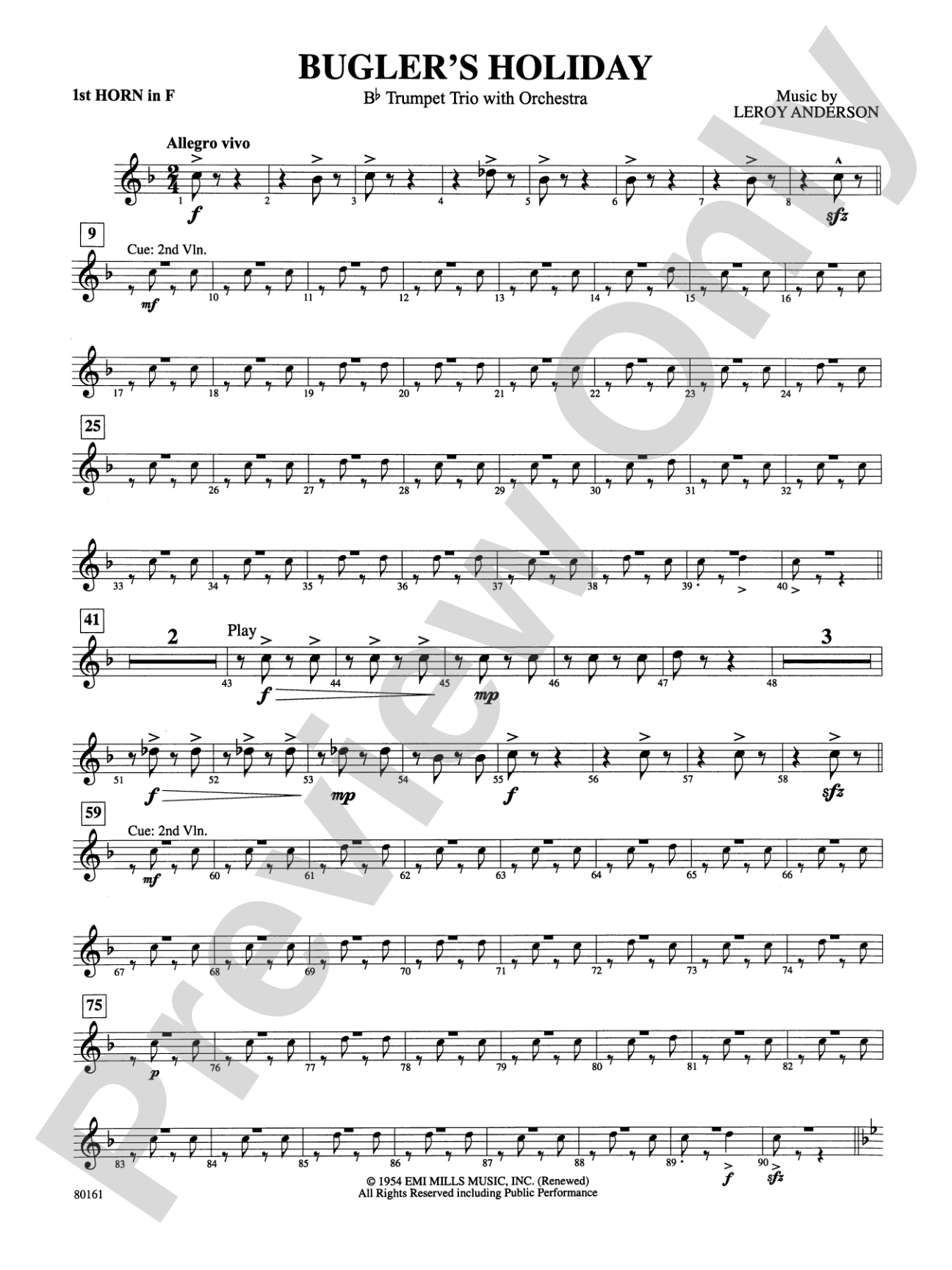

Bugler's Holiday: 1st F Horn
Trumpet Section Feature
By Leroy Anderson
Grade: 3.5
Item: 00-PC-0001932_H1
$3.00
Pickup currently not available
Description
Probably the best-known trumpet trio of all time! Every trumpeter should experience the thrill of playing this piece and the original is playable by most school orchestras. Newly re-engraved with a full score. (2:27)


Don't just read it, hear it, play along with it, and watch your students grow with it. In MakeMusic Cloud, Bugler's Holiday: 1st F Horn comes alive with professional accompaniment, adjustable tempo, and built-in practice tools that turn solo practice into real progress.
Open in the Player
Jump straight in and assign it today.
Start Your Free Trial
Open this title and explore the full library in minutes.
Sample Audio
1
Audio File
--:--
0:00
0:00
Sample Video
No sample videos found.
Additional Details
Series:
Belwin Concert Full Orchestra
Publisher:
Alfred Music
Page Count:
144
SKU:
00-PC-0001932_H1
More about this title
About the Composer: Leroy Anderson
Leroy Anderson (1908-1975) was an American composer and conductor who became famous for his light orchestral works that bridged classical and popular music. His gift for memorable melodies, orchestration wit, and rhythmic sophistication made him one of the most recorded composers of the mid-20th century, with pieces like "Plink, Plank, Plunk!" and "Sleigh Ride" becoming standards in school and concert orchestras.
Anderson studied composition at Harvard and later served as assistant conductor of the Boston Pops under Arthur Fiedler. His work for orchestra was prolific and accessible without being simplistic; he understood how to write for student musicians and professional ensembles alike, creating music that entertained audiences while respecting the craft of orchestration.
Why we love this
This is the piece that defines the trumpet trio moment in concert programming. Anderson's writing for three trumpets is so idiomatic and rewarding that it transcends novelty; the dialogue between the parts, the buoyant rhythmic drive, and the orchestral support create a genuine showcase rather than a gimmick. Conductors program it because audiences light up, student orchestras sound polished and energized, and the three trumpet soloists walk off stage knowing they've nailed something quintessentially musical.
What to expect
Buoyant and witty, with the cheerful swagger of a military march reimagined as urbane entertainment. The opening declares itself with confidence; the trumpet trio exchanges brisk, friendly commentary while the orchestra provides colorful support. There's a sense of refined playfulness throughout, with Anderson's orchestral touches (pizzicato strings, subtle woodwind interjections) creating layers of humor and sophistication beneath the surface charm.
Who it's for
This score and parts set is essential for conductors leading school orchestras at the intermediate level and above who want to program a piece that guarantees engagement from both performers and audiences. It works equally well for community orchestras and advanced high school groups seeking a contest or festival piece with immediate appeal.
How to get the most out of it
- Balance the three trumpet parts carefully during the opening announcement and dialogue sections. The uppermost voice should sit slightly forward without overwhelming the inner lines, which carry harmonic color.
- Lock the rhythmic precision of the full orchestra to the tempo of the trumpet parts. Anderson's light swing feel depends on the ensemble moving as one unit, especially in the syncopated passages.
- Coach the trumpet soloists to shape their lines with vocal phrasing rather than mechanical articulation. This piece lives or dies on elegance and character, not just accuracy.
- Use the full orchestral texture as a springboard for the trio episodes. The sections featuring strings and woodwinds should feel like musical conversation partners, not accompaniment filler.
How to use it
Program this in the second half of a concert to lift energy after a serious work, or open a lighter portion of the program where it can stand as a showcase piece on its own. It pairs naturally with other Anderson compositions or with American light concert repertoire. The compact length (2:27) makes it an ideal festival selection or a featured moment in an all-concert program.
Skills your students will build
- Intonation and balance in small ensemble (trumpet trio) within full orchestral context
- Rhythmic precision in syncopated passages and light swing idioms
- Orchestral color and texture awareness through doubling, pizzicato, and wind interjections
- Phrasing and musical characterization in a non-symphonic style
- Listening and independence as individual voices navigate dialogue with the ensemble