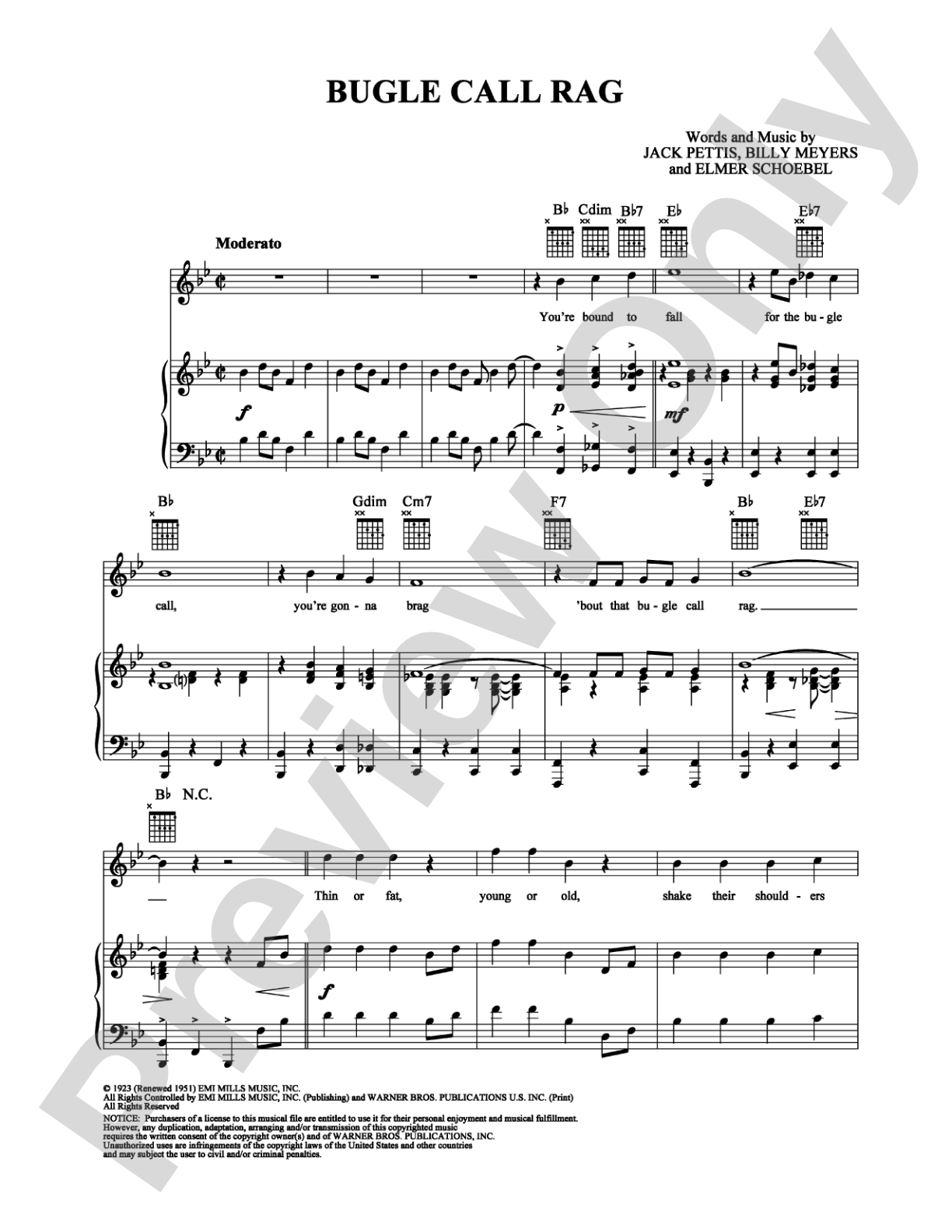
Bugle Call Rag: Piano/Vocal/Chords Digital Sheet Music

Bugle Call Rag: Piano/Vocal/Chords Digital Sheet Music

Benny Goodman, Jack Pettis, Elmer Schoebel, Bill Meyers

Item: 00-PS-0007529

Digital Download
$3.99
Description

Bugle Call Rag: Piano/Vocal/Chords Digital Sheet Music isn't in MakeMusic Cloud just yet...but it could be. Let us know you'd like to see it, and you'll help shape what comes next. In the meantime, start a free trial and dive into thousands of interactive titles your students can play along with today.

Sample Audio
No sample audio found.
Sample Video
Additional Details
SKU: 00-PS-0007529

More about this title

About the Artist: Benny Goodman

Benny Goodman (1909-1986) was a clarinetist and bandleader who defined the swing era and brought jazz into the mainstream concert hall. His clarion tone and virtuosic improvisation set the standard for the instrument, and his bands became incubators for some of the finest soloists in American music. Goodman's work spans from small-group swing to classical commissions, making him a bridge figure between popular and concert music.

In education, Goodman's legacy matters because he demonstrated that jazz musicianship requires the same technical rigor and ear training as classical playing. His arrangements and compositions remain teaching tools for understanding swing rhythms, blues changes, and the collaborative spirit of ensemble playing.

Why we love this

Bugle Call Rag captures the rhythmic vitality and melodic charm that made swing era standards so durable in performance. This digital sheet music gives pianists and singers a score that honors the idiom without requiring a full band, making it accessible for recital, studio, or classroom contexts where you want authentic swing character at a manageable instrumentation.

What to expect

Bugle Call Rag sparkles with the bounce and wit of early jazz, evoking the dancehalls and recording studios where the swing sound was born. The bugle-call figure gives the piece an almost military clarity, yet the syncopation and jazz harmonies keep everything loose and playful, balancing precision with joy.

Who it's for

This arrangement serves pianists who want to expand their jazz standards repertoire and singers preparing swing material for recital or audition. It also works for advanced students exploring the compositional techniques and rhythmic language of the 1920s-30s swing idiom.

How to get the most out of it

  • Shape the syncopated figures with clear articulation; the swing feel depends on crisp attack followed by relaxed sustain rather than even legato
  • Let the piano comping breathe in dialogue with the vocal line instead of filling every beat—space is part of the rhythm section's vocabulary
  • Lock the piano's left hand to the underlying pulse while allowing the right hand and voice to float expressively over the beat
  • Treat the bugle-call motif as the structural anchor; return to it with clarity each time so the form reads unmistakably to the listener

How to use it

Program this alongside other standards from the swing canon to create a themed recital segment on American jazz classics, or use it as a teaching piece to explore how composers drew on military and folk idioms within jazz. For singers, it pairs well with other Goodman-era standards and offers a lighter, more rhythmically driven contrast to ballads.

Skills your students will build

  • Swing rhythm and syncopation at the piano
  • Reading jazz chord symbols and comping patterns
  • Coordination between sung melody and improvised accompaniment figures
  • Phrasing across bar lines in a jazz idiom
  • Understanding song form (verse, chorus, bridge) in a standard arrangement

You May Also Like