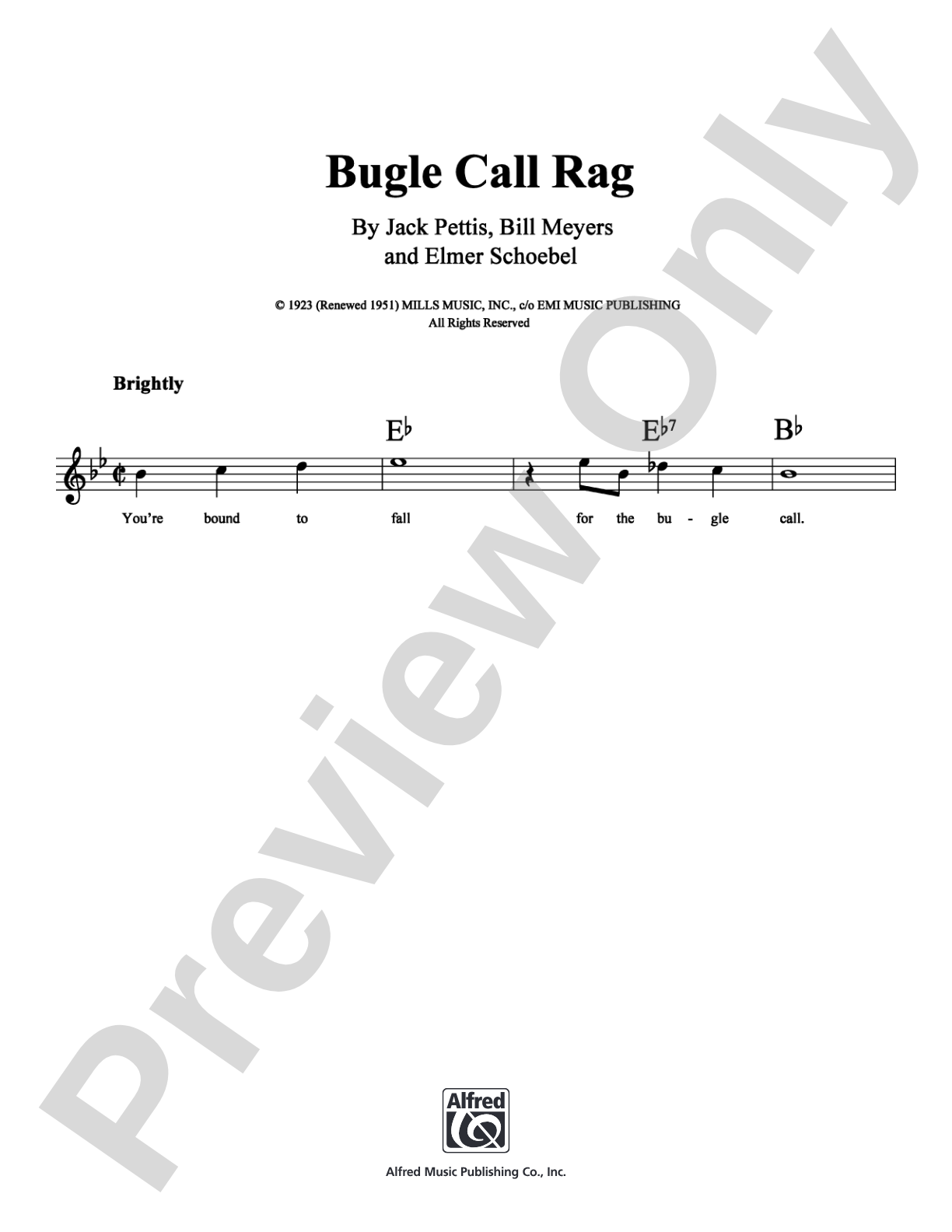
Bugle Call Rag: Lead Sheet Digital Sheet Music

Bugle Call Rag: Lead Sheet Digital Sheet Music

Benny Goodman, Jack Pettis, Elmer Schoebel, Bill Meyers

Item: 00-PS-0007528

Digital Download
$1.99
Description

Bugle Call Rag: Lead Sheet Digital Sheet Music isn't in MakeMusic Cloud just yet...but it could be. Let us know you'd like to see it, and you'll help shape what comes next. In the meantime, start a free trial and dive into thousands of interactive titles your students can play along with today.

Sample Audio
No sample audio found.
Sample Video
Additional Details
SKU: 00-PS-0007528

More about this title

About the Artist: Benny Goodman

Benny Goodman (1909-1986) earned his place in jazz history as the "King of Swing," bringing jazz into the mainstream American concert hall and radio. A clarinetist of extraordinary technical command and musical sophistication, Goodman led one of the most influential big bands of the 1930s and 1940s, and he remained active as a performer and recording artist well into his later years.

For music educators, Goodman's legacy offers a bridge between classical training and jazz idiom. His arrangements and compositions showcase how disciplined musicianship, clear phrasing, and ensemble balance create the foundation for swinging jazz performance. Teaching his work helps students understand that jazz is not improvisation without structure, but rather music that demands the same attention to intonation, articulation, and musical communication as classical repertoire.

Why we love this

Bugle Call Rag distills the energy and wit of the swing era into a piece that students can actually grasp and perform. The lead sheet format lets musicians focus on the melody and harmonic structure without getting lost in a full score, making it accessible for students learning to navigate jazz standards. It's a tune that sounds like jazz without requiring advanced improvisation skills, so pianists and hornists at intermediate levels can genuinely enjoy playing it.

What to expect

Bugle Call Rag bounces with playful momentum. The melody is bright and conversational, with the kind of rhythmic snap that makes you want to move; it feels like a sunny afternoon jam session rather than a formal recital piece. There's humor and lightness in the writing, paired with solid harmonic changes that give the tune real substance beneath its cheerful surface.

Who it's for

This lead sheet works well for jazz ensemble members, pianists preparing standards for recital or study, and students beginning to explore the jazz repertoire. It suits musicians who can read lead sheet notation and want to learn a piece of swing history that is genuinely fun to play.

How to get the most out of it

  • Shape the melody with forward motion and light articulation; this tune thrives on rhythmic clarity and bounce rather than legato phrasing.
  • Listen to Goodman's original recording to absorb the feel and tempo. The swing style is unmistakable once you hear it, and hearing the tune first makes reading the lead sheet far more intuitive.
  • Treat the lead sheet as a springboard. Once you have the melody secure, experiment with small variations in phrasing and rhythm to find your own voice within the standard.

How to use it

Program this as a featured solo in a jazz concert or casual performance setting, where its accessibility and charm shine. It pairs well with other swing-era standards in a thematic set, or you can use it as an encore piece that leaves the audience smiling.

Skills your students will build

  • Reading and interpreting lead sheet notation
  • Understanding swing articulation and rhythmic placement
  • Recognizing and performing ii-V-I chord progressions
  • Developing phrasing and melodic shaping over jazz changes
  • Building familiarity with jazz standards and their harmonic language

You May Also Like