
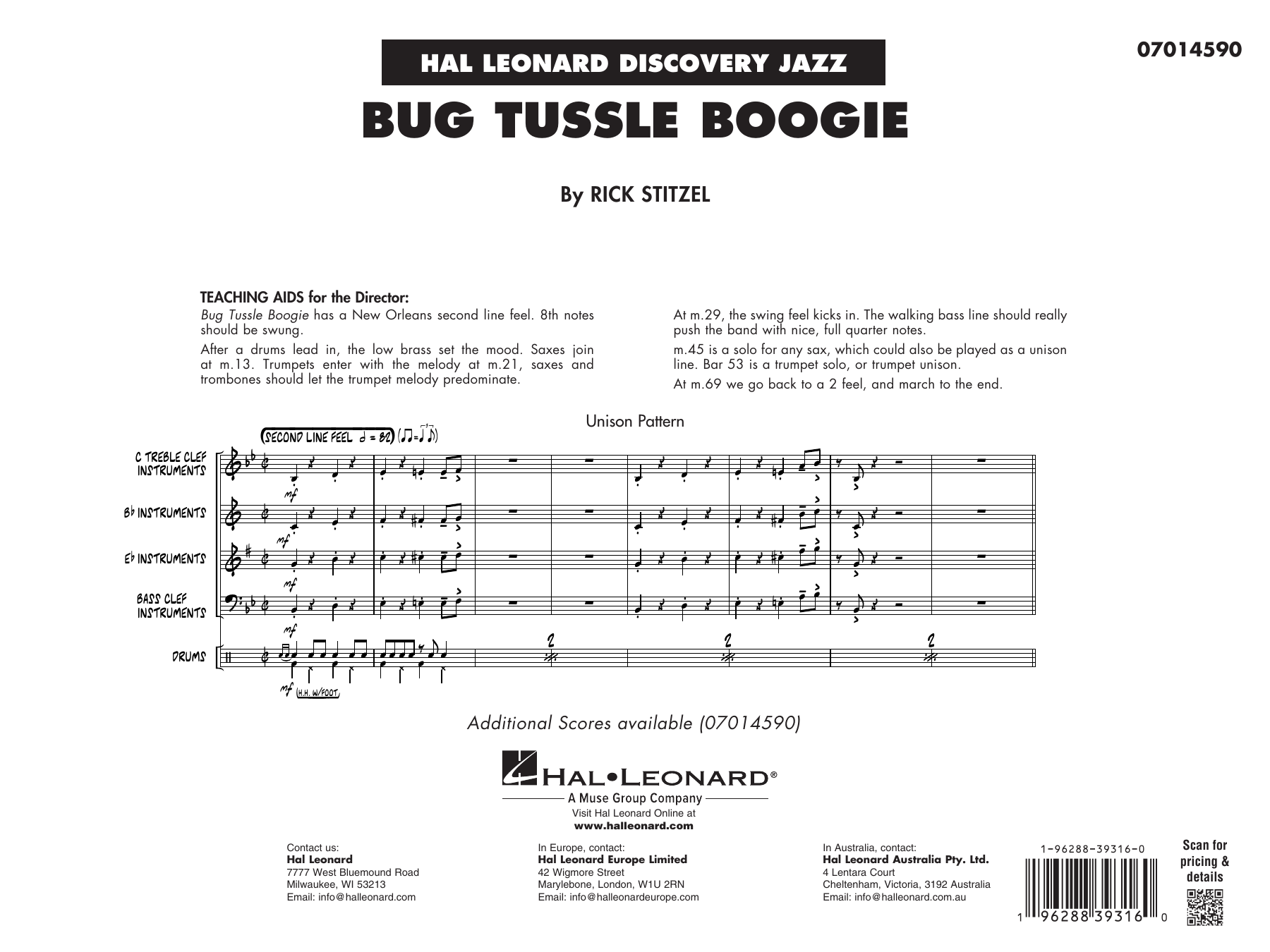

Bug Tussle Boogie: Jazz Ensemble Conductor Score & Parts
By Rick Stitzel
Grade: 1.5
Item: 35-PK01929609
$45.00
Pickup currently not available
Buy Extra Parts (Digital PDF Download)
| Product | Price | Quantity |
|---|---|---|
| Bug Tussle Boogie - Conductor Score (Full Score) | $7.50 | |
| Bug Tussle Boogie - Alto Sax 1 | $6.00 | |
| Bug Tussle Boogie - Alto Sax 2 | $6.00 | |
| Bug Tussle Boogie - Tenor Sax 1 | $6.00 | |
| Bug Tussle Boogie - Tenor Sax 2 | $6.00 | |
| Bug Tussle Boogie - Baritone Sax | $6.00 | |
| Bug Tussle Boogie - Trumpet 1 | $6.00 | |
| Bug Tussle Boogie - Trumpet 2 | $6.00 | |
| Bug Tussle Boogie - Trumpet 3 | $6.00 | |
| Bug Tussle Boogie - Trombone 1 | $6.00 | |
| Bug Tussle Boogie - Trombone 2 | $6.00 | |
| Bug Tussle Boogie - Trombone 3 | $6.00 | |
| Bug Tussle Boogie - Guitar | $6.00 | |
| Bug Tussle Boogie - Piano | $6.00 | |
| Bug Tussle Boogie - Bass | $6.00 | |
| Bug Tussle Boogie - Drums | $6.00 | |
| Bug Tussle Boogie - Flute | $6.00 | |
| Bug Tussle Boogie - Bb Clarinet 1 | $6.00 | |
| Bug Tussle Boogie - Bb Clarinet 2 | $6.00 | |
| Bug Tussle Boogie - F Horn | $6.00 | |
| Bug Tussle Boogie - Tuba | $6.00 |
Parts Added to Cart!
Description
A fun and accessible chart perfect for beginning jazz ensembles features a hip, bluesy melody set over a groove that shifts between a 2nd line, New Orleans style groove and swing. Perfectly scored for maximum playability. Open solo sections for Saxes and Trumpets.


Bug Tussle Boogie: Jazz Ensemble Conductor Score & Parts isn't in MakeMusic Cloud just yet...but it could be. Let us know you'd like to see it, and you'll help shape what comes next. In the meantime, start a free trial and dive into thousands of interactive titles your students can play along with today.
Request This Title
Tell us you want it.
Start Your Free Trial
Explore everything that's ready to play right now.
Sample Audio
No sample audio found.
Sample Video
No sample videos found.
Additional Details
Publisher:
Hal Leonard
SKU:
35-PK01929609
More about this title
About the Composer: Rick Stitzel
Rick Stitzel has built a reputation as a composer and arranger who writes with genuine understanding of what student ensembles can execute while still having fun. His work consistently balances accessibility with musical substance, ensuring that players improve without getting bogged down in unnecessary technical complexity.
Why we love this
This chart lands in that rare sweet spot where students get to play something genuinely groovy without drowning in technical demands. The writing for saxes and trumpets on the open solos gives emerging improvisers a structured playground, and the shift between 2nd line and swing feels organic rather than gimmicky. You'll hear your ensemble lock in on the groove faster than you'd expect at this level.
What to expect
The bluesy melody sits in a comfortable register where it breathes naturally. You'll feel the pull of New Orleans street rhythms giving way to classic swing architecture, like the chart is dancing between two Americas. The groove invites listeners in while giving your young players something irresistible to lock into.
Who it's for
Beginning jazz ensembles looking for a first chart that teaches groove and solo etiquette without requiring advanced improvisation skills. This works especially well for middle school programs or high school jazz bands in their opening weeks of the school year.
How to get the most out of it
- Lock the rhythm section (bass, drums, piano) into the 2nd line pocket first before bringing in the horns. The groove is the glue that holds everything together, so rehearse the comping and timekeeping separately.
- Give your solo chairs room to experiment during rehearsals before the transition to swing begins. They need to own their melodies before worrying about keeping time with the band.
- Articulation consistency among your saxes and trumpets on the written melody will make the bluesy character sing. Spend time on how notes start and stop together rather than rushing through the heads.
- When you move from 2nd line to swing, mark a clear point in the score where the feel shifts. Have your drummer underscore the moment by adjusting comping and kick drum patterns so the band hears it coming.
How to use it
Open a jazz concert or informal performance with this one. It sets a relaxed, welcoming tone and lets your audience see exactly what your ensemble is learning. It also works beautifully as a program bridge between classical and contemporary selections, signaling that your group speaks multiple musical languages.
Skills your students will build
- Understanding the rhythmic and feel differences between 2nd line and swing grooves
- Ensemble cohesion in a non-classical idiom
- Solo section negotiation with rhythmic independence
- Blues vocabulary in melody and harmonic comping
- Section coordination across saxes and trumpets with articulation and phrasing