
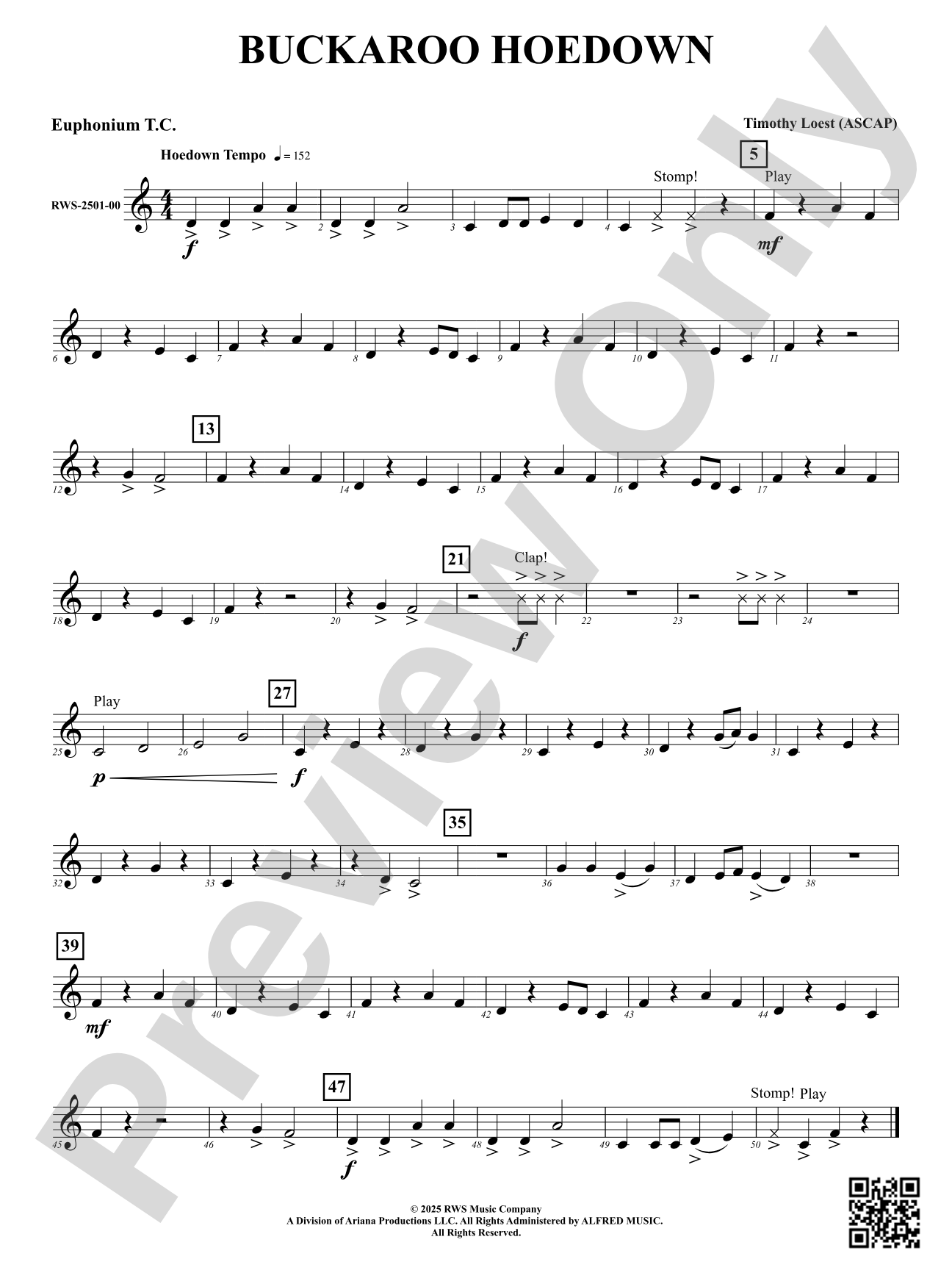

Buckaroo Hoedown: Euphonium T.C.
By Timothy Loest
Level:.5
Item: 98-PC-RWS2501_BTC1
$3.99
Pickup currently not available
Description
Experience the lively energy of a cowboy hoedown in this spirited piece by Timothy Loest using only six notes! Catchy melodies, driving rhythms, foot stomps, and cracking whips bring the Old West to life. Slapstick, vibraslap, cowbell, and temple blocks add excitement, offering a musical glimpse into the American cowboy's world. Saddle up! (1:20)


Buckaroo Hoedown: Euphonium T.C. isn't in MakeMusic Cloud just yet...but it could be. Let us know you'd like to see it, and you'll help shape what comes next. In the meantime, start a free trial and dive into thousands of interactive titles your students can play along with today.
Request This Title
Tell us you want it.
Start Your Free Trial
Explore everything that's ready to play right now.
Sample Audio
1
Audio File
--:--
0:00
0:00
Sample Video
Additional Details
Series:
RWS - Very Beginning Band
Publisher:
RWS Music Company
SKU:
98-PC-RWS2501_BTC1
More about this title
About the Composer: Timothy Loest

Timothy Loest has spent over thirty years in the classroom at F.E. Peacock Middle School in Itasca, Illinois, where he learned firsthand what young musicians need to succeed. His compositions for beginning and developing bands are performed internationally, and his pedagogical influence extends through multiple published method series including Measures of Success and Warm-ups and Beyond. In 2017, one of his pieces was heard by over 5,000 people at Chicago's Millennium Park, and that same year he received the Illinois Grade School Music Association's Cloyd Myers Memorial Award for Excellence in Music Education.
Since his first publication in 1995, Loest has written for major publishers including Warner Bros., C.L. Barnhouse, FJH Music, and MakeMusic Publications. His work has also appeared on network television, including The Tonight Show Starring Jimmy Fallon and Good Morning America. In 2022, he founded Fanfare Music Press to develop high-quality band repertoire. Loest holds degrees in music education from Illinois State University and a master's degree from Northwestern University, and he is an active member of ASCAP.
Why we love this
Loest proves you don't need technical complexity to create real musical energy. The constraint of six notes forces compositional ingenuity; every melodic moment earns its place, and the rhythmic drive carries the piece forward without relying on range or chord changes. Pairing simple melodies with foot stomps, whips, and hand percussion turns every student into a percussionist and actor, which means even your most reserved players find a way to shine.
What to expect
Saddle leather, saloon energy, and unapologetic fun. The spirited melody bounces along a rhythm that makes feet move, while the percussion detail paints a vivid Old West scene. It's lighthearted without being condescending, energetic without being exhausting.
Who it's for
This piece belongs in every beginning band's first year. With only six notes to manage, students focus on rhythm, breath support, and ensemble playing rather than fingering anxiety. Directors of very young or struggling bands will find it a confidence builder that still delivers genuine musical payoff.
How to get the most out of it
- Assign cowbell, slapstick, vibraslap, and temple blocks to students who might struggle with pitched instruments; this ensures full ensemble engagement and rewards non-traditional musicianship.
- Use the foot stomps as a visual anchor for ensemble cohesion. Have the entire band tap their feet or stomp on the floor during the beat, making pulse physical and impossible to lose.
- Shape the whip cracks and percussion hits with intentional dynamics; they should snap or pop, not blur into the melodic texture. Clean attacks keep the hoedown from sounding sloppy.
- Record a rehearsal and listen back for rhythmic clarity in the driving sections. Six-note pieces expose rhythmic untidiness quickly, so nail the groove before polishing intonation.
How to use it
Open a family concert with this piece to grab attention immediately and set a joyful tone. Pair it with other accessible Americana works, or use it as an unexpected finale that leaves the audience smiling. At just 1:20, it works as a palate cleanser between weightier selections.
Skills your students will build
- Playing limited pitch sets with rhythmic accuracy
- Foot-stomp and body percussion coordination
- Ensemble rhythm synchronization in driving tempos
- Mallet control on auxiliary percussion (cowbell, vibraslap, temple blocks)
- Following conductor cues for sudden articulations and rhythmic hits
- Sustaining melodic lines over repetitive accompaniment patterns