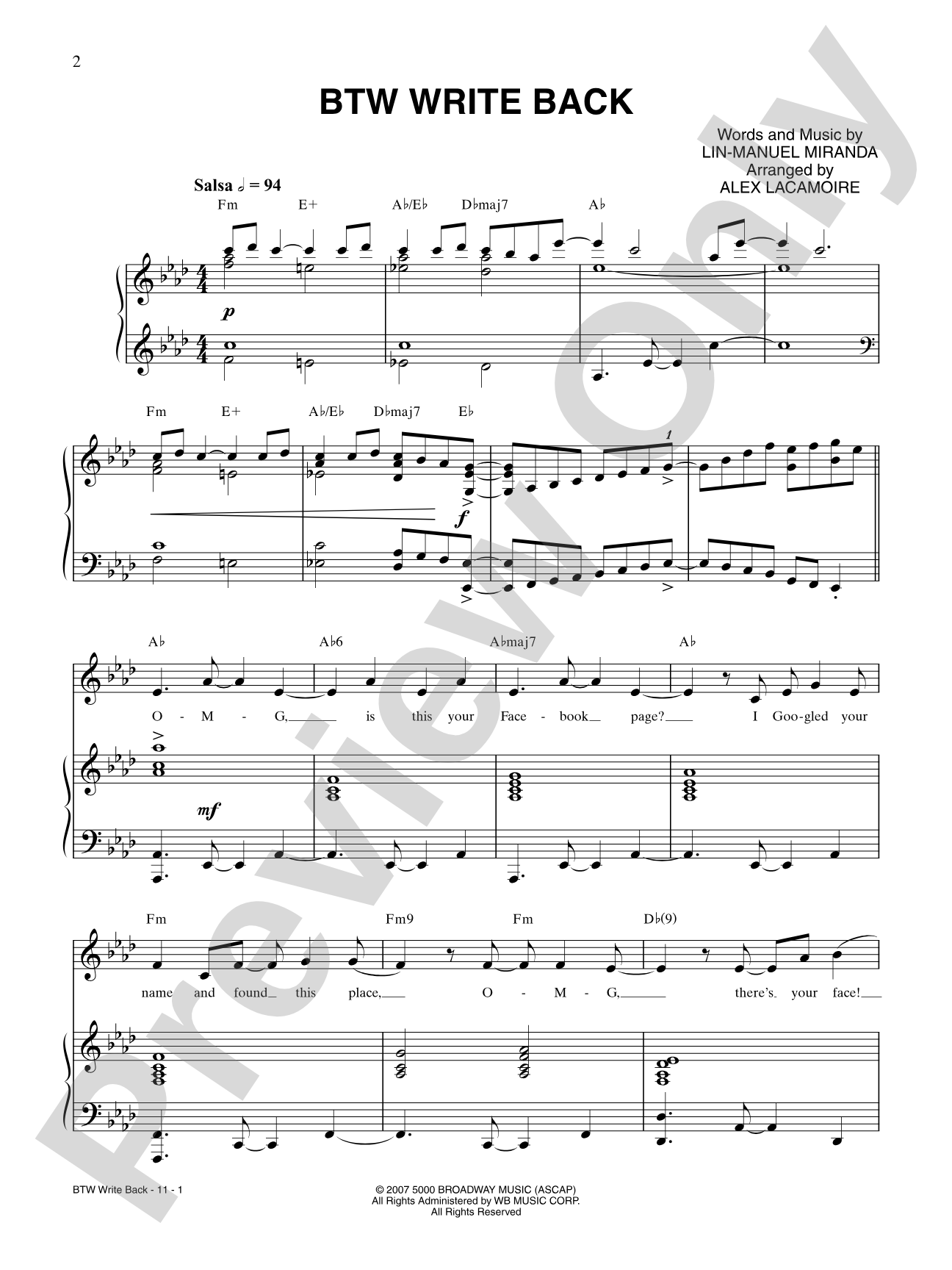
BTW Write Back: Piano/Vocal/Chords Digital Sheet Music

BTW Write Back: Piano/Vocal/Chords Digital Sheet Music

Lin-Manuel Miranda, Alex Lacamoire

Item: 00-PS-0015117

Digital Download
$3.99
Description

BTW Write Back: Piano/Vocal/Chords Digital Sheet Music isn't in MakeMusic Cloud just yet...but it could be. Let us know you'd like to see it, and you'll help shape what comes next. In the meantime, start a free trial and dive into thousands of interactive titles your students can play along with today.

Sample Audio
No sample audio found.
Sample Video
Additional Details
SKU: 00-PS-0015117

More about this title

About the Arranger: Alex Lacamoire

Alex Lacamimore is a composer and arranger whose work spans Broadway, film, and concert music. He has received Tony Awards for his orchestrations and is known for crafting arrangements that preserve the emotional core of a piece while making it accessible across different instrumental and vocal contexts.

Why we love this

Lacamoire's piano/vocal arrangement captures the intimate character of the original while giving singers and pianists room to shape the phrasing. The chord notation provides flexibility for accompanists who want to adjust voicings or add harmonic color, making it work equally well in a teaching studio or a casual performance setting.

What to expect

The arrangement balances clarity with warmth, giving the music enough harmonic support to feel grounded while keeping the texture lean enough for the vocal line to shine. It has the accessibility of a well-crafted lead sheet but with the detail of a fully realized piano part.

Who it's for

Singers preparing audition material or performance pieces will find this a practical, musician-friendly version. Piano students and collaborative pianists appreciate having both the notated accompaniment and chord symbols for flexibility in rehearsal and performance.

How to get the most out of it

  • Balance the vocal line so it sits naturally above the piano part rather than fighting for space; Lacamoire's voicings are written to support, not compete.
  • Use the chord symbols to explore different comping approaches; the progression supports both straightforward accompaniment and more interpretive harmonic choices.
  • Shape the phrasing across full phrases rather than note by note; this arrangement rewards singers who think in longer musical arcs.

How to use it

This works as an audition piece for singers in school productions, a recital selection for voice students, or a teaching tool in a piano studio. It's particularly useful when you need a version that moves quickly through rehearsal without requiring a full orchestra or band.

Skills your students will build

  • Reading piano/vocal score format with chord symbols
  • Coordinating vocal phrasing with piano accompaniment patterns
  • Interpreting lead sheet notation to shape harmonic color
  • Balancing vocal projection over a full keyboard part

You May Also Like