
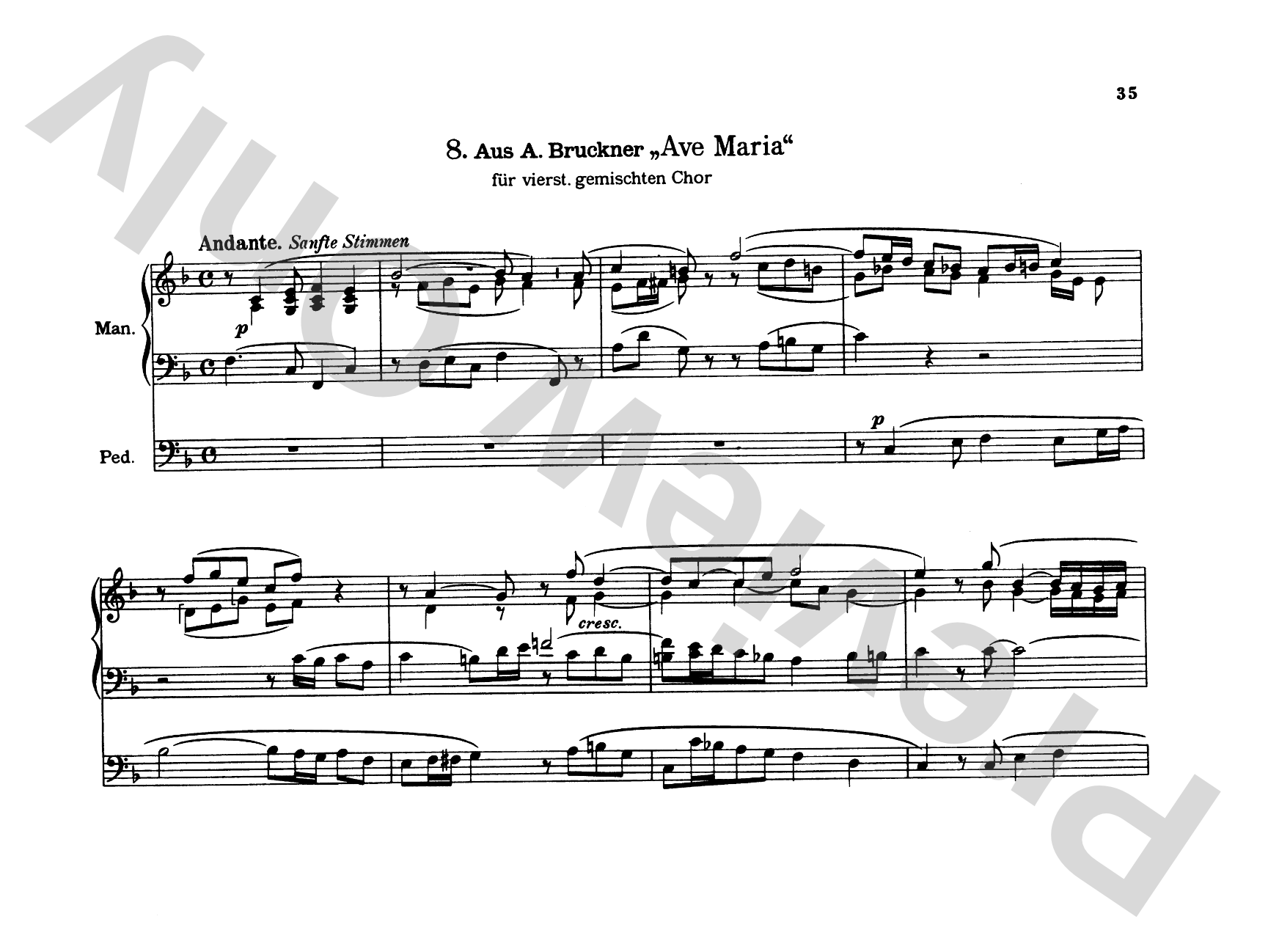

Bruckner: Album of Various Pieces (Including Preludes, Postludes, Transcriptions)
Including Preludes, Postludes, and Transcriptions
By Anton Bruckner
Item: 00-PC-0003139
$0.99
Pickup currently not available
Description
The comb binding creates a lay-flat book that is perfect for study and performance.


Don't just read it, hear it, play along with it, and watch your students grow with it. In MakeMusic Cloud, Bruckner: Album of Various Pieces (Including Preludes, Postludes, Transcriptions) comes alive with professional accompaniment, adjustable tempo, and built-in practice tools that turn solo practice into real progress.
Open in the Player
Jump straight in and assign it today.
Start Your Free Trial
Open this title and explore the full library in minutes.
Sample Audio
No sample audio found.
Sample Video
No sample videos found.
Additional Details
Series:
Kalmus Edition
Publisher:
Alfred Music
Page Count:
40
SKU:
00-PC-0003139
More about this title
About the Composer: Anton Bruckner
Anton Bruckner (1824-1896) was an Austrian composer and organist whose symphonic works defined the late Romantic era. Beyond his monumental symphonies, Bruckner was a virtuoso church musician who composed extensively for organ, blending the architectural grandeur of his symphonic thinking with the liturgical traditions of Catholic Austria. His organ works reveal a composer deeply attuned to the instrument's capabilities for both intimate reflection and overwhelming power.
Bruckner's sacred music emerged from decades spent as a working church organist and eventually as a professor at the Vienna Conservatory. His organ compositions range from brief postludes suitable for Sunday services to substantial preludes that explore harmonic innovation and structural complexity. These pieces demonstrate how a symphonist's sensibility can transform liturgical music into something both spiritually profound and musically substantial.
Why we love this
Bruckner's organ writing occupies a rare space: it demands real musicianship and interpretive maturity while remaining performable by competent church musicians and serious students. The variety within this collection means you can program a single piece to fit a specific liturgical need or sequence several pieces to create a compelling recital arc that showcases Bruckner's range from intimate prayer to monumental statement.
What to expect
These pieces embody the spiritual architecture of the Catholic tradition Bruckner knew intimately, moving between moments of hushed devotion and passages of overwhelming architectural scale. You'll find harmonic language that reaches toward the transcendent alongside writing that sits comfortably within the liturgical context of a church service. The emotional temperature shifts across the collection from consolatory to triumphant, often within a single piece.
Who it's for
This collection suits advanced organists preparing church service music, recital programs, or competition repertoire, as well as serious organ students studying the sacred Romantic tradition. The range of difficulty within the album means instructors can assign individual pieces strategically throughout a student's development rather than waiting for advanced proficiency.
How to get the most out of it
- Allow phrases to breathe according to their harmonic rhythm rather than pushing through uniform tempos; Bruckner's organ works often contain suspended moments that reward patience
- Explore the registration possibilities available on your instrument rather than defaulting to standard combinations; Bruckner wrote with specific orchestral colors in mind that can be approximated through thoughtful stop selection
- Attend to the counterpoint in passages with multiple voices, particularly in the fugal sections and complex textures that reveal the composer's symphonic ambitions
- Practice hand and foot independence carefully in pieces with demanding pedal lines; Bruckner expects coordination that won't emerge from passive reading
How to use it
Draw individual pieces for specific moments in the church year rather than programming the entire album at once; a brief prelude or postlude serves liturgical function while a longer piece could anchor a recital devoted to Bruckner's sacred music. The collection's scope makes it valuable as a resource for students exploring how symphonic thinking manifests in the organ tradition, with new pieces available for study as playing level advances.
Skills your students will build
- Managing large-scale harmonic progressions and tonal architecture characteristic of Romantic organ writing
- Coordinating complex pedal figures while maintaining independence of upper voices
- Interpreting rubato and phrase architecture in liturgical contexts
- Selecting and combining organ stops to create orchestral colors from limited resources
- Reading and realizing figured bass and implied harmonies in nineteenth-century sacred idiom