Brown Shuffle: Woodwinds 1 Sheet Music Preview

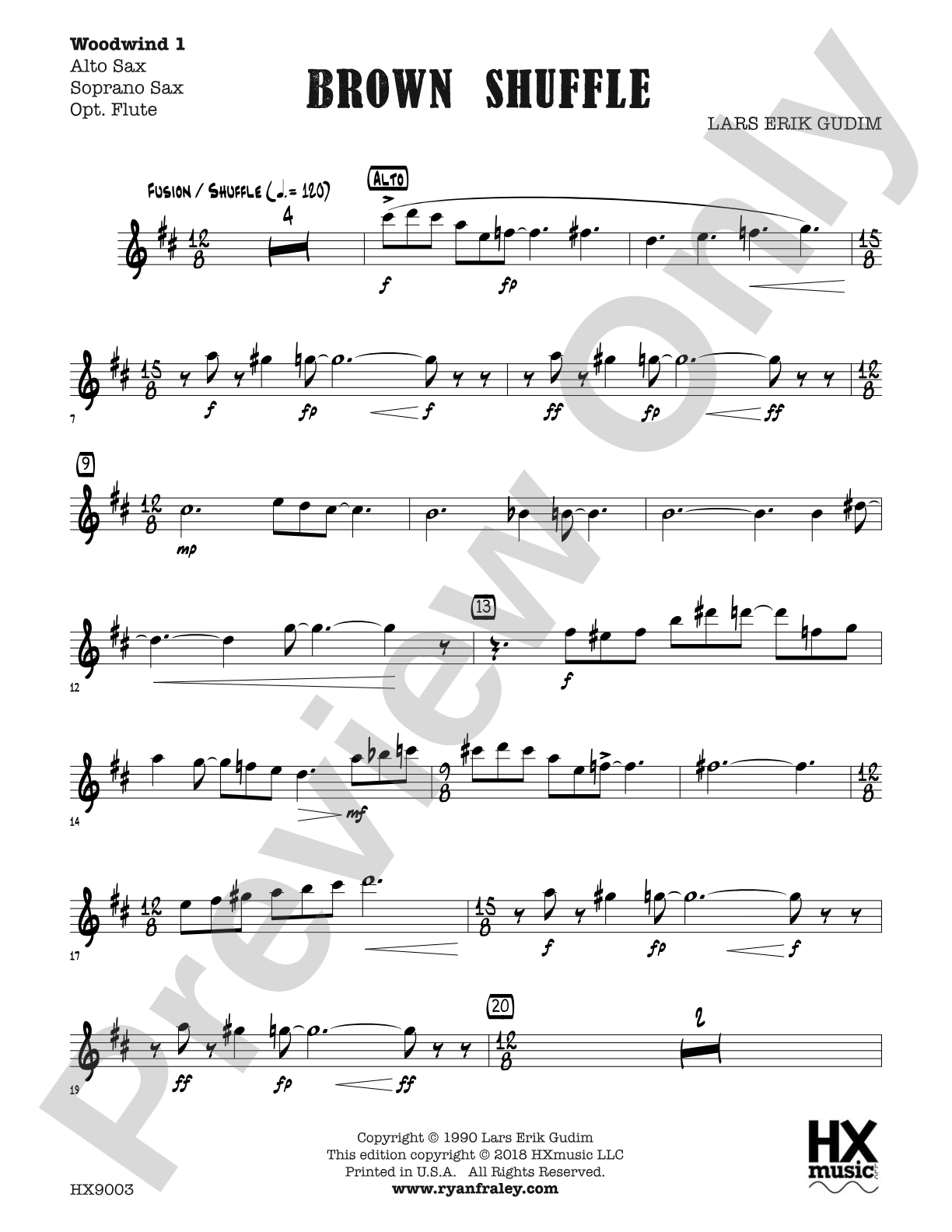
Brown Shuffle: Woodwinds 1

By Lars Erik Gudim

Grade: 5

Item: 98-PC-DHX9003_WOOD1

Digital Download
$3.99
Description
Brown Shuffle was first recorded by Norway's Oslo Groove Company on their jaw-dropping album Anno 1990. Now, for the first time, this newly-engraved edition is available in the United States. Lars Erik Gudim's excellent scoring brings the full ensemble together with dovetailed flourishes and a hard 12/8 groove built from interlocking rhythms across the band. This fusion/shuffle chart features primary sections in 12/8, 15/8 and 9/8 with interspersed sections of straight-ahead swing in 4/4. Alto sax 1 doubles on soprano and flute, alto 2 doubles on flute, and trumpets 1 and 2 double on flugelhorns. The solos are scored for trumpet 2 and trombone 2 and can optionally be opened up for more. A wonderful chart for advanced groups!

Brown Shuffle: Woodwinds 1 isn't in MakeMusic Cloud just yet...but it could be. Let us know you'd like to see it, and you'll help shape what comes next. In the meantime, start a free trial and dive into thousands of interactive titles your students can play along with today.

Sample Audio
0:00
0:00
Sample Video
Additional Details
Series: HXmusic
Publisher: HXmusic
SKU: 98-PC-DHX9003_WOOD1

More about this title

About the Composer: Lars Erik Gudim

Lars Erik Gudim is a Norwegian composer and arranger who has deep roots in the Scandinavian jazz and fusion scenes. His work with groups like the Oslo Groove Company demonstrates his ability to craft intricate ensemble writing that balances compositional sophistication with genuine groove sensibility.

Why we love this

Gudim's orchestration here is genuinely inventive. Rather than layering players on top of a simple riff, he weaves instrumental voices into interlocking rhythmic patterns that require real precision and ensemble awareness. The meter shifts feel organic, not academic, which keeps students engaged rather than overwhelmed.

What to expect

Propulsive and sophisticated. The 12/8 foundation drives forward with serious groove while the meter shifts create moments of genuine tension and surprise. It feels modern and fusion-forward, never settling into comfortable predictability.

Who it's for

Advanced jazz ensembles ready to tackle metric complexity without sacrificing swing feel. This chart rewards groups with solid section balance, secure rhythm sections, and the maturity to hear how unusual meters can groove.

How to get the most out of it

  • Lock the 12/8 pocket first. Have the rhythm section (bass, drums, piano) internalize the groove in isolation before bringing in the horns; this foundation makes the interlocking lines sit naturally.
  • Mark the meter changes visually in your score and parts. Color-code or bracket the 15/8 and 9/8 sections so players catch them without losing the groove's momentum.
  • Balance the saxophone doublings carefully during ensemble passages. The soprano and flute doublings on altos should blend as support, not compete for space with the main melody line.
  • Give trumpet 2 and trombone 2 time to develop their solo voices separately. Consider rehearsing these solos with a smaller group first so they command attention when the full ensemble backs them.

How to use it

Program this at a jazz festival or concert where you want to showcase your ensemble's technical chops and musicality in equal measure. It sits naturally alongside other contemporary jazz writing and proves to audiences that meter shifts belong in a swingin' band's toolkit.

Skills your students will build

  • Reading and executing mixed meters (12/8, 15/8, 9/8, and 4/4)
  • Maintaining groove across metric modulation
  • Voice independence within interlocking rhythmic textures
  • Doubling coordination (saxophone reeds and brass on flugelhorns)
  • Listening for ensemble balance during complex harmonic and rhythmic backgrounds
  • Solo phrasing and accompaniment sensitivity

You May Also Like