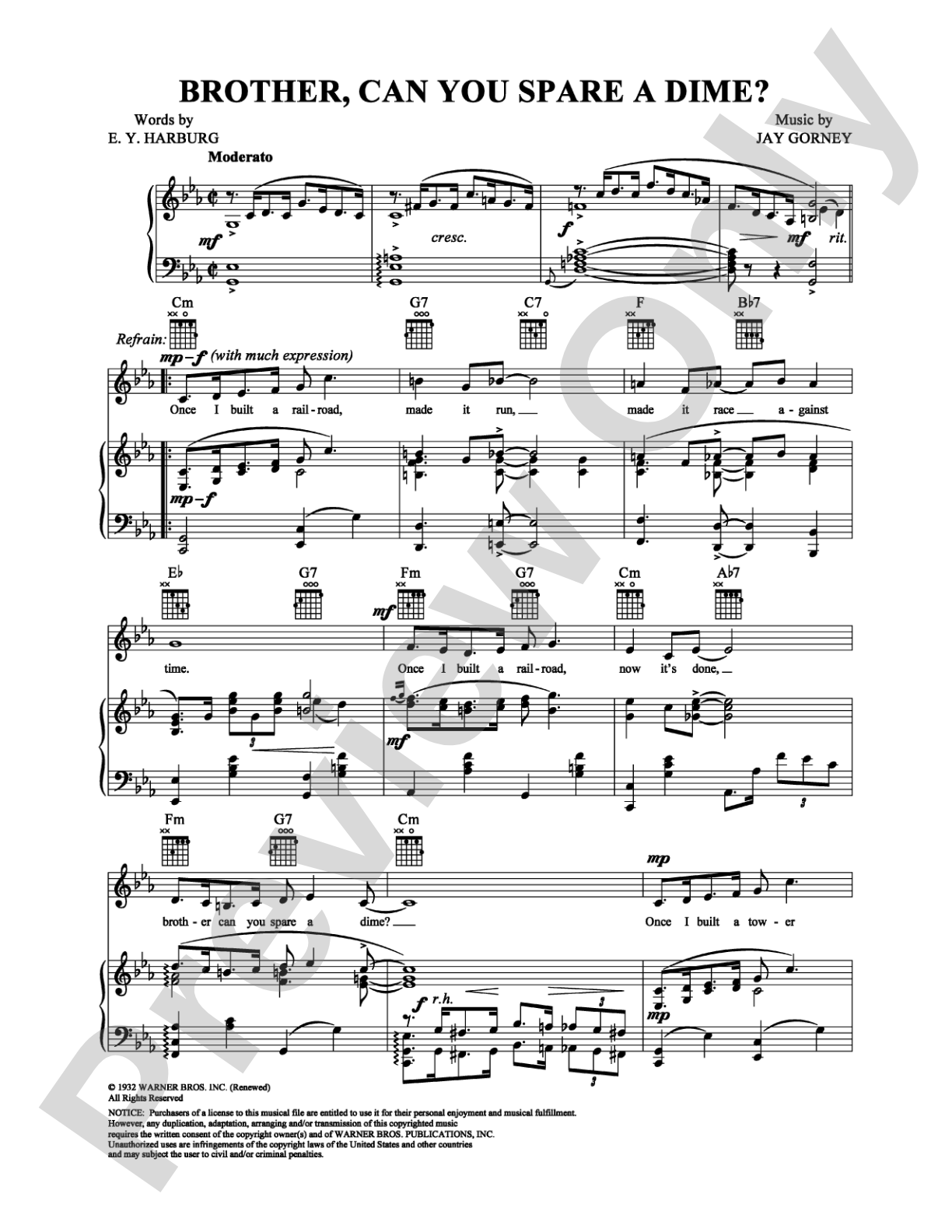
Brother, Can You Spare a Dime?: Piano/Vocal/Chords Digital Sheet Music

Brother, Can You Spare a Dime?: Piano/Vocal/Chords Digital Sheet Music

Peter Paul & Mary, Jay Gorney

Item: 00-PS-0005288

Digital Download
$3.99
Description

Brother, Can You Spare a Dime?: Piano/Vocal/Chords Digital Sheet Music isn't in MakeMusic Cloud just yet...but it could be. Let us know you'd like to see it, and you'll help shape what comes next. In the meantime, start a free trial and dive into thousands of interactive titles your students can play along with today.

Sample Audio
No sample audio found.
Sample Video
Additional Details
SKU: 00-PS-0005288

More about this title

About the Artist: Peter Paul & Mary

Peter, Paul and Mary formed in 1961 and became one of the most influential folk groups of the 1960s. Their blend of acoustic instrumentation, close harmonies, and socially conscious repertoire helped define the folk revival and brought traditional and contemporary folk songs to mainstream audiences. The trio's interpretations of both traditional ballads and newly written compositions demonstrated how folk music could address contemporary issues while remaining deeply human and emotionally resonant.

Why we love this

This arrangement captures the devastating simplicity of Harburg and Gorney's Depression-era classic while remaining singable and pianistically accessible. The chord structure supports both intimate solo performance and group arrangements, making it equally valuable for a singer-songwriter recital or a broader folk repertoire exploration. Peter, Paul and Mary's recording brought this song back to prominence during the 1960s, and their approach honors both the song's historical weight and its enduring emotional immediacy.

What to expect

Quiet, measured, and haunting. The song sits in a conversational register, as if the singer is asking a direct personal question rather than performing a plea. There's a dignity beneath the desperation that refuses to become sentimental, grounded in the specific historical moment while speaking across decades.

Who it's for

Solo singers preparing recitals, community musicians exploring American folk standards, and vocalists building a repertoire that bridges folk and popular traditions. This arrangement works well for adult singers seeking material that combines technical accessibility with emotional and historical substance.

How to get the most out of it

  • Treat the accompaniment sparsely at first; let the vocal melody and lyrics carry the emotional weight before adding harmonic or textural color
  • Pay attention to the conversational phrasing between melody and chords, which mirrors the song's narrative arc from question to quiet dignity
  • Adjust tempo and dynamics to match the narrative journey; resist rushing through the bridge, where the tension of the plea becomes most acute
  • Balance vocal production carefully so the vulnerability in the melody remains audible even when the piano provides fuller harmonic support

How to use it

Position this as a centerpiece in a program exploring American social history through song, or pair it with other Depression-era standards and contemporary folk interpretations. It works effectively as a solo showcase that demonstrates a singer's ability to inhabit a character and convey narrative through restraint rather than virtuosity.

Skills your students will build

  • Narrative interpretation and character development through song
  • Balancing vocal intimacy with harmonic accompaniment
  • Understanding the relationship between historical context and emotional authenticity
  • Phrasing and breath control in conversational, speech-inflected melody
  • Chord-based improvisation in folk and popular song idioms

You May Also Like