
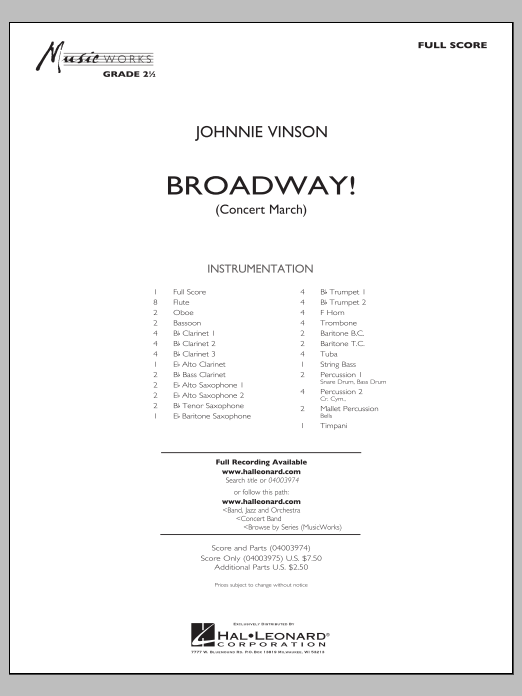

Broadway!: Concert Band Conductor Score & Parts
By Johnnie Vinson
Grade: 2.5
Item: 35-PK00294245
$65.00
Pickup currently not available
Buy Extra Parts (Digital PDF Download)
| Product | Price | Quantity |
|---|---|---|
| Broadway! - Full Score | $10.00 | |
| Broadway! - Flute | $6.00 | |
| Broadway! - Oboe | $6.00 | |
| Broadway! - Bassoon | $6.00 | |
| Broadway! - Bb Clarinet 1 | $6.00 | |
| Broadway! - Bb Clarinet 2 | $6.00 | |
| Broadway! - Bb Clarinet 3 | $6.00 | |
| Broadway! - Eb Alto Clarinet | $6.00 | |
| Broadway! - Bb Bass Clarinet | $6.00 | |
| Broadway! - Eb Alto Saxophone 1 | $6.00 | |
| Broadway! - Eb Alto Saxophone 2 | $6.00 | |
| Broadway! - Bb Tenor Saxophone | $6.00 | |
| Broadway! - Eb Baritone Saxophone | $6.00 | |
| Broadway! - Bb Trumpet 1 | $6.00 | |
| Broadway! - Bb Trumpet 2 | $6.00 | |
| Broadway! - F Horn | $6.00 | |
| Broadway! - Trombone | $6.00 | |
| Broadway! - Baritone B.C. | $6.00 | |
| Broadway! - Baritone T.C. | $6.00 | |
| Broadway! - Tuba | $6.00 | |
| Broadway! - String Bass | $6.00 | |
| Broadway! - Percussion 1 | $6.00 | |
| Broadway! - Percussion 2 | $6.00 | |
| Broadway! - Mallet Percussion | $6.00 | |
| Broadway! - Timpani | $6.00 |
Parts Added to Cart!
Description
Reminiscent of a musical style from the heyday of Broadway musicals, Johnnie Vinson has created this lively and entertaining cut time march. Composed using the traditional march form, "Broadway!" includes interesting lines for all instruments and a nice variety in scoring and dynamics.
Dur: 2:30


Broadway!: Concert Band Conductor Score & Parts isn't in MakeMusic Cloud just yet...but it could be. Let us know you'd like to see it, and you'll help shape what comes next. In the meantime, start a free trial and dive into thousands of interactive titles your students can play along with today.
Request This Title
Tell us you want it.
Start Your Free Trial
Explore everything that's ready to play right now.
Sample Audio
No sample audio found.
Sample Video
No sample videos found.
Additional Details
Publisher:
Hal Leonard
SKU:
35-PK00294245
More about this title
About the Composer: Johnnie Vinson
Johnnie Vinson is a prolific composer and arranger whose work spans concert band, jazz ensemble, and educational settings. His compositions consistently balance accessibility with musical substance, earning him recognition among directors seeking repertoire that engages both performers and audiences without sacrificing artistic integrity.
Why we love this
Vinson captures the infectious energy of classic Broadway without relying on borrowed melodies or pastiche. The march form gives the piece structural clarity while the scoring and dynamic variety keep rehearsals interesting; every section has moments that matter, which means your students stay invested from first reading through final performance.
What to expect
Stepping into a Broadway pit orchestra during its golden age. The piece bristles with showmanship and optimism; it moves with purpose and charm, built on the solid bones of march form but dressed in the sophisticated orchestration that defined great musical theater writing.
Who it's for
Concert bands at the intermediate level who want a crowd-pleasing opener or closer with substance. It works equally well for programs where you need a lighter moment or where you're introducing students to arranged styles beyond classical traditions.
How to get the most out of it
- Maintain crisp articulation in the march sections to honor the cut time feel; sloppiness here undermines the style.
- Balance the variety in scoring by listening across sections during ensemble rehearsals; some parts sit high or low and need projection adjustments.
- Shape the dynamic shifts deliberately rather than treating them as sudden on-off switches; this theatrical quality is what makes the Broadway idiom work.
- Keep the tempo steady and energetic; this piece thrives when it feels performed, not laboriously executed.
How to use it
Open a pops concert with this to set an upbeat tone, or pair it with heavier classical works as a palate-cleansing contrast. The two-and-a-half minute duration makes it ideal for filling programming slots or creating a mixed-style set where you showcase different ensemble capabilities in a single concert.
Skills your students will build
- Maintaining steady tempo in cut time
- Executing precise articulation in march idioms
- Balancing ensemble sound across varied instrumentation
- Interpreting dynamic contrasts with theatrical intention
- Reading traditional march form and its structural conventions