
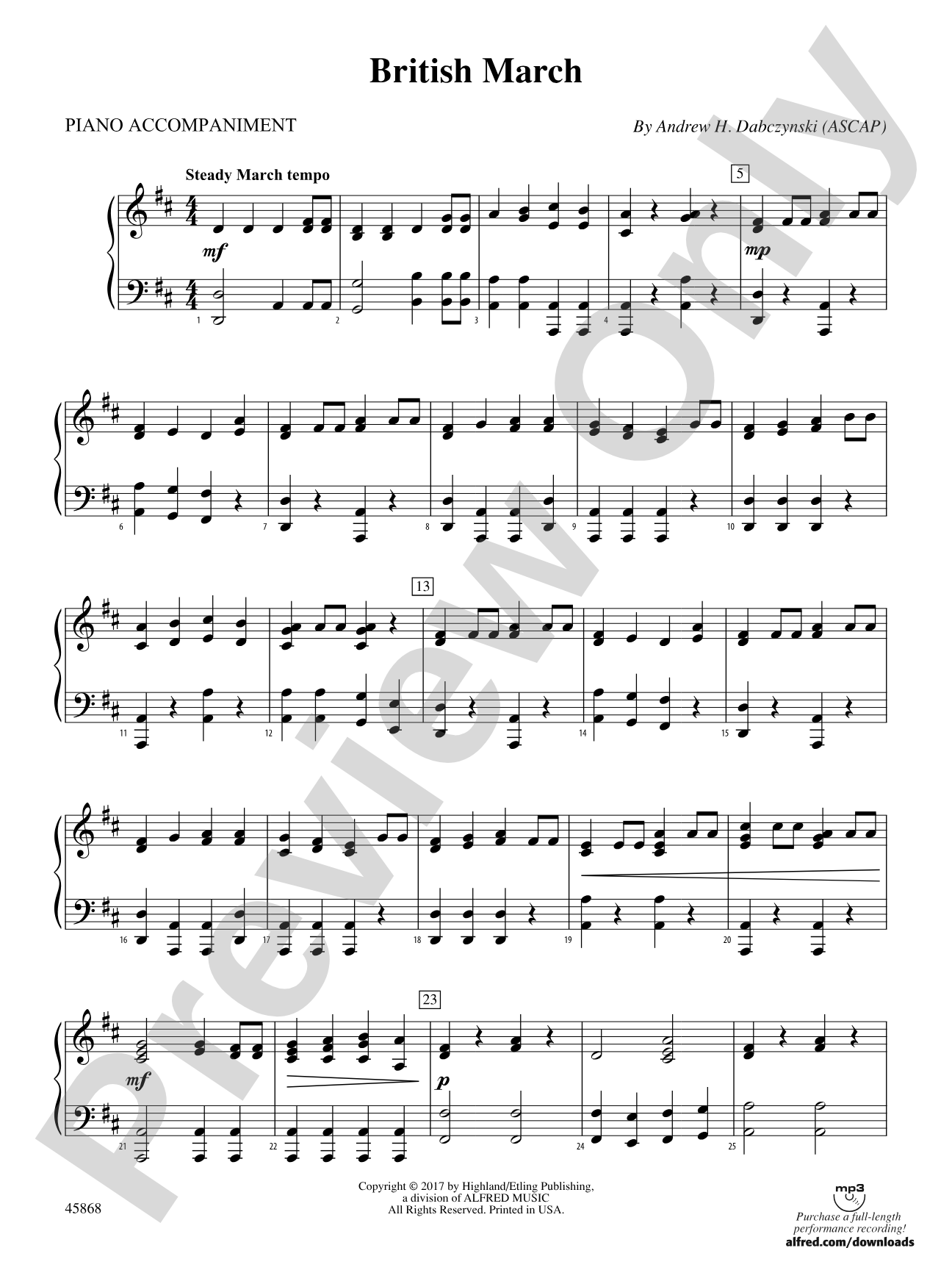

British March: Piano Accompaniment
By Andrew H. Dabczynski
Grade: 1
Item: 00-PC-0017667_K
$5.99
Pickup currently not available
Description
In the tradition of great British wind band marches like "British Eighth" and "Colonel Bogey," this original is intended for beginning orchestra. Students in their first year will find this piece absolutely playable, using only open strings, notes within a one-octave D scale, and simple bowing patterns. Optional beginning percussion and piano parts ensure that British March by Andrew H. Dabczynski will make a perfect opening or closing piece on any concert program. (2:15)


Don't just read it, hear it, play along with it, and watch your students grow with it. In MakeMusic Cloud, British March: Piano Accompaniment comes alive with professional accompaniment, adjustable tempo, and built-in practice tools that turn solo practice into real progress.
Open in the Player
Jump straight in and assign it today.
Start Your Free Trial
Open this title and explore the full library in minutes.
Sample Audio
1
Audio File
--:--
0:00
0:00
Sample Video
Additional Details
Series:
Highland/Etling String Explorer
Publisher:
Alfred Music
Page Count:
152
SKU:
00-PC-0017667_K
More about this title
About the Composer: Andrew H. Dabczynski

Andrew H. Dabczynski spent decades shaping string education from multiple angles: as a performer with regional orchestras including the Rochester Philharmonic and Hartford Symphony, as a faculty member at Eastman and in public school systems across New York and Michigan, and as a researcher dedicated to string pedagogy and traditional music. He founded the BYU "New Horizons Orchestra" at Brigham Young University, where he served as Emeritus Professor of Music Education and developed a model program for beginning adult string players that became a training ground for string teachers.
His contributions to the field earned recognition including BYU's Joseph E. White Fellowship for Teaching and Learning, Utah ASTA's "Higher Education Teacher of the Year" award in 2005, and subsequent recognition for outstanding contributions to music education. Dabczynski co-authored the String Explorer method series with Alfred Music, a comprehensive resource widely adopted in schools. His work reflects deep knowledge of both Western classical string tradition and folk music practices, informing his approach to accessible, practical repertoire for young players.
Why we love this
Dabczynski understands exactly what beginning string orchestras need: a piece that sounds genuinely like a march, feels rewarding to play, and requires zero compromise on musicality or fun. The orchestration with optional percussion and piano lets you shape the piece to match your ensemble's strengths, whether you're starting the concert with energy or closing it with polish.
What to expect
A spirited, straightforward march with the confidence of British tradition: melodic enough to engage listeners, rhythmically straightforward enough to let young players focus on tone and ensemble balance rather than decoding complex notation. There's genuine musical substance here, not just an exercise dressed up as a piece.
Who it's for
First-year string orchestra students who are ready to play something substantial but still need accessible ranges, simple bowing, and reassurance that they can succeed. Directors of beginning orchestras will find it ideal for students working within open strings and the D major scale who haven't yet tackled complex fingering patterns or advanced bow techniques.
How to get the most out of it
- Establish the march character from the first rehearsal by conducting with clear, steady beats and encouraging the string sections to feel the pulse through their bow motion rather than just counting.
- Balance the melody between first and second violins during the main themes; the piece gains clarity and maturity when both parts are equally present.
- Use the optional percussion sparingly at first while students solidify their parts, then layer in snare drum and timpani for final rehearsals to build full sound.
- Shape the dynamics with intention even though the range is simple; subtle crescendos and diminuendos in two- or four-measure phrases prevent the piece from sounding flat.
How to use it
Open your first concert of the year with this to set a strong, polished tone before moving into more experimental repertoire. It also works as a closing number, leaving the audience with a clear, memorable melody and the satisfaction of hearing a real march performed well.
Skills your students will build
- Maintaining steady tempo and ensemble pulse throughout a multi-section form
- Playing in D major using open strings and notes within one octave
- Basic march rhythms and their coordination across string parts
- Dynamic control and phrasing in a binary form structure
- Ensemble balance between melody and accompaniment voices