Bringer of War: Trombone Sheet Music Preview

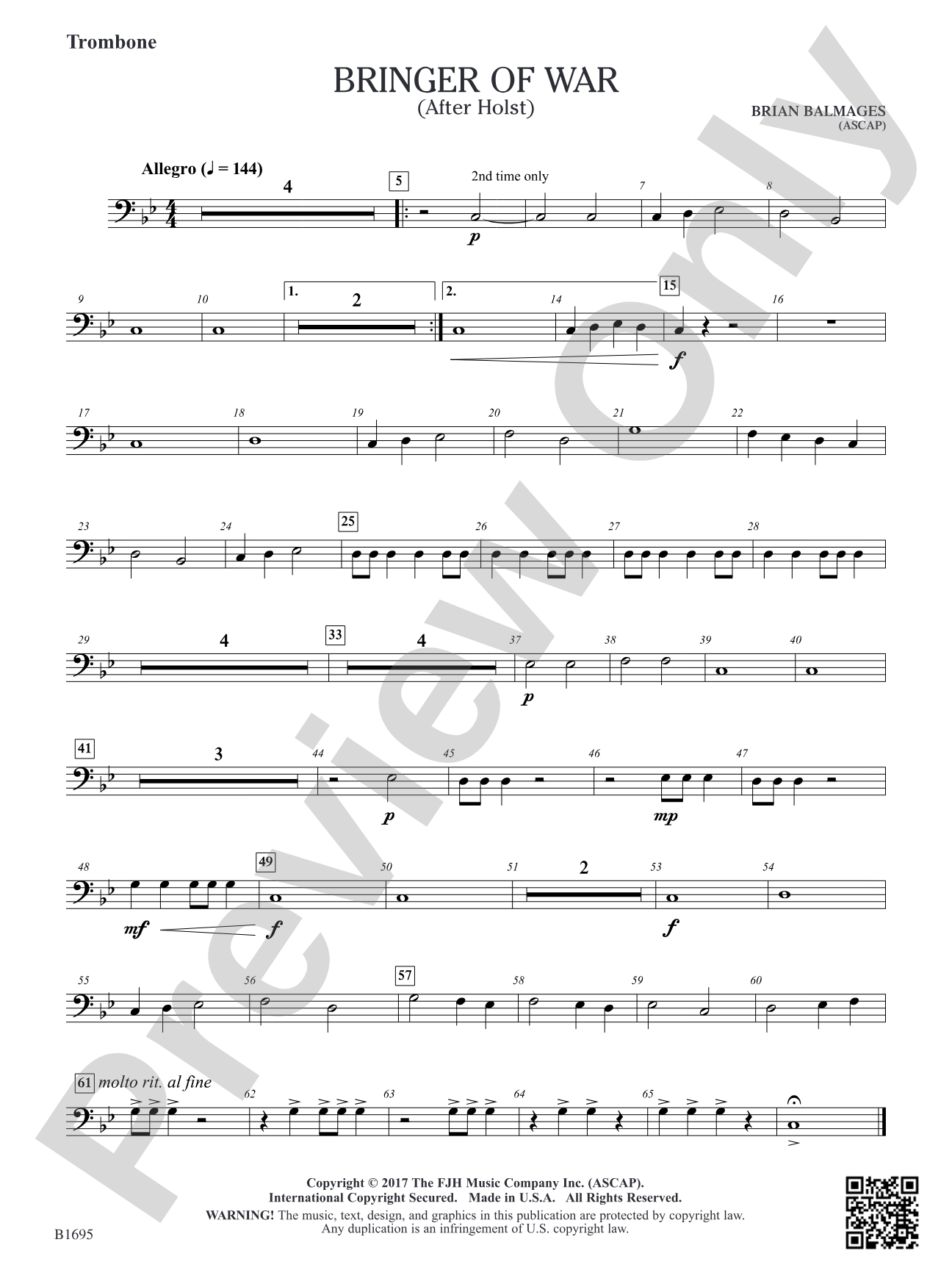
Bringer of War: Trombone

By Brian Balmages

Level:.5

Item: 98-PC-DB1695_TN1

Digital Download
$7.00
Description
Inspired by The Planets by Gustav Holst, this original piece pays homage to the first movement, Mars. Using only six notes in all instruments, the music still has a powerful quality that dares the listener to embrace the bold, majestic melodies and rhythmic ostinato. A unique original that invites further study of a master composer!

Don't just read it, hear it, play along with it, and watch your students grow with it. In MakeMusic Cloud, Bringer of War: Trombone comes alive with professional accompaniment, adjustable tempo, and built-in practice tools that turn solo practice into real progress.

Sample Audio
0:00
0:00
Sample Video
Additional Details
Series: FJH Starter Series
Publisher: The FJH Music Company, Inc.
SKU: 98-PC-DB1695_TN1

More about this title

About the Composer: Brian Balmages

Brian Balmages

Brian Balmages has built a career composing and conducting across orchestral, band, and chamber idioms, with performances spanning from professional orchestras to school ensembles in venues like Carnegie Hall, the Kennedy Center, and Sydney Opera House. He is an A. Austin Harding Award recipient, winner of the 2020 NBA William D. Revelli Composition Contest for Love and Light, and an elected member of the American Bandmasters Association.

His guest conducting has taken him to the Midwest Clinic, Western International Band Clinic, and ensembles throughout the world. Balmages holds the James Madison University Distinguished Alumni Award and was commissioned by the University of Miami to compose for the inauguration of President Julio Frenk. His work was performed at the 2013 Presidential Inaugural Prayer Service attended by President Obama and Vice President Biden. He currently serves as Director of MakeMusic Publications and Digital Education for Alfred and MakeMusic.

Why we love this

Balmages demonstrates remarkable restraint here by restricting the palette to just six notes yet delivering music with genuine visceral impact. Young bands often struggle with rhythmic precision and tonal focus; this piece trains both by forcing students to rely entirely on articulation, breath control, and rhythmic clarity rather than harmonic interest. The Mars connection gives conductors a natural teaching moment about how constraints fuel creativity in even the greatest composers.

What to expect

Propulsive and commanding, built on a relentless rhythmic foundation that drives the piece forward with military precision. The restricted note set creates an almost primal quality, channeling the ominous power of Holst's Mars through bold, unadorned sound.

Who it's for

Beginning and early intermediate concert bands ready to tackle rhythmic discipline and ensemble cohesion. This works beautifully for groups transitioning from fundamentals to literature where restraint becomes a strength rather than a limitation.

How to get the most out of it

  • Treat the rhythmic ostinato as the heartbeat of the ensemble. Lock the percussion and lower winds into a unified pulse before adding melodic layers.
  • Shape the six-note melody with intentional phrasing despite its simplicity. Each statement should sound bold and declarative, not mechanical.
  • Control dynamics carefully throughout. The power comes from precision and unified articulation, not from playing louder.

How to use it

Open a concert with this as a statement piece that establishes your band's rhythmic control and focus. It pairs well with more complex works later in the program, making the contrast between simplicity and sophistication work in your favor. Also highly suitable for festival and contest settings where it demonstrates musicianship without overshadowing younger players.

Skills your students will build

  • Rhythmic precision and ensemble synchronization in ostinato-based music
  • Articulation control as a primary expressive tool
  • Reading and performing with sustained focus despite limited melodic material
  • Understanding how constraint and minimalism serve compositional purpose

You May Also Like