Bright Lights!: 1st Percussion Sheet Music Preview

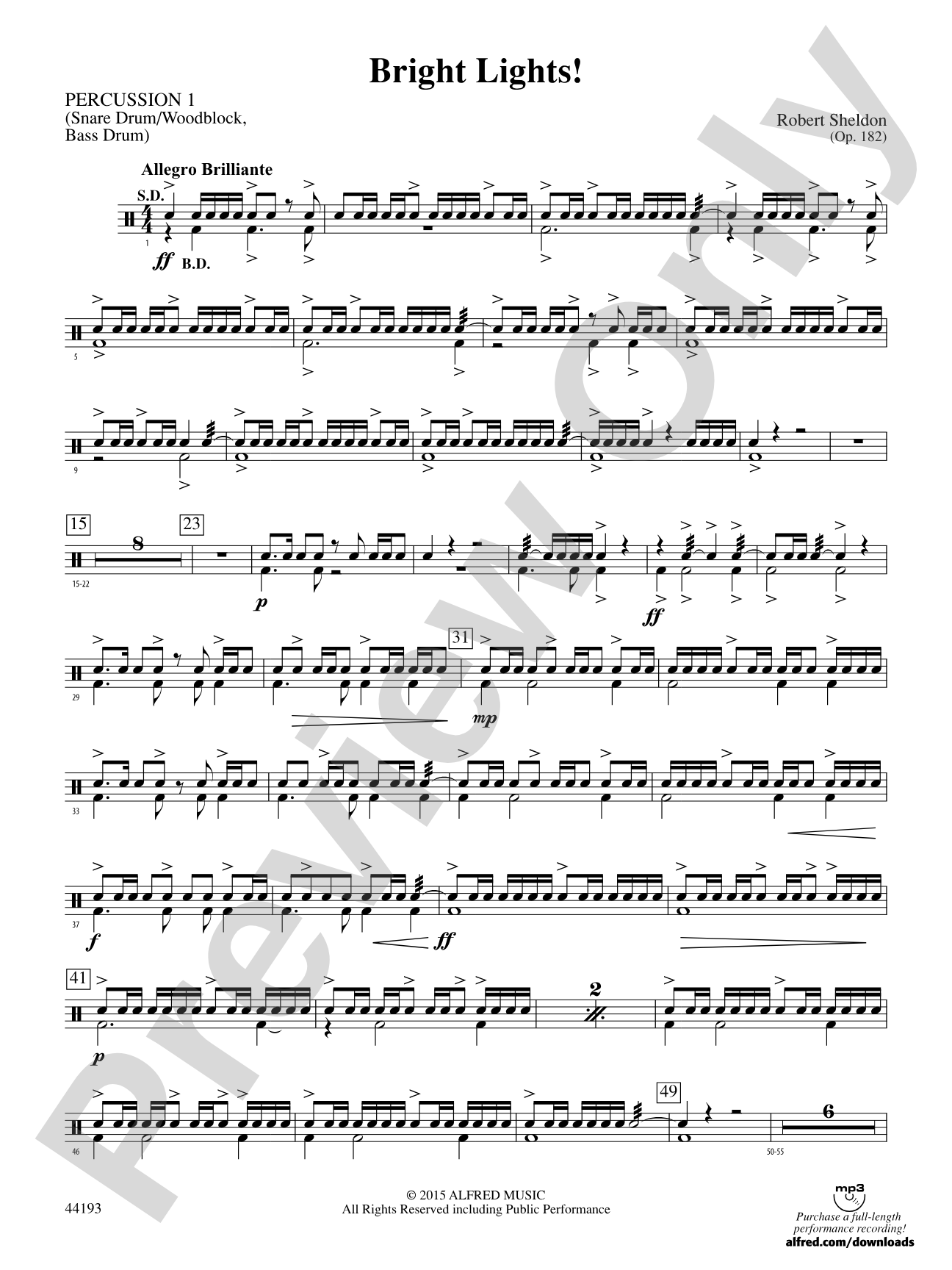
Bright Lights!: 1st Percussion

By Robert Sheldon

Grade: 4 (Medium Difficult)

Item: 00-PC-0017043_PC1

Digital Download
$3.00
Description
'Bright Lights!" is a fast-paced, high-energy showcase for concert band. A strong rhythmic pulse drives the tuneful melodies and technical flourishes that are present throughout. Written in a modified rondo form, this joyful offering works well as an opener, closer, or encore piece. (4:00) This title is available in MakeMusic Cloud.

Don't just read it, hear it, play along with it, and watch your students grow with it. In MakeMusic Cloud, Bright Lights!: 1st Percussion comes alive with professional accompaniment, adjustable tempo, and built-in practice tools that turn solo practice into real progress.

Sample Audio
0:00
0:00
Sample Video
Additional Details
Series: Alfred Concert Band
Publisher: Alfred Music
Page Count: 284
SKU: 00-PC-0017043_PC1

More about this title

About the Composer: Robert Sheldon

Robert Sheldon

Robert Sheldon's wind band compositions are performed by ensembles across six continents, and his work consistently appears on state and national contest lists. Beyond his prolific output as a composer, Sheldon co-authored Sound Innovations for Concert Band and has earned recognition from the American School Band Director's Association, Phi Beta Mu, and the American Society of Composers, Authors and Publishers.

His schedule balances conducting commitments with active clinician work. Sheldon has led All-State and Regional Honor Bands, presented at universities and state music education conferences, and conducted premieres and performances in Carnegie Hall, Boston Symphony Hall, The Sydney Opera House, and the Kennedy Center. He received an honorary doctorate from VanderCook College of Music in 2020.

Why we love this

Sheldon writes for what a concert band actually wants to play: infectious energy paired with real musical substance. The modified rondo structure gives the piece shape and memory, making it equally compelling for audiences and performers, while the rhythmic drive means your ensemble will stay locked in from first to last measure.

What to expect

Bright, propulsive, and unapologetically joyful. The rhythmic foundation anchors everything while melodies soar over it, creating a sense of forward motion that feels like the ensemble is accelerating even when the tempo stays constant. Technical passages catch light without overshadowing the tuneful core.

Who it's for

Concert bands in the intermediate-to-advancing range (Grade 4) who need a piece that energizes audiences and doesn't demand specialized instrumentation or excessive rehearsal time. Directors programming mixed-level concerts, contest festivals, or opening numbers will find this scores well with audiences and adjudicators alike.

How to get the most out of it

  • Establish the rhythmic pulse as your primary conductor's gesture. This piece lives on its groove, so your beat clarity and subdivision prep work will directly affect how sharp the ensemble's attack sounds.
  • Balance the technical flourishes against the tuneful material. These aren't show-off passages that should overwhelm; they're meant to sparkle within the context of the overall musical line.
  • Use the rondo returns as opportunities to deepen the ensemble's understanding of phrasing. Each return invites slightly different weight or articulation choices, keeping the form audible.

How to use it

Program this as an opener to set a high-energy tone, use it as a closer to send audiences out smiling, or place it as an encore after a heavier work to remind everyone why they love playing. At four minutes, it's substantial enough to stand on its own yet short enough to pair well with longer works in a concert arc.

Skills your students will build

  • Maintaining rhythmic precision in fast tempos
  • Balancing technical passage work with lyrical phrasing
  • Understanding rondo form and how reprise sections can vary in performance
  • Blending ensemble articulation in high-energy contexts
  • Reading standard concert band instrumentation and ranges

You May Also Like