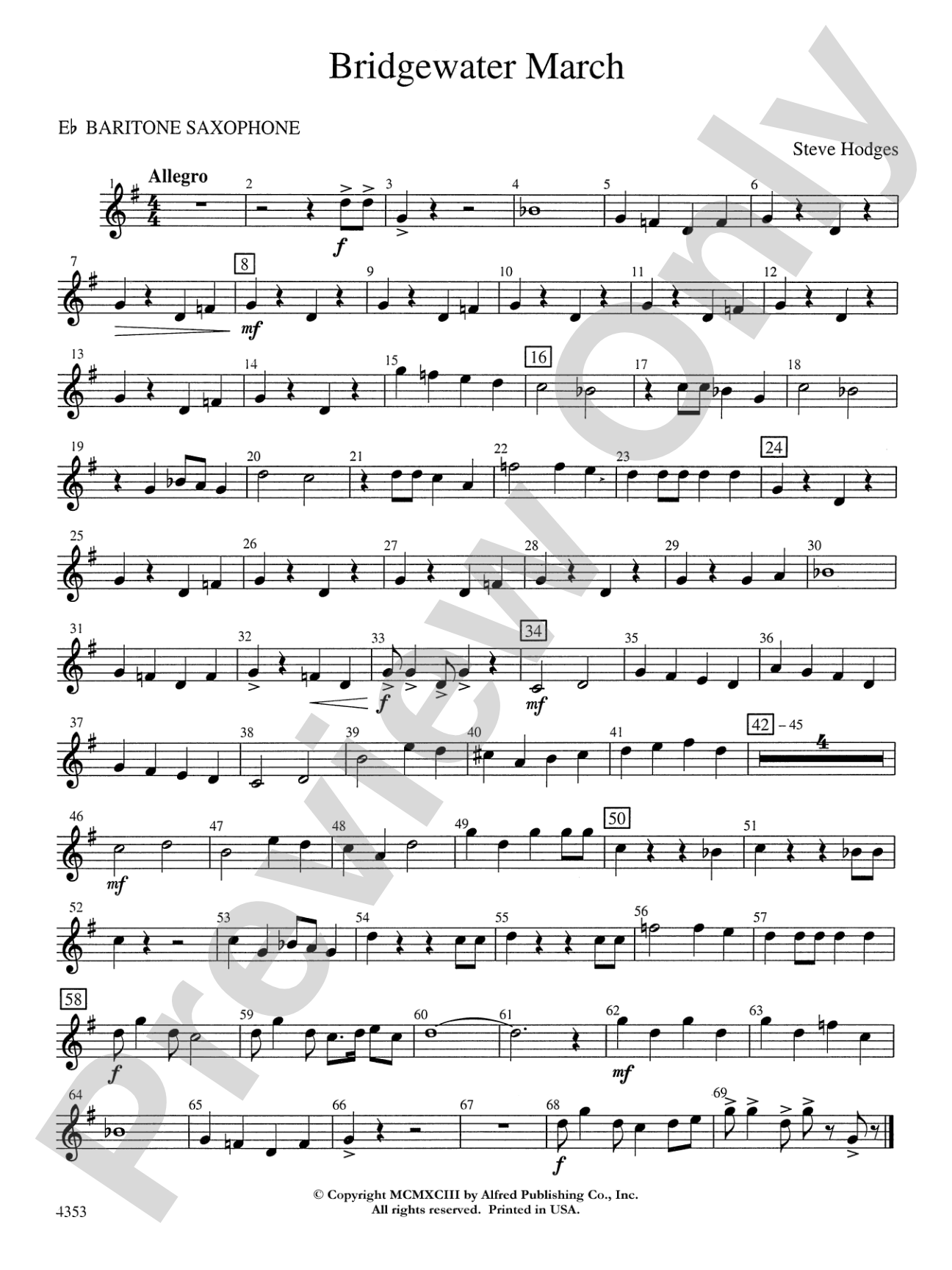
Bridgewater March: E-flat Baritone Saxophone Sheet Music Preview

Bridgewater March: E-flat Baritone Saxophone

By Steve Hodges

Grade: 1.5 (Easy)

Item: 00-PC-0001858_BTX

Digital Download
$3.00
Description

Don't just read it, hear it, play along with it, and watch your students grow with it. In MakeMusic Cloud, Bridgewater March: E-flat Baritone Saxophone comes alive with professional accompaniment, adjustable tempo, and built-in practice tools that turn solo practice into real progress.

Sample Audio
0:00
0:00
Sample Video
Additional Details
Series: Challenger Band Series
Publisher: Alfred Music
Page Count: 116
SKU: 00-PC-0001858_BTX

More about this title

About the Composer: Steve Hodges

Steve Hodges

Steve Hodges studied music education at Western Oregon University and Central Washington University, earning degrees that prepared him for four decades of directing bands, choirs, and small ensembles across public schools. Since 1986, he has composed more than 120 concert band works published by Alfred Music, along with choral arrangements released through Staff Music and Shawnee Press. His compositions have been performed internationally at festivals and state conventions, with commissioned works from honor bands and schools spanning Virginia, Iowa, Winnipeg, British Columbia, Oregon, Washington, and North Carolina.

Hodges is an ASCAP member whose music has appeared on TBS and ESPN broadcasts. Now retired and based in The Dalles, Oregon, he remains active in community music while watching his grandchildren perform his compositions in their school bands. His long career as a working music educator deeply informs the practical, accessible quality of his writing.

Why we love this

Hodges knows exactly what early-level bands need: music that sounds confident and complete without demanding the precision of higher grades. This march grabs attention with a straightforward melodic idea and clean harmonic support, making it an excellent choice for contest festivals where young ensembles shine. The 116-page conductor score and parts package delivers professional preparation materials right out of the download.

What to expect

A crisp, forward-moving march with the character of a well-designed educational piece. The writing is transparent enough that each section can hear what it needs to do, yet the overall effect is ensemble music, not a collection of independent parts. The march celebrates competence without condescension.

Who it's for

Early-level concert bands preparing for contest festivals, school concert series, or festival performances. This piece is approachable enough for beginning bands while maintaining enough musical substance to satisfy an audience and adjudication panel.

How to get the most out of it

  • Keep the march tempo steady but not rigid. Young bands often rush through marches when they feel secure with the material. Set a metronome marking early in rehearsals and reference it throughout.
  • Balance the melody between sections. The main theme likely passes through different voices, so rotate principal players during sectionals to ensure clarity when the part moves.
  • Build the dynamic shape across full phrases rather than note to note. This prevents the march from feeling choppy and gives performers something musical to aim for.
  • Conduct with clear beat definition. Grade 1.5 ensembles respond well to a director who shows exactly where the beat lands, especially in the rhythmic figures that anchor marches.

How to use it

Program this as the anchor of a contest or festival submission where you want to showcase the ensemble's musicality and precision. It also works well as a concert opener or closer, establishing energy without overshadowing other pieces on the program. For school events, it serves as a logical step up from purely recreational beginner pieces.

Skills your students will build

  • Maintaining steady tempo through repeated phrases and varying textures
  • Balancing melodic lines with harmonic support across an ensemble
  • Reading articulation and dynamic markings as indicators of musical intent
  • Executing marching style rhythms with clarity and consistency
  • Responding to a conductor's tempo and expressive gestures in a concert setting

You May Also Like