
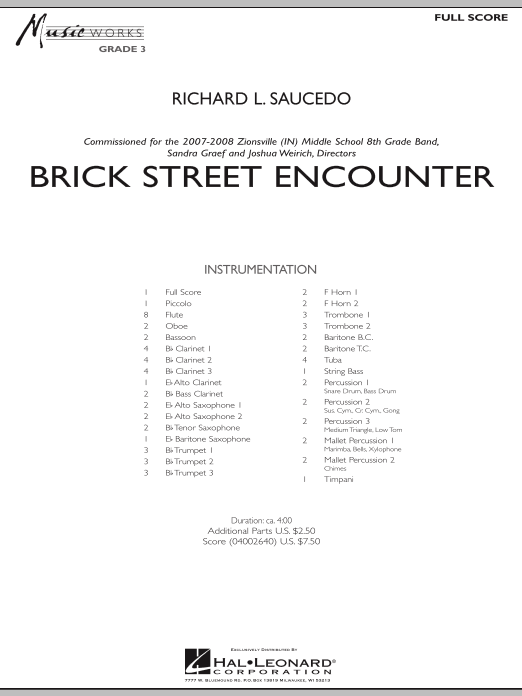

Brick Street Encounter: Concert Band Conductor Score & Parts
By Richard L. Saucedo
Grade: 3
Item: 35-PK00120679
$65.00
Pickup currently not available
Buy Extra Parts (Digital PDF Download)
Parts Added to Cart!
Description
Displaying a wide variety of colors and textures, here is an exceptional work for young bands. After a grandiose and majestic-sounding opening, the main section of the work is fueled by the percussion and features mixed meters and careful use of dissonance. A chorale-like middle section features woodwind colors and rich harmonies, then a percussion section feature leads to the energetic reprise and final strains. Dur: 4:00


Brick Street Encounter: Concert Band Conductor Score & Parts isn't in MakeMusic Cloud just yet...but it could be. Let us know you'd like to see it, and you'll help shape what comes next. In the meantime, start a free trial and dive into thousands of interactive titles your students can play along with today.
Request This Title
Tell us you want it.
Start Your Free Trial
Explore everything that's ready to play right now.
Sample Audio
No sample audio found.
Sample Video
No sample videos found.
Additional Details
Publisher:
Hal Leonard
SKU:
35-PK00120679
More about this title
About the Composer: Richard L. Saucedo

Richard L. Saucedo shaped the Indiana band landscape during his 31 years as Director of Bands and Performing Arts Chairman at Carmel High School, retiring in 2013. His programs earned state, regional, and national recognition across concert, jazz, and marching categories, including three appearances by the Wind Symphony I at the Music for All National Concert Band Festival and back-to-back Indiana State Champion titles. The Carmel Marching Greyhounds made 17 consecutive top-ten finishes at the Bands of America Grand National Championship, claiming national championships in 2005 and 2012; that same year Carmel became the rare program to win a BOA National Championship while performing at the Midwest Clinic.
Saucedo earned Indiana's Bandmaster of the Year award (1998-99) and Outstanding Music Educator honor (2010), followed by his induction into the Music for All Hall of Fame (2015) and Drum Corps International Hall of Fame (2022). He currently serves as music ensemble coordinator for the Blue Devils Drum and Bugle Corps and previously arranged and composed for the Cavaliers, contributing to five DCI world championships. Beyond his consulting roles with Music for All and Bands of America, Saucedo maintains an active freelance practice writing for marching bands, concert bands, choral ensembles, and orchestras.
Why we love this
Saucedo knows exactly what young bands need: immediate textural interest without overwhelming complexity. The piece opens with genuine gravitas, then pivots to percussion-driven rhythmic energy that keeps players engaged while building fundamental ensemble skills. That arc from bold statement to chorale to feature to finale gives every section meaningful moments, which is the mark of a composer who spent three decades teaching bands.
What to expect
You move from stately and commanding into rhythmic pulse and modern harmonies, then pause to savor lyrical woodwind writing before the percussion takes hold and propels you forward again. The whole arc unfolds like a conversation between tradition and contemporary color.
Who it's for
Grade 3 bands ready to explore structural sophistication and textural variety without tackling advanced technical demands. This works equally well for developing ensembles seeking concert program depth and for experienced groups wanting a piece that teaches arrangement craft through listening.
How to get the most out of it
- Establish clear articulation vocabulary early in rehearsals for the opening gesture. Uniform attack on that majestic entrance sets the tone for the entire work.
- Lean into the mixed meter passages with a steady conducting pulse rather than fighting the meter changes; this helps percussionists lock in the rhythmic foundation and clarifies the dissonant textures for the full band.
- Balance the woodwind chorale section carefully. The rich harmonies need blend without sacrificing individual line clarity, so isolate those sections in sectionals before full ensemble rehearsal.
- Use the percussion feature as a momentum builder. Don't let it meander; keep it driving toward the reprise so the energy transfer feels organic rather than like two separate pieces.
How to use it
Slot this early to mid-concert to showcase your band's range. It pairs well with a lyrical ballad earlier and something with higher technical demands later, demonstrating your program's versatility. The four-minute duration and clear sectional divisions also make it an excellent closing piece for a concert that explores 20th-century band writing.
Skills your students will build
- Reading and executing mixed meters (as noted in primary section)
- Balancing ensemble sound across dissonant harmonic contexts
- Maintaining precision during rhythmically complex passages led by percussion
- Listening to and blending with non-traditional harmonies in a chorale setting
- Understanding and responding to dynamic architectural shifts across a movement