
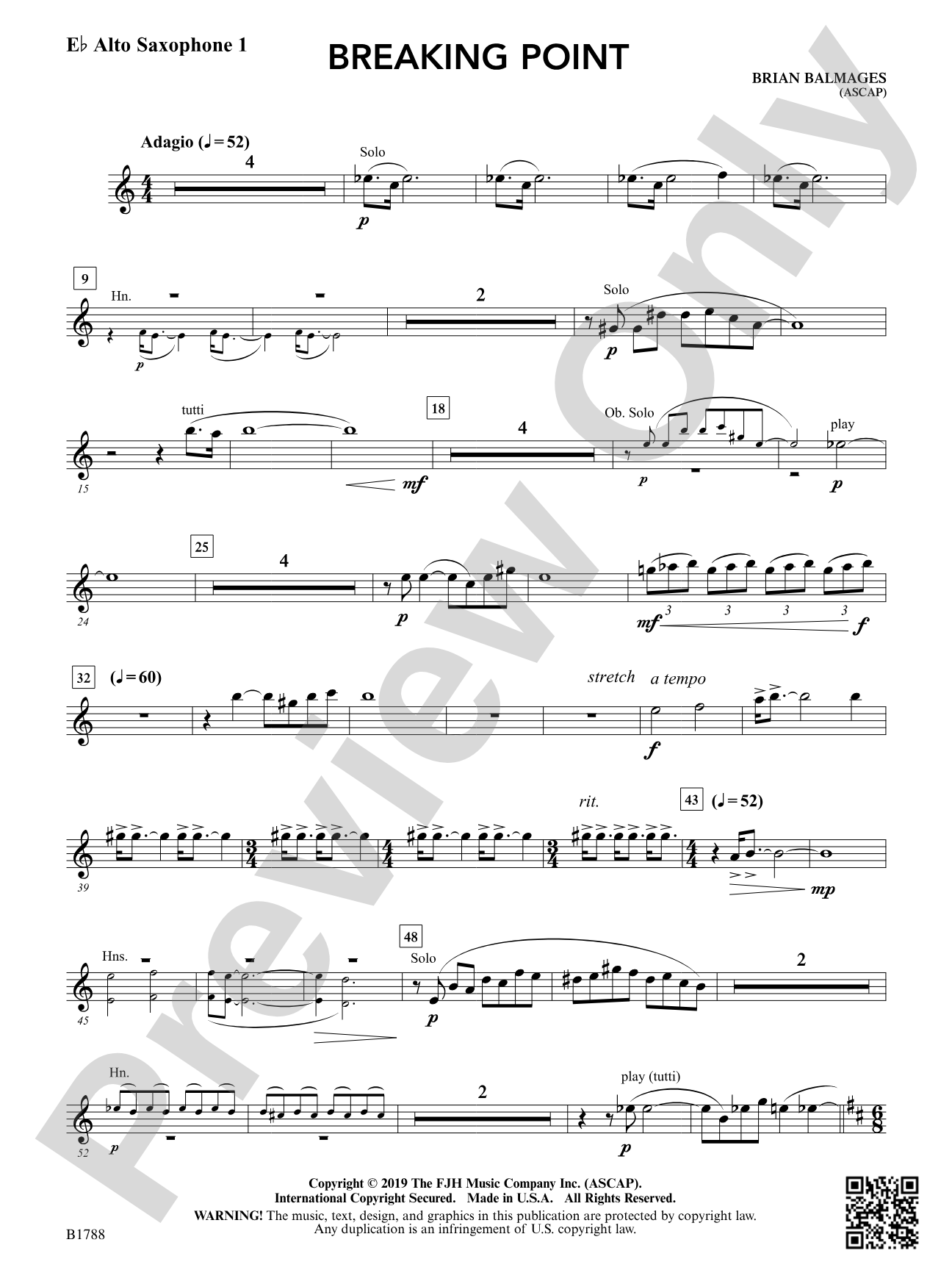

Breaking Point: E-flat Alto Saxophone 1
By Brian Balmages
Grade: 4
Item: 98-PC-DB1788_AX1
$7.00
Pickup currently not available
Description
Written over a several month period when the composer's father was dying, the composer states: "Throughout this entire experience, I have reached my own breaking point. Over and over again. So I fall apart, put myself together, and am then broken all over again." One of the most emotional and powerful pieces Balmages has ever written, there are moments of untamed beauty, anger, rage, hope, despair, and frustration. Once you perform this one, you will never forget it.


Don't just read it, hear it, play along with it, and watch your students grow with it. In MakeMusic Cloud, Breaking Point: E-flat Alto Saxophone 1 comes alive with professional accompaniment, adjustable tempo, and built-in practice tools that turn solo practice into real progress.
Open in the Player
Jump straight in and assign it today.
Start Your Free Trial
Open this title and explore the full library in minutes.
Sample Audio
1
Audio File
--:--
0:00
0:00
Sample Video
Additional Details
Series:
FJH Symphonic Band
Publisher:
The FJH Music Company, Inc.
SKU:
98-PC-DB1788_AX1
More about this title
About the Composer: Brian Balmages

Brian Balmages has established himself as a distinctive voice across orchestral, band, and chamber music, with performances spanning from professional symphony orchestras to elementary school ensembles. His work has been heard at Carnegie Hall, the Kennedy Center, Sydney Opera House, and the Toronto Centre for the Arts. He received the A. Austin Harding Award from the American School Band Directors Association, won the 2020 NBA William D. Revelli Composition Contest for Love and Light, and holds membership in the American Bandmasters Association.
Balmages' conducting résumé includes appearances at the Midwest Clinic, Western International Band Clinic, the College Band Directors Conference, and regional all-state ensembles worldwide. He received the inaugural James Madison University Distinguished Alumni Award and was later commissioned by the University of Miami to compose music for the inauguration of the institution's 6th president. His compositions were performed at the 2013 Presidential Inaugural Prayer Service attended by President Obama and Vice President Biden. He currently serves as Director of MakeMusic Publications and Digital Education for Alfred and MakeMusic.
Why we love this
Breaking Point stands apart because it channels raw emotional authenticity into music that resonates with student musicians and audiences alike. The emotional arc feels earned rather than manufactured, giving your ensemble a meaningful artistic experience rather than a routine performance. This is the kind of work that lingers in the minds of both performers and listeners long after the final note.
What to expect
Breaking Point cycles through moments of untamed beauty, white-hot anger, crushing despair, flickering hope, and raw frustration. The music pulls listeners into a deeply personal struggle, creating an experience that feels immediate and cathartic rather than distant or abstract.
Who it's for
Concert bands at Grade 4 level who are ready to engage with mature emotional content and complex musical demands. This work suits ensembles that have developed solid fundamentals and can handle shifting textures, dynamic control, and the psychological depth the piece requires.
How to get the most out of it
- Shape the dynamic architecture carefully; the piece moves between rage and tenderness, and these transitions need clear intention from the conductor to land with full impact.
- Allow space for breath in the quieter moments, particularly during passages of despair. Rushing these sections undermines their emotional weight.
- Balance the ensemble so that any sudden outbursts of anger don't overshadow the underlying vulnerability. This isn't a piece about volume alone.
- Encourage your musicians to connect with the narrative of the piece during rehearsals. Knowing the composer's intent behind each section deepens their interpretation.
How to use it
Program this as a centerpiece in a concert exploring emotional depth or human resilience, where it can stand alongside works of comparable substance. It also serves powerfully as a contest or festival selection for bands seeking a piece that demonstrates both technical facility and expressive maturity.
Skills your students will build
- Dynamic control across a wide emotional range, from whispered vulnerability to explosive intensity
- Interpretation of complex emotional narrative within instrumental music
- Ensemble balance and blend during rapid textural shifts
- Conductors' understanding of how pacing and space affect emotional impact