
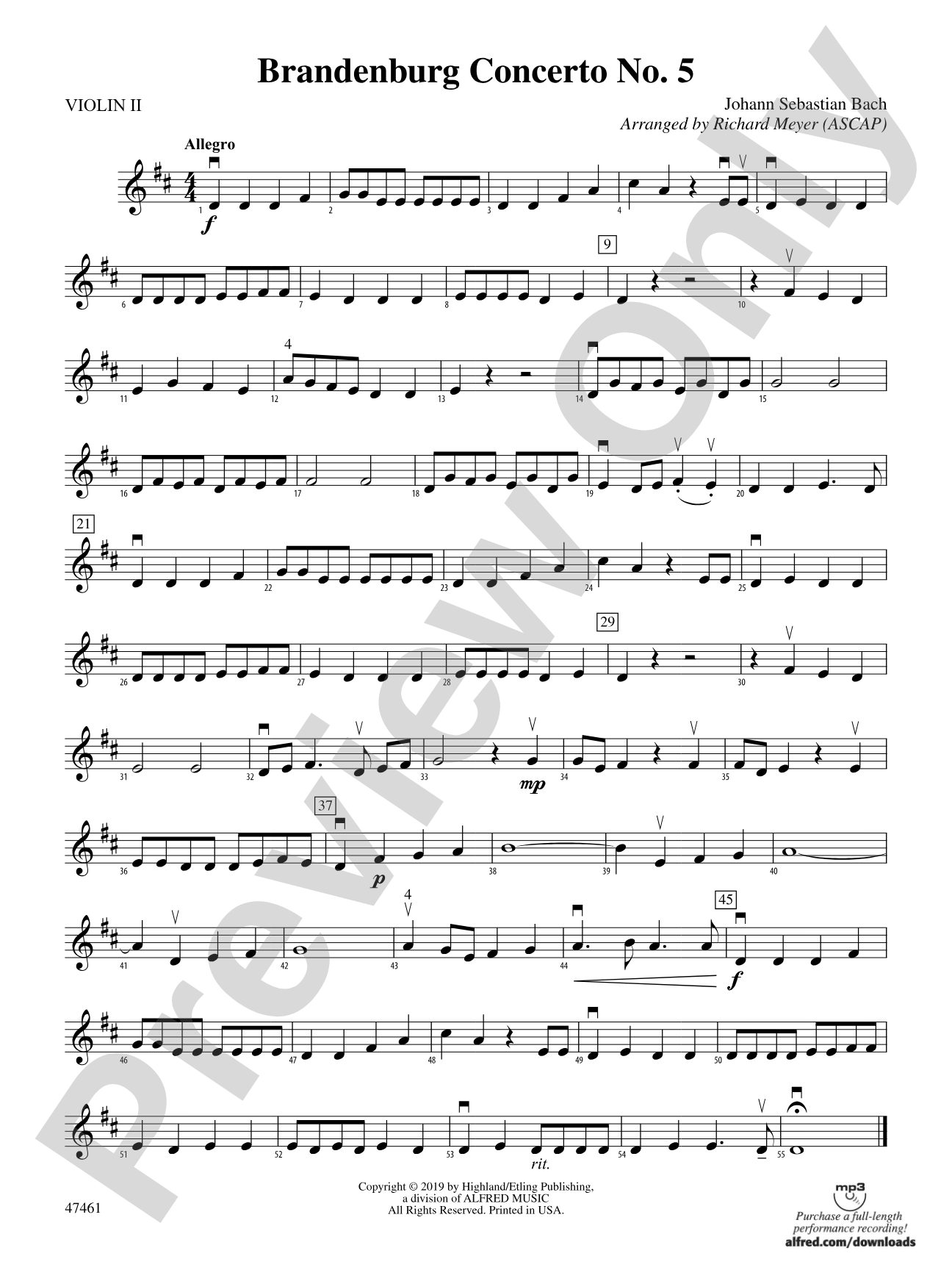

Brandenburg Concerto No. 5: 2nd Violin
By Johann Sebastian Bach / arr. Richard Meyer
Grade: 1.5
Item: 00-PC-0017990_VN2
$5.99
Pickup currently not available
Description
The famous first movement of Bach's Brandenburg Concerto No. 5, arranged by Richard Meyer, has been simplified and shortened for the first-year player but still retains all the energy and spirit of the original. It uses only the notes of the D major scale (including a few "high E's" for Violin I), and the rhythms are within reach of players with very little experience. The perfect selection for your beginning orchestra's first "real piece," this arrangement is sure to become a traditional part of your string curriculum.


Don't just read it, hear it, play along with it, and watch your students grow with it. In MakeMusic Cloud, Brandenburg Concerto No. 5: 2nd Violin comes alive with professional accompaniment, adjustable tempo, and built-in practice tools that turn solo practice into real progress.
Open in the Player
Jump straight in and assign it today.
Start Your Free Trial
Open this title and explore the full library in minutes.
Sample Audio
1
Audio File
--:--
0:00
0:00
Sample Video
Additional Details
Series:
Highland/Etling String Explorer
Publisher:
Alfred Music
Page Count:
72
SKU:
00-PC-0017990_VN2
More about this title
About the Composer: Johann Sebastian Bach
Johann Sebastian Bach (1685-1750) stands as one of history's most prolific and systematically inventive composers. Working across multiple genres—from intimate chamber works to grand choral compositions—Bach synthesized the musical language of the German Baroque into forms of unprecedented sophistication and emotional depth. His Brandenburg Concertos represent some of the earliest and most successful examples of the concerto grosso, a form in which a small group of soloists dialogues with a larger ensemble.
For string orchestra programs, Bach's music offers inexhaustible pedagogical value. His writing reveals the architecture of melody, harmony, and rhythm with crystalline clarity; his insistence on independent yet interlocking voices teaches young players how to listen and contribute simultaneously. These qualities make Bach an ideal composer for building musicianship from the ground up.
Why we love this
Richard Meyer's arrangement captures the joy and drive of Bach's original without sacrificing the voice-leading intelligence that makes this concerto special. First-year players encounter an unfamiliar harmonic world here, not the folk-song simplicity they may have practiced in method books; the D major key and flowing sixteenth-note figures awaken their ears to what baroque counterpoint sounds like. Programming this early in the year signals to your ensemble that they're ready for genuine repertoire, not just exercises dressed up as music.
What to expect
Bright and buoyant, this arrangement sparkles with Baroque clarity and forward momentum. The D major tonality rings with optimism, and the interweaving melodic lines create a sense of playful dialogue between the strings. Young players experience the satisfaction of moving beyond single-note melodies into genuine polyphonic textures, where their part has real musical meaning.
Who it's for
This arrangement is designed for first-year string orchestras ready to tackle a masterwork without oversimplified orchestration or dumbed-down harmonic language. Students in grades 4-6 who have spent a year developing basic technique and reading skills will find themselves challenged but supported by Meyer's thoughtful reduction. Conductors seeking a traditional concert or festival selection that builds both musicianship and ensemble pride will return to this piece year after year.
How to get the most out of it
- Establish a steady pulse in rehearsal using the recorded accompaniment or a metronome before layering in the individual parts; Bach's energy depends on rhythmic precision, not rushing.
- Balance the two violin parts carefully so that Violin II's inner voices remain audible beneath Violin I's active melody line.
- Shape the phrase endings with slight reductions in tempo and dynamic so the architecture of each section becomes clear; Bach wrote in long arcs, not in isolated gestures.
- Tune the D major tonality precisely during sectional rehearsals, paying particular attention to the raised F-sharps and C-sharps that define the key.
How to use it
Program this as a centerpiece of your fall or winter concert to celebrate your ensemble's first milestone. Its familiarity to concert audiences (Brandenburg Concerto No. 5 is widely recognized) makes it an excellent choice for introducing your program to parents and community members while showcasing what beginning orchestras can achieve. It also works well as a warm-up or opening selection at local festivals where you want to demonstrate solid fundamentals and musical maturity.
Skills your students will build
- Reading and performing independent melodic lines within a polyphonic texture
- Playing in D major with secure intonation, particularly with F-sharps and C-sharps
- Sustaining a steady pulse while listening to other parts moving at different rhythmic speeds
- Shaping musical phrases with dynamic and agogic nuance rather than mechanical phrasing
- Understanding the relationship between melody and accompaniment in baroque compositional practice