
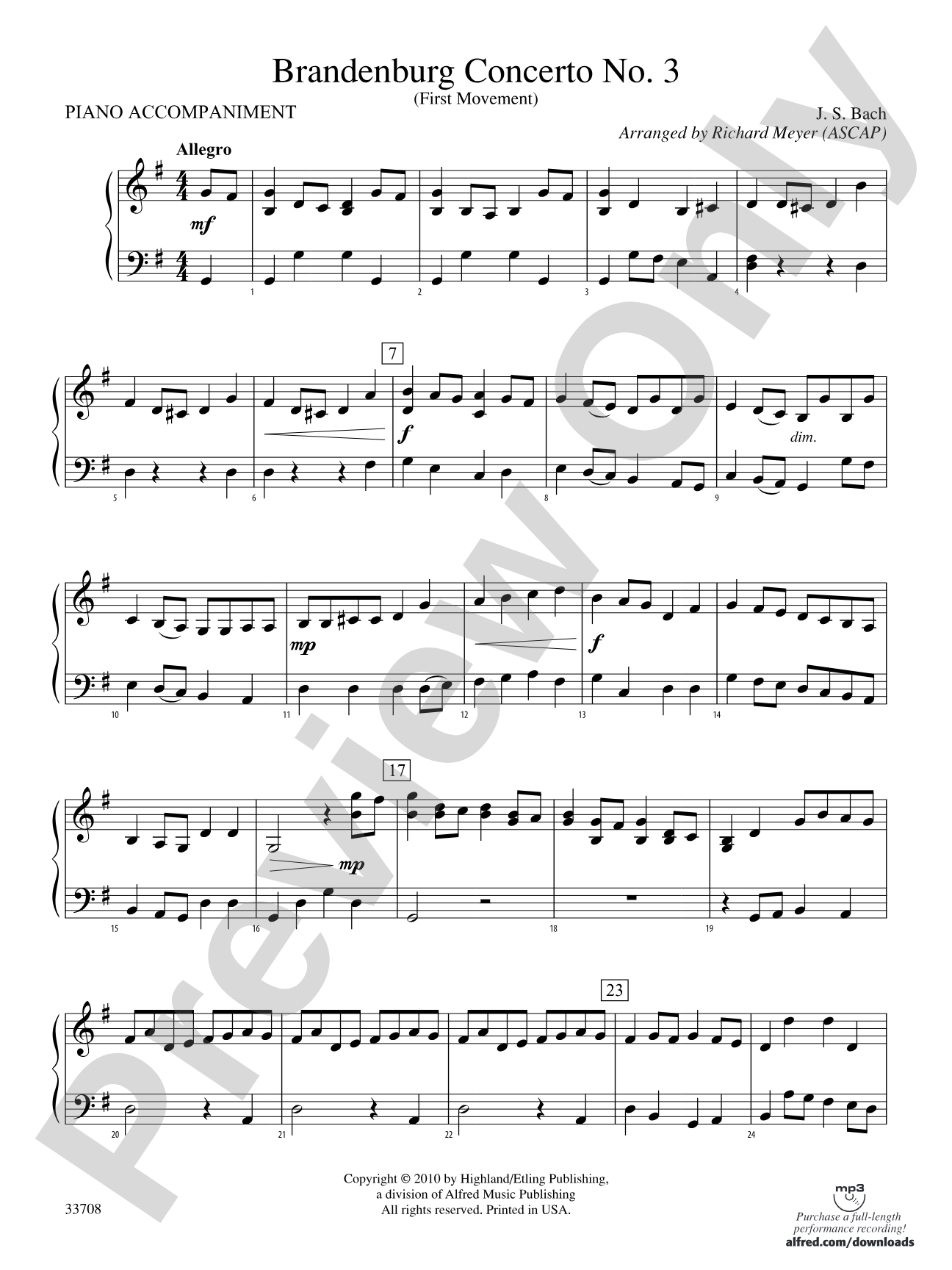

Brandenburg Concerto No. 3 (First Movement): Piano Accompaniment
By Johann Sebastian Bach / arr. Richard Meyer
Grade: 2
Item: 00-PC-0014494_K
$5.99
Pickup currently not available
Description
Now your younger string players can experience the contrapuntal delights of this orchestral masterpiece! The difficult string crossings and the chromatic development section have been eliminated, but all of the color and energy of the original remain in this amazingly authentic-sounding arrangement. All parts are in first position throughout. There are no extensions in the cello part, and the few "high third" fingers in the violins and violas are always approached stepwise, from below. There is even a third violin part (viola treble clef) and a piano accompaniment part that could be played on "harpsichord" setting. Although specifically for younger ensembles, older groups will also sound great performing this tasteful, educationally sound version. This title is available in MakeMusic Cloud.


Don't just read it, hear it, play along with it, and watch your students grow with it. In MakeMusic Cloud, Brandenburg Concerto No. 3 (First Movement): Piano Accompaniment comes alive with professional accompaniment, adjustable tempo, and built-in practice tools that turn solo practice into real progress.
Open in the Player
Jump straight in and assign it today.
Start Your Free Trial
Open this title and explore the full library in minutes.
Sample Audio
1
Audio File
--:--
0:00
0:00
Sample Video
Additional Details
Series:
Highland/Etling String Explorer
Publisher:
Alfred Music
Page Count:
88
SKU:
00-PC-0014494_K
More about this title
About the Composer: Johann Sebastian Bach
Johann Sebastian Bach (1685-1750) stands as one of the most influential composers in Western music history. His mastery of counterpoint, harmonic language, and structural design established compositional principles that shaped every musical era that followed. Bach's prolific output spans sacred and secular works across nearly every genre of his time, and his music continues to serve as a cornerstone of music education and performance.
Why we love this
Richard Meyer's arrangement captures the architectural brilliance of Bach's original without the technical barriers that typically keep this masterwork out of younger ensembles' hands. String players encounter authentic Baroque writing, genuine contrapuntal interplay, and the intellectual satisfaction of performing real Bach, not a simplified approximation. This is the kind of arrangement that expands what students think they're capable of learning.
What to expect
This movement radiates the brightness and forward momentum characteristic of Baroque energetic writing. Multiple violin lines weave together in a fabric of sound that feels both intricate and transparent, creating an impression of complexity that players discover they can actually manage. The contrapuntal writing gives each section something genuinely musical to do throughout.
Who it's for
Grade 2 string orchestras and advanced intermediate ensembles looking to expand beyond typical arrangements into genuine Baroque literature. Directors seeking repertoire that challenges younger players intellectually while remaining accessible technically will find this tailored to their needs.
How to get the most out of it
- Balance the three violin parts so each melodic line remains audible; this isn't about one part dominating but three voices in conversation.
- Approach the chromatic passages with clarity of articulation so the harmonic movement reads distinctly without rushing the tempo.
- Use the third violin part (in viola treble clef) to reinforce harmonic texture; it functions like an inner voice rather than a leading melody.
- If using the piano accompaniment, consider the harpsichord setting to maintain period-appropriate harmonic support without overwhelming the strings.
How to use it
Feature this as a concert opener or closer to establish artistic credibility early in your season; it signals that your ensemble engages with serious repertoire. It pairs naturally with other Baroque works or contemporary pieces that emphasize textural clarity, and works equally well in festival settings where judges recognize authentic arrangement choices.
Skills your students will build
- Reading and executing contrapuntal voice lines independently
- Managing multiple melodic strands occurring simultaneously
- Maintaining intonation while playing stepwise finger approaches
- Balancing dynamic shaping within a three-part string texture
- Understanding harmonic movement through active participation in Baroque voice-leading