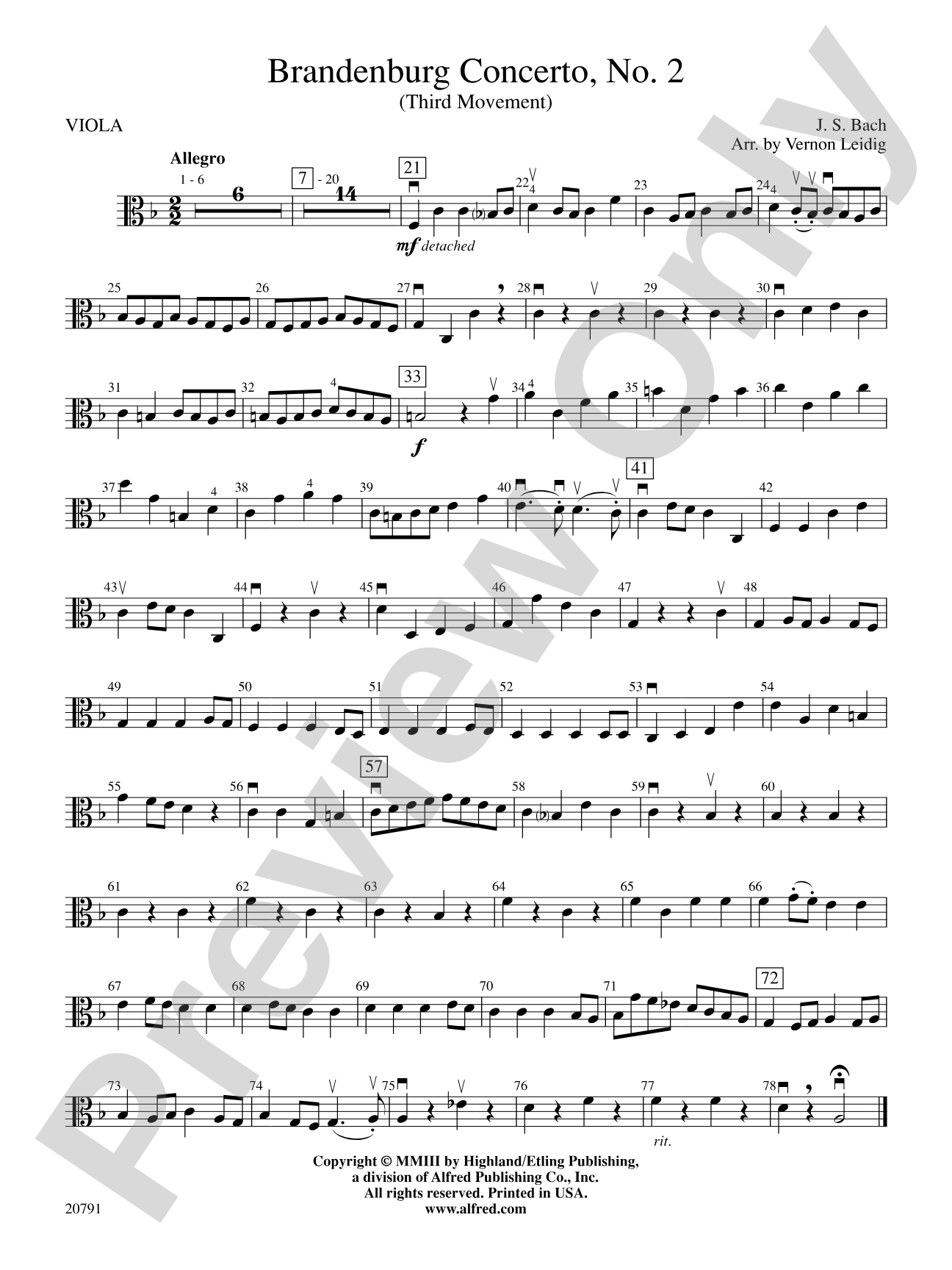
Brandenburg Concerto No. 2 (3rd Movement): Viola Sheet Music Preview

Brandenburg Concerto No. 2 (3rd Movement): Viola

By Johann Sebastian Bach / arr. Vernon Leidig

Grade: 3

Item: 00-PC-0000458_VA1

Digital Download
$5.99
Description
J. S. Bach's Brandenburg Concertos are concerti grossi: a group of solo instruments set in unison and/or contrast with an orchestra. In 1719, Christian Ludwig, Margrave of Brandenburg commissioned Bach to write music for his orchestra. Two years later, Bach completed a set of six concertos (now known as the Brandenburg Concertos). Imagination, beauty and originality marked these concertos. It is suggested that this arrangement of the third movement be performed following the arrangement of the first movement by Merle Isaac (Alfred #12755).

Don't just read it, hear it, play along with it, and watch your students grow with it. In MakeMusic Cloud, Brandenburg Concerto No. 2 (3rd Movement): Viola comes alive with professional accompaniment, adjustable tempo, and built-in practice tools that turn solo practice into real progress.

Sample Audio
0:00
0:00
Sample Video
Additional Details
Series: Highland/Etling String Orchestra
Publisher: Alfred Music
Page Count: 124
SKU: 00-PC-0000458_VA1

More about this title

About the Composer: Johann Sebastian Bach

Johann Sebastian Bach (1685-1750) shaped the entire trajectory of Western music through his mastery of counterpoint, harmonic innovation, and structural clarity. Working across Germany as a church musician, court composer, and teacher, Bach synthesized Italian concerto form, German church traditions, and French dance styles into a language of extraordinary depth. His ability to write for any instrument or ensemble while maintaining both intellectual rigor and musical beauty made him the model for generations of composers who followed.

Why we love this

This movement distills Bach's gift for writing chamber-sized textures that sound expansive without overwhelming young orchestras. Vernon Leidig's arrangement preserves the elegant counterpoint of the original while making it accessible to Grade 3 ensembles, so your students experience genuine Baroque architecture rather than a simplified version. It pairs naturally with the first movement arrangement, letting you program a substantial work that feels complete.

What to expect

Elegant and ornate, yet lean. The third movement unfolds with courtly grace, its individual lines weaving together like threads in a tapestry. There's both formality and forward momentum, with moments of gentle suspense as the music turns through its harmonic surprises.

Who it's for

String orchestra directors looking to introduce students to the Baroque concerto grosso without requiring advanced technical facility. Grade 3 ensembles can perform this arrangement meaningfully, hearing how Bach builds musical argument through counterpoint rather than harmonic color.

How to get the most out of it

  • Attend to rhythmic precision in the opening statement; Bach's lines interlock like gears, and even small timing slips will cloud the texture. A steady rehearsal tempo helps players lock the independent voices together.
  • Balance the melody across your first violins without letting them dominate. The violas and cellos carry supporting lines that deserve clarity; if inner voices vanish, the counterpoint collapses.
  • Shape the phrasing in natural two- or four-bar units. Baroque music breathes in shorter phrases than Romantic repertoire, so resist the urge to sustain entire sections without articulative release.
  • Use the full page-turn spacing to plan bow changes and section breaks that minimize sound loss. The conductor score shows where natural breathing points occur.

How to use it

Program this following the Merle Isaac arrangement of the first movement (Alfred #12755) to create a two-movement concert selection that demonstrates Bach's architecture and gives your orchestra a polished, substantial offering for a fall or winter concert. It also works as a festival or contest piece where judges expect to hear both technical control and mature musical understanding.

Skills your students will build

  • Baroque counterpoint and voice independence
  • Balance and blend in multi-layered textures
  • Stylistically appropriate articulation and phrasing
  • Rhythmic precision and ensemble synchronization
  • Reading divided viola and cello parts

You May Also Like